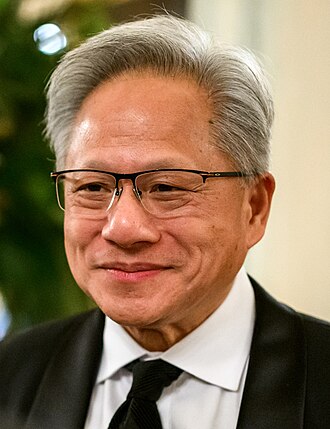
Huang was born in Taiwan in 1963 and spent part of his childhood in Thailand. In 1973, at nine and not yet fluent in English, he was sent to the United States, where relatives enrolled him at the Oneida Baptist Institute in Kentucky, a reform academy they mistook for a boarding school. He later rejoined his parents in Oregon, graduated from Aloha High School at 16 and worked the graveyard shift at Denny's as a dishwasher, busboy and waiter from 1978 to 1983. He earned a bachelor's degree in electrical engineering from Oregon State University in 1984.
After college Huang designed microprocessors at AMD while taking night classes at Stanford University, where he earned a master's degree in electrical engineering in 1992. He then moved to LSI Logic, which introduced him to Sun Microsystems engineers Chris Malachowsky and Curtis Priem. Together they finished the GX graphics engine in 1989. Its sales helped lift Sun's revenue from $262 million in 1987 to $656 million in 1990, and Huang was promoted to director of CoreWare, LSI's division that made chips for hardware vendors.
As Sun's business slowed after 1990, the three resigned to make graphics chips for PC games. They planned the company at a Denny's in East San Jose and capitalized it with $600, $200 from each founder; Huang signed the articles of incorporation on April 5, 1993, and was president and CEO from the first day. With money from Sequoia Capital's Don Valentine and Sutter Hill Ventures, Nvidia built its first chip, came back from near-bankruptcy in the 1990s and went public in 1999.
Under Huang, Nvidia expanded from graphics chips into high-performance computing and AI, and in October 2025 it became the first company worth more than $5 trillion. He has argued that US export rules hand China's $50 billion AI chip market to Huawei, as Nvidia's share there fell to 34%. In October he said "CoreWeave's strength is improving every day" and that no backstop is needed for the cloud company, about 10% of which Nvidia owns. He has described Nvidia's $20 billion Groq deal as integrating Groq's processors while "not acquiring Groq as a company".
Sources · written 16 October 2026