AES's $33.4 billion take-private at $15 clears Europe and Chile; FERC decides the rest
Europe and Chile have cleared the GIP/EQT takeover in October, and the asset keeps improving at a price fixed in March. The arb now turns on FERC, where Public Citizen and an Indiana citizens' group have challenged the buyers' 15 to 20 percent return math.
 Richard Tang · 3 min read
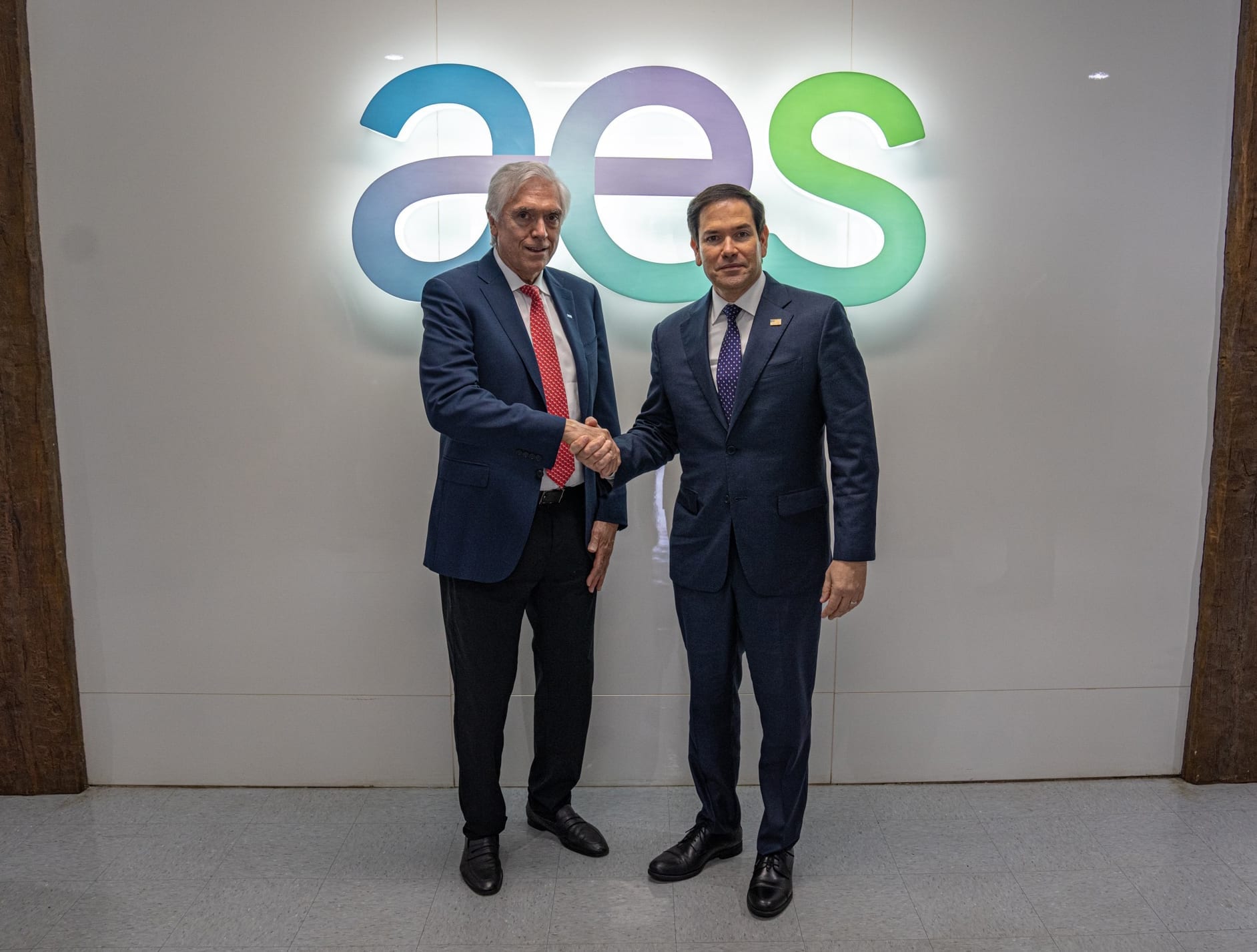
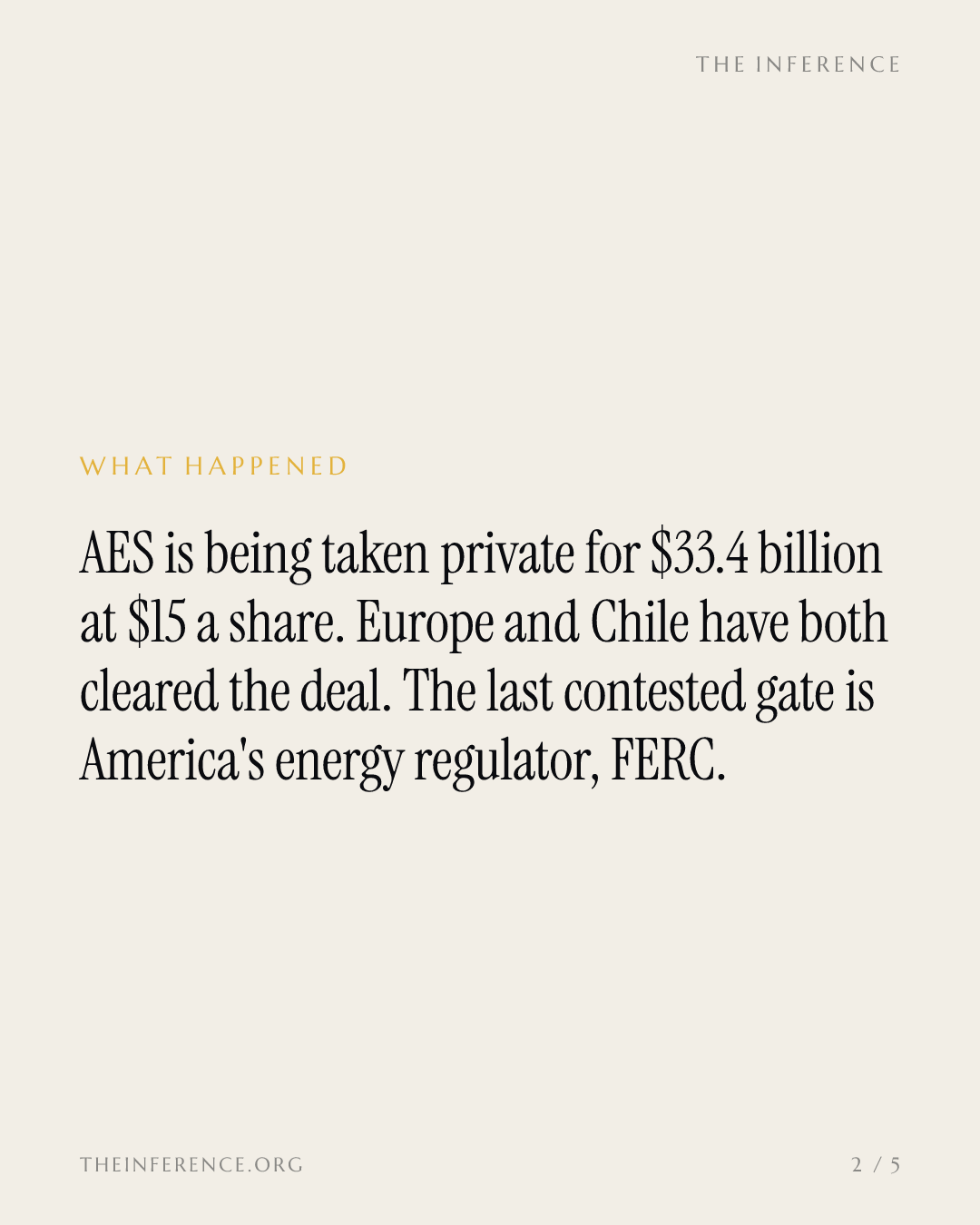
AES Corporation's0.00% — AES Corporation, unchanged today $33.4 billion take-private at $15 a share has now cleared both foreign gates, and the last contested one is American 12. The European Commission closed its foreign-subsidies review on October 28, the day AES filed the 8-K saying so 1, and Chile's antitrust authority approved on October 1 with no conditions after finding the buyers would hold only about a tenth of Chilean generation capacity 2. Every box checked abroad makes the remaining spread between the $15 deal price and the market a bet on FERC 12.
Every gate abroad has opened
The buyer group is Global Infrastructure Partners, BlackRock's0.00% — BlackRock, unchanged today infrastructure arm, alongside EQT's infrastructure fund, with CalPERS, the California public employees' pension fund, holding 20 percent and Qatar's sovereign fund 10 percent 3. Shareholders approved in June; closing is expected late 2026 or early 2027 2.
Foreign approvals arriving on schedule usually means the paperwork is done and only the home regulator remains, and here the home regulator is contested.
The contested gate: what has changed since our last report
We wrote on October 10 that the deal turns on one question, whether 20 percent money can run a 10 percent utility, when Public Citizen, the Washington-based consumer advocacy group, and the Citizens Action Coalition had just filed their challenge at FERC 12. What is new since is timing and teeth. The EU and Chile clearances both landed in October, after that piece 12.
And the Indiana Utility Regulatory Commission has now set its rehearing of a $71 million AES Indiana rate increase for March 11, 2027, a hearing that will examine how the BlackRock acquisition and a 390 megawatt Google data center factor into the utility's costs 3. The increase reaches customer bills first, so any refund would arrive after months of higher bills 3. GIP's documented 15 to 20 percent target return still frames both fights, but the calendar around it is now fixed 3.
The asset keeps improving at a fixed price
Revenue rose 8.7 percent year over year in the first quarter of 2026 and about 20 percent in the second, with EBITDA up sharply in both; the negative year-over-year figures through most of 2025 make the 2026 quarters the turn, not one quarter's noise 5. New York has also issued final siting permits to repower six wind farms totaling up to 672 megawatts 5.
AES revenue and EBITDA climbed through 2026 while the deal price sat fixed
- Revenue
- EBITDA
Data
| Revenue | EBITDA | |
|---|---|---|
| Q3 '24 | 3.29B | 1.3B |
| Q4 '24 | 2.96B | 1.15B |
| Q1 '25 | 2.93B | 0.74B |
| Q2 '25 | 2.86B | 0.78B |
| Q3 '25 | 3.35B | 1.13B |
| Q4 '25 | 3.1B | 0.95B |
| Q1 '26 | 3.18B | 1.23B |
| Q2 '26 | 3.42B | 1.26B |
The watch list that moves the spread
Three dates decide this arb, in this order. First, the open FERC decision window: approval, or conditions, moves the spread before anything else on this list does. Second, the expected late-2026 or early-2027 close, which slips if FERC extracts conditions. Third, the March 11, 2027 Indiana rehearing, which lands after closing most likely and prices the buyers' return math into the record rather than the deal itself. Conditions, not approval, are the spread risk, and FERC is where that risk lives now.
Get Deals by email, free
The acquisitions, rounds and contracts that move AI money. In our daily email, every weekday.