Bending Spoons upsized its junk bond to $1.8 billion as filed data shows Evernote revenue peaked in 2024
SEC-filed data shows more than 200 pricing experiments on a captive base, with revenue peaking in 2024 and falling in 2025. Berkshire added fresh equity days before an upsized $1.8 billion junk-bond sale.
 Richard Tang · 3 min read
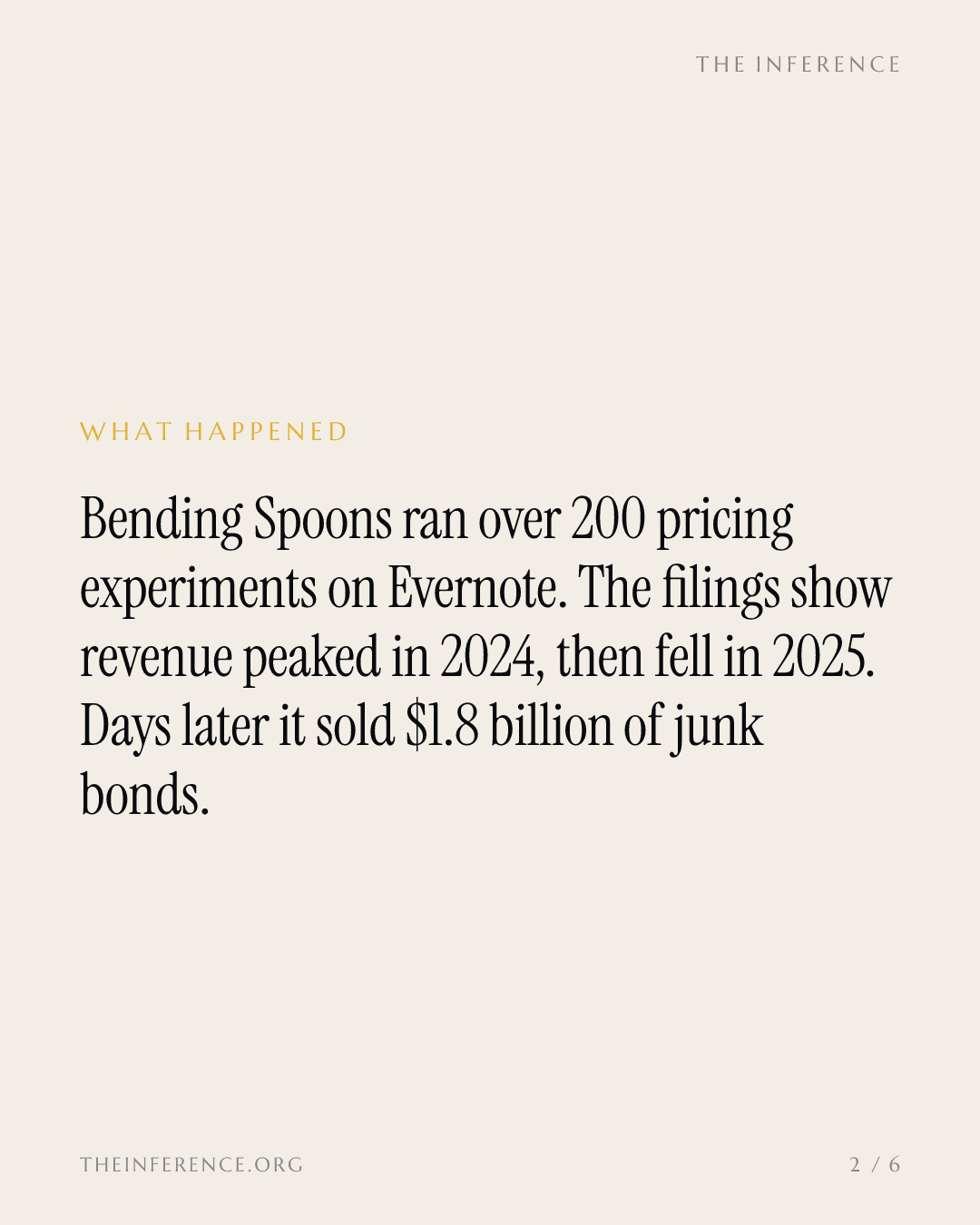
Bending Spoons−2.24% — Bending Spoons, down 2.24 percent today ran Evernote$200M — Evernote, private, latest valuation $200M like a pricing laboratory, and the lab results are now public: SEC filings describe more than 200 pricing and feature experiments between 2023 and 2025 1 2, and they also show Evernote's revenue peaked in 2024 and fell in 2025 despite the whole program 1. That second number is the one Bending Spoons' shareholders, and its lenders, should be reading.
We reported the 92% top-tier price rise to $250 two weeks ago (previous coverage); what is new is the filed experiment data behind it, and what it says about the playbook's ceiling.
The experiments worked, and they worked on captive users
Bending Spoons, the Italian company that bought Evernote in 2023, capped free accounts at 50 notes and one notebook in December 2023, then measured what happened 1. By 2025, over half of all conversions to paid plans came from users hitting those limits, and average revenue per monthly active user rose 2.5 times between 2022 and 2025 1. The company filed all of this itself, in June, as a selling point 1.
But the base shrank faster than the price rose
The same filings show the cost. Evernote's 2025 revenue stood at 130% of its 2021 level, down from 134% in 2024: price rises extracted more per user while the paying base contracted 1.
The asset underneath is tenure. The average customer had used Evernote for 7.2 years at acquisition, with thousands of notes built into personal workflows, so leaving means abandoning an archive and rebuilding the routines built on it 2. That is why users pay rather than migrate, and it is why the pricing works 2. To its credit, Bending Spoons also reversed the decay in new signups, which turned positive after years of decline 2.
Evernote revenue peaked in 2024 and fell in 2025 despite the pricing program
Data
| Value | |
|---|---|
| 2021 | 100 |
| 2024 | 134 |
| 2025 | 130 |
The money is arriving from both directions
Days ago, Berkshire Hathaway−0.14% — Berkshire Hathaway, down 0.14 percent today put in another $330 million of fresh equity through newly issued shares, after $600 million at this year's IPO 3. In the same week, Bending Spoons priced junk bonds that were upsized from $1.5 billion to about $1.8 billion, paying 9.625% on the dollar tranche, with proceeds earmarked for future acquisitions of Evernote-shaped properties like Vimeo$1.38B — Vimeo, private, latest valuation $1.38B and Eventbrite$500M — Eventbrite, private, latest valuation $500M 3 4. Long-term debt already stood near $4.1 billion at June 2026, up from $2.3 billion a year earlier, against second-quarter revenue of $704 million 3.
What the 9.625% coupon prices in
The equity says the acquisition machine mints cash. The coupon says lenders want paying for the risk that it does not: each acquired app holds a finite stock of locked-in users to reprice, and Evernote's own filed numbers show that stock depleting. The test for the next app in the queue is whether its revenue curve bends the same way in year three. Watch for it, and price the debt accordingly; none of this is a recommendation to buy or sell.
Get Deals by email, free
The acquisitions, rounds and contracts that move AI money. In our daily email, every weekday.