ASMPT kept its SMT unit, and management says HBM stacking-tool demand waits until 2029
Management's guidance makes the HBM stacking boom smaller and later than the bull case assumed; the revenue that replaces it, logic packaging and AI server assembly, is already in the order book. That split, not the record quarter, decides the stock.
 Richard Tangthree-minute read
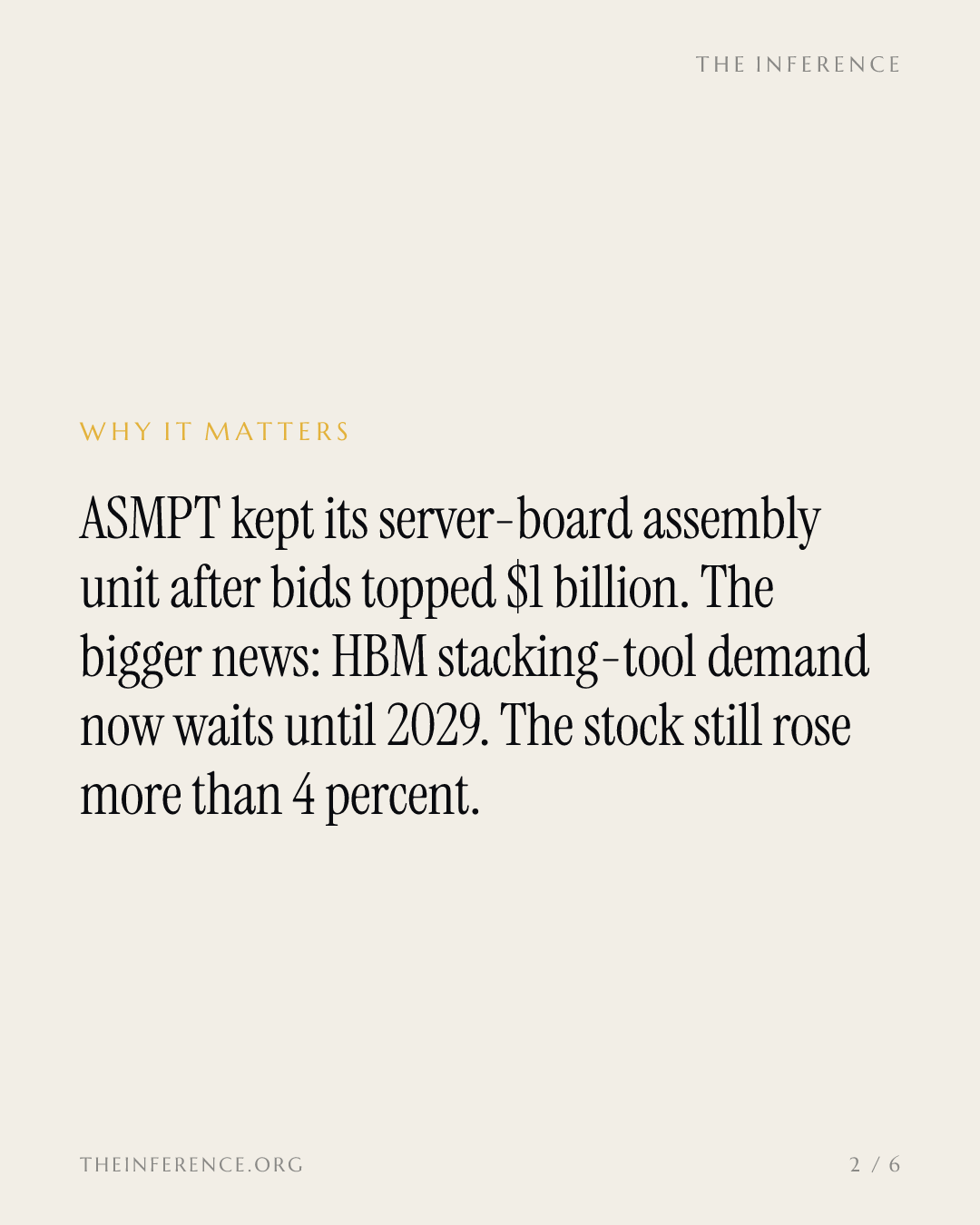
ASMPT+5.93% — ASMPT, up 5.93 percent today rose more than 4 percent in Hong Kong on November 11, a move attributed to its decision to keep the SMT unit, the business whose machines place components on AI server circuit boards 12. The retention, announced on November 4, ended a sale process that had drawn bids above $1 billion 3. Neither is the week's most important sentence.
In a JPMorgan note published after third-quarter results, management said HBM4E, the next generation of the stacked memory that sits beside AI processors, may stop at 8 or 12 layers rather than the expected 16, citing tight memory capacity and trade-offs among cost, bandwidth and heat 4. It expects meaningful demand for its memory stacking tools only from 2029 4.
Management sees HBM4E stacks at 8 or 12 layers, not the 16 the bull case assumed
- HBM4E stack height
- Estimate
Data
| HBM4E stack height | |
|---|---|
| 8 layers (estimate) | 8 |
| 12 layers (estimate) | 12 |
| 16 layers (estimate) | 16 |
The memory boom did not cancel; its clock restarted. Last week's 14 percent sell-off priced the wrong half of the company 4.
Fewer layers means fewer bonding machines
Thermocompression bonding is where HBM enthusiasm becomes tool revenue: every added layer of DRAM in a stack is another bond a machine must place, so taller stacks sell more machines. With stacks staying short, the memory side of that equation shrinks until 16-layer designs spread, around 2029 4. The layer guidance is on the record; the recovery date is a projection, and it has just moved back.
Logic, not memory, pays now
JPMorgan+0.39% — JPMorgan, up 0.39 percent today estimates HBM bonding tools are already a small share of ASMPT's advanced packaging revenue this fiscal year, so a flat memory market leaves little to lose 4. The company guides the bonding-tool market above $1.6 billion in 2028 4.
Logic, not memory, holds the bulk of a bonding-tool market guided above $1.6 billion for 2028
- Bonding-tool market, 2028 estimate
- Estimate
Data
| Bonding-tool market, 2028 estimate | |
|---|---|
| 2028 market (estimate) | $1.6B |
| Logic share (estimate) | $1.2B ($1.12–1.28B) |
| HBM share (estimate) | $0.4B ($0.32–0.48B) |
Logic chips will take 70 to 80 percent of it, by the bank's estimate 4. In the CoWoS-L advanced packaging ecosystem, ASMPT holds more than 90 percent of chip-to-substrate tools 4. The quarter's record bookings came from there: record logic chip-to-substrate orders from packaging subcontractors of a leading advanced logic customer, plus photonics 5. Behind them, second-generation hybrid bonding tools, close to the market leader's capability, enter customer qualification within 12 to 18 months 4.
The HBM dollar goes into the wafer first
The same week, ASM International+6.97% — ASM International, up 6.97 percent today, the Dutch maker of deposition tools for wafer fabs and a quarter-owner of ASMPT, posted record quarterly revenue up 45 percent, with memory sales rising sharply on HBM-related DRAM 367. It pulled its 2030 revenue target forward into 2027 67. The AI memory dollar is landing in the tools that make the DRAM dies before it reaches the machines that stack them.
Server assembly carries the company until memory returns
Keeping SMT applies the same logic one layer up: AI-related applications have grown past half the segment's bookings this year, which is why the board preferred holding on to a billion-dollar sale 2. China, more than 40 percent of historical revenue, is the next order book, with new orders expected within six months, and the next risk 4.
JPMorgan keeps an overweight rating and a June 2027 target of HK$200, on earnings it expects to rise 69 percent next year 4. The shares trade near HK$96 8. The full-year results will give the memory line its first full-year number, and they will show a company paid for logic packaging and server assembly, waiting on a memory cycle that arrives at the end of the decade.
Get Chips by email, free
How AI demand is reshaping chipmakers, memory and the fabs behind them. In our daily email, every weekday.