Cerebras' $26.1 billion backlog grew $700 million in a quarter that recognized $210.8 million
The $26.1 billion of contracted revenue is mostly one OpenAI buildout that is already late, and the hyperscaler deals that lifted the stock 11.2% sit outside it. The fourth-quarter core margin, guided to break-even, is the next test.
 Vincent Jiangthree-minute read

On November 13 Cerebras, the Sunnyvale maker of wafer-scale AI processors, rose 11.2% to $108.72 while 33 of the 34 other semiconductor companies worth $2 billion or more fell, Advanced Micro Devices−6.22% — Advanced Micro Devices, down 6.22 percent today down 8.8% 4. The print behind the move had landed the day before, along with a cloud deal with Microsoft−0.88% — Microsoft, down 0.88 percent today that made it the third hyperscaler win in six months, after Amazon Web Services−3.25% — Amazon Web Services, down 3.25 percent today and Oracle−5.13% — Oracle, down 5.13 percent today 35.
Record revenue built on services, not chips
Core revenue, the company's adjusted measure, was a record $230.9 million, up 70%, against $210.8 million of GAAP revenue, up 55% 1. Core net income of $29.8 million was the first positive as a public company; the GAAP net loss was $161.2 million 1. Hardware sales fell 28.8% to $68.9 million while cloud and other services revenue jumped 265% to $141.9 million 12. The stock still sits 65% below its first close of $311.07 on May 14 3.
A $29.8 million core profit sits above a $161.2 million GAAP loss
- Core (adjusted)
- GAAP
Data
| Core (adjusted) | GAAP | |
|---|---|---|
| Revenue | $230.9M | $210.8M |
| Net income | $29.8M | -$161.2M |
$700 million added, $211 million recognized
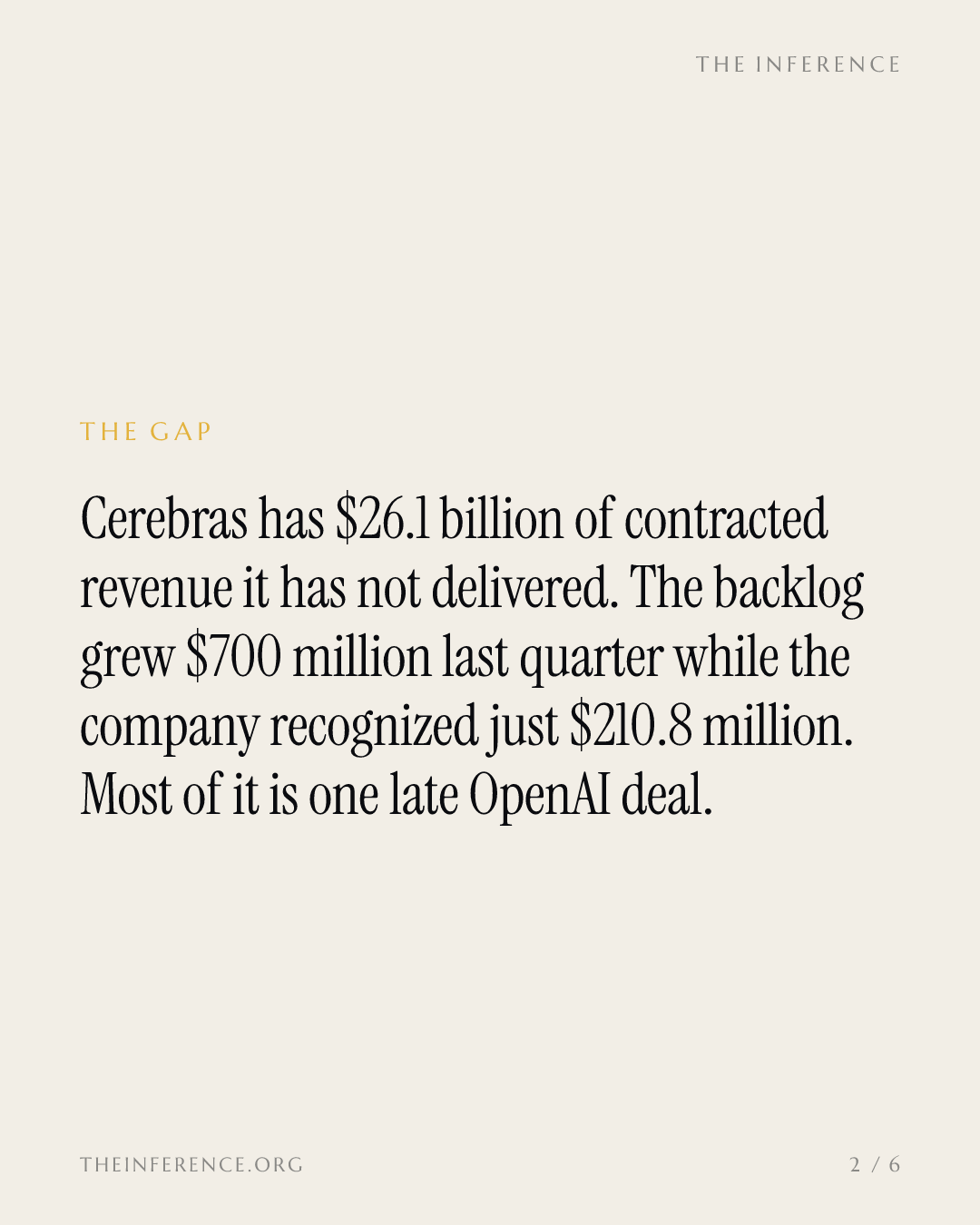
Remaining performance obligations, the revenue Cerebras−8.85% — Cerebras, down 8.85 percent today has already contracted but not yet delivered, stood at $26.1 billion on September 30 against $25.4 billion at the end of June 1. Subtract the two and the backlog grew $700 million in a quarter that recognized $210.8 million 2. It is about 124 times the quarter's revenue, and the deals that made the headlines, with AWS, Oracle and Microsoft, are not yet in it and produce no revenue yet 2.
Most of the backlog is one contract: the $10 billion OpenAI$1.18T — OpenAI, private, latest valuation $1.18T inference deal signed in January 2026, covering 750 megawatts, with figures of $20 billion to $30 billion for 2026 to 2032 in circulation if OpenAI exercises an option for another 1.25 gigawatts by 2030 2.
A $26.1 billion backlog that grew $0.7 billion last quarter
Contracted revenue is 124x what Cerebras recognized in Q3
Data
| Value | |
|---|---|
| Backlog, 30 Sep | $26.1B |
| Backlog, 30 Jun | $25.4B |
| Q3 revenue | $0.21B |
Late sites, 3% credits and a 90-day exit
The first tranche is late, and chief executive Andrew Feldman blames sites, power and finished buildings, not silicon 3. Contracted revenue already nets delay credits the customer can apply later; management calls them small, Morgan Stanley sizes them at $0.6 billion to $0.9 billion, about 3% of the backlog 3.
If a shortfall runs 90 days, either side can cancel the affected capacity; Cerebras puts under 5% of committed capacity at risk in 2026, with no cancellations so far 3. Capacity under contract for delivery by the end of 2027 now totals 700 gross megawatts, but most new supply arrives mid-2027 and cloud revenue is guided roughly flat for the fourth quarter 3.
A $178 target while executives sell
Bulls own the print: Morgan Stanley−2.46% — Morgan Stanley, down 2.46 percent today kept its Overweight rating and a $178 target, 8 times its forecast 2028 revenue of $6.67 billion, with management expecting to triple revenue in 2027 13. Bears own the contract: after lock-up expirations, executives including the chief operating and chief financial officers filed notices to sell tens of millions of dollars of stock 3.
The test is simple. If 3% credits and a 5% cap are the whole exposure, the 65% drawdown is overpaid pessimism; if the backlog is a construction schedule with a chip attached, the pop on November 13 was the exit.
The December 31 deadline
The fourth quarter is the test management set itself: core revenue of $310 million to $330 million and a core operating margin between (1%) and 1%, against a core operating loss of about $33 million this quarter 14. The backlog is booked. Whether the buildings show up decides when it becomes money.
Get Chips by email, free
How AI demand is reshaping chipmakers, memory and the fabs behind them. In our daily email, every weekday.




Reader comments
0 comments