Chime grew 32% with credit at 29% of purchase volume; its co-founder's trust sold $2 million of stock
Chime printed 32% growth with credit at 29% of purchase volume, and is buying its bank for cheaper funding just as the Fed resumes hiking. Its co-founder's trust sold about $2 million of shares into the rally the same week.
 Richard Tangthree-minute read
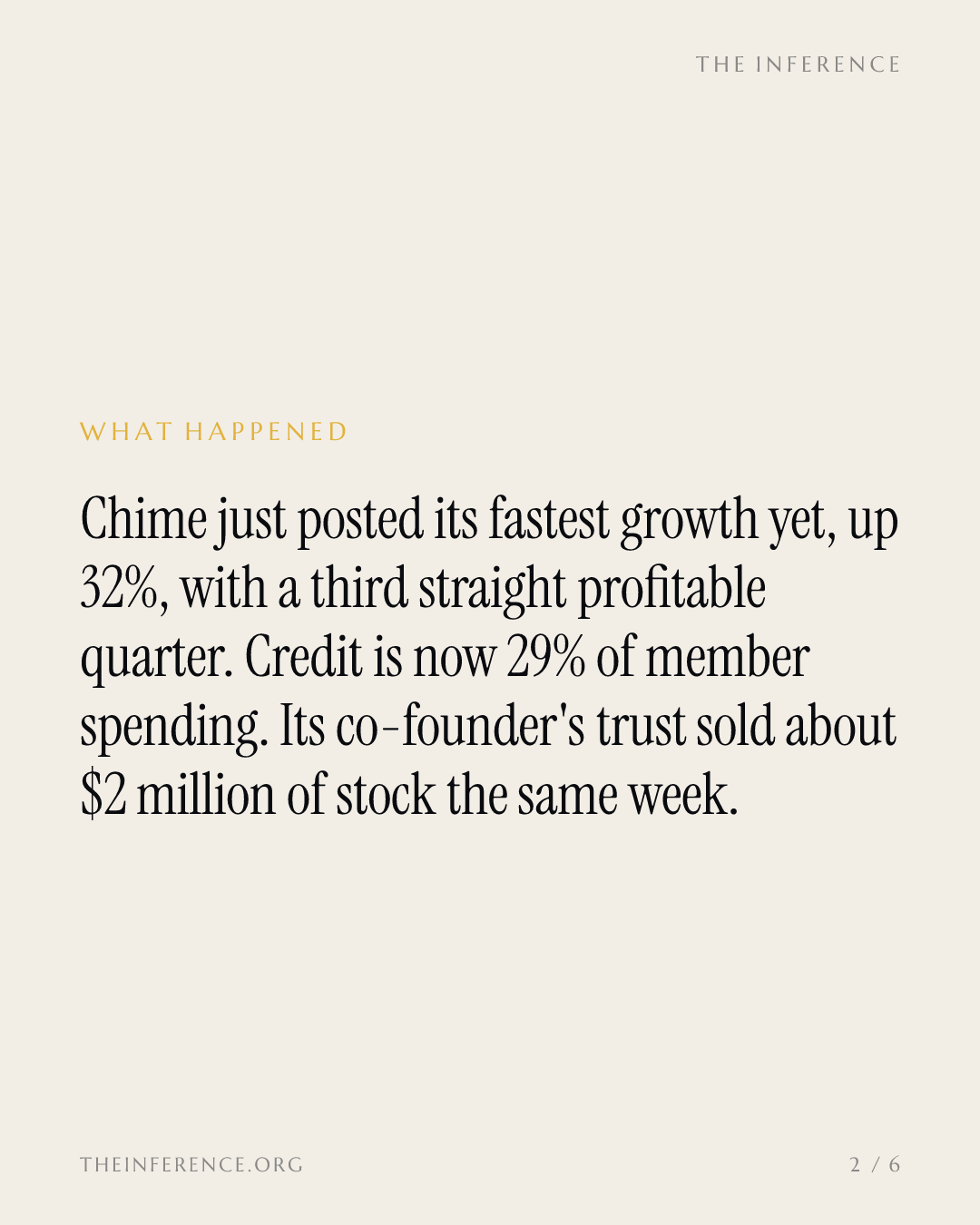
Chime+2.35% — Chime, up 2.35 percent today just reported its fastest growth as a public company, and it is becoming a quarter lender: credit made up 29% of purchase volume in Q3, nearly double a year earlier 1. Revenue rose 32% to $718 million with $44 million of net income, the third straight profitable quarter 1.
Management raised its full-year outlook and put numbers on the bank purchase for the first time: more than $100 million of annual after-tax savings and a first-half-2027 close for Stride 12. It is building a loan book and the funding to carry it just as the rate cycle turns against lenders.
The bank purchase gets its savings number and a closing window
Stride Bank is the federally chartered sponsor bank that holds Chime's member deposits, so buying it removes the fees Chime pays to rent that charter and lowers what its loans cost to fund. We reported the $590 million purchase in October 3. What is new this week is what management expects from it: more than $100 million of annual net after-tax savings, mainly from lower funding costs and avoided sponsor-bank fees, with closing expected in the first half of 2027 and the deal accretive from close 12.
Direct-deposit data underwrites the loan book, and losses are creeping up
The underwriting edge is direct-deposit data: MyPay, an advance against an upcoming paycheck, reached a record $5.3 billion of originations with losses near the 1% target management set 1. Prime, Chime's paid membership tier, is pulling in higher earners, and Prime members are the ones eligible for Instant Loans, the installment product 5. More members with more income on deposit means more borrowers, which is how the credit mix reached 29% ahead of schedule 1.
Chime's revenue growth accelerated into Q3 2026
Data
| Revenue | |
|---|---|
| Q4 '24 | 475 |
| Q1 '25 | 519 |
| Q2 '25 | 528 |
| Q3 '25 | 544 |
| Q4 '25 | 596 |
| Q1 '26 | 647 |
| Q2 '26 | 670 |
| Q3 '26 | 718 |
Loss rates are climbing into the hikes
The strain shows one link later, in the loss numbers. Instant Loans grew about 30% from the prior quarter to $381 million of originations, and its loss rate rose to 6.3% as first-time Prime members borrowed; management expects another small increase this quarter 5.
That is the number that matters into a tightening cycle: the Fed hiked in September for the first time in three years, and CPI, the inflation gauge, lands Tuesday with a risk of another hike after it 4. The market has already shown how it treats credit-heavy growth: Affirm beat both estimates the same week and still sold off, on higher credit-loss allowances and cautious volume guidance 6.
Two owners moved while the stock rallied
On November 5 the family trust of co-founder Ryan King converted 63,382 Class B shares, the super-voting stock that must convert to Class A common stock before it can be sold, and sold all of them at $31.26 to $32.11, about $2 million, under a preset trading plan; the filing still shows 11.7 million Class B shares in the trusts 7.
Menlo Ventures, an early Chime investor, amended its passive stake to 2.4% of the class; a Schedule 13G/A is a passive-holding disclosure dated September 30, and it signals position reporting, not a sale 8. The trust turned an illiquid stake into cash at $31 8. Shareholders, meanwhile, own a fintech that is becoming a bank with 29% of purchase volume in credit 8.
The Q4 call is the test
The stock closed Friday at $31.33, up about 24% since January 9. The average analyst target sits near $40 9. The Q4 call, where 2027 guidance lands, is the test 1. By then the Instant Loans loss rate, now 6.3% and expected to rise, will either have stayed contained through the hikes, or it will confirm that funding costs and losses move together, which is exactly what Stride was bought to blunt 1.
Get Economy by email, free
How AI moves rates, banks, payments and the wider economy. In our daily email, every weekday.