Visa's benchmark: AI shopping agents fail 42.8% of runs as Visa trades 12% above its 5-year median
Visa's first industry benchmark for AI shopping, released November 5, 2026, found models fail 42.8% of realistic buying runs and still complete a purchase in 54% of failures. Management says agentic commerce will not meaningfully help fiscal 2027 revenue, yet the stock trades about 12% above its five-year valuation norm after a week of rising price targets.
 Richard Tang · 4 min read
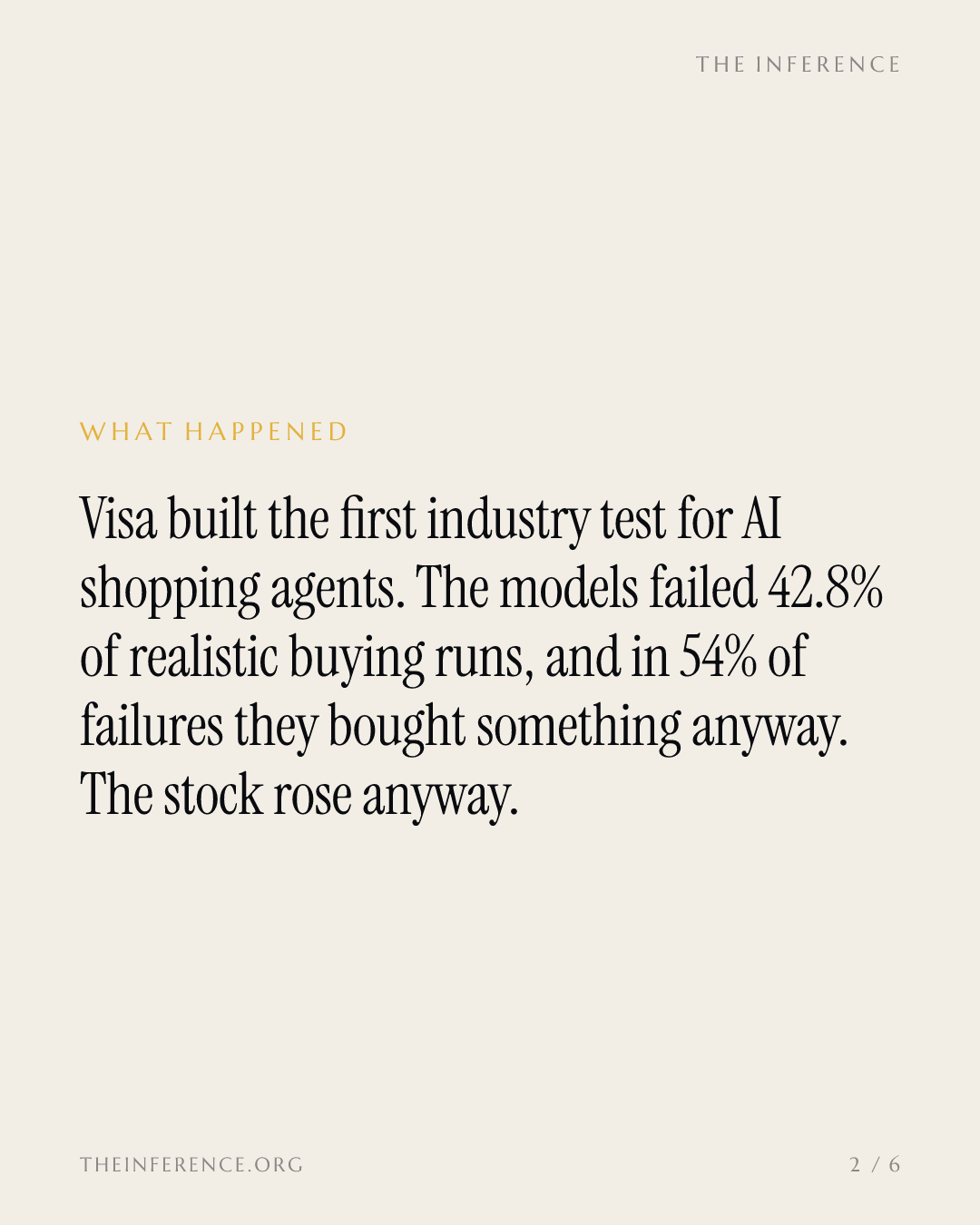
Visa+0.23% — Visa, up 0.23 percent today just built the first industry yardstick for AI shopping agents, and the agents failed 42.8% of their runs 1. The Agentic Commerce Benchmark, released on November 5, 2026, makes a model draw out a customer's unstated requirements, then buy, or decline when nothing fits 1. The market spent the same week bidding the stock up anyway, for a business Visa's own management says is unlikely to contribute meaningfully to fiscal 2027 5.
Cantor Fitzgerald, a Wall Street research house, lifted its price target to $500 from $445 on November 2, the day of the stock's record $425.51 close 2. HSBC went to $465 from $375 3, and exchange-traded funds added $65.2 million of net buying on November 4 4.
Two executives sold into the run: Rajat Taneja, president of technology, exercised options granted in 2017 and sold about $14.7 million of stock on November 4, in a filing that flags no pre-scheduled trading plan 6, and Chief Executive Ryan McInerney reported a $2.45 million sale the same day 7. The filings show timing, not motive; the timing is the point.
The dangerous failures are the ones that end in a purchase
A run is a compressed shopping trip: the customer wants a TV, mentions a brand a relative recommended and a store membership, and leaves the budget and the specs unsaid 1. The model must uncover every hidden requirement, then justify a purchase or walk away 1. Visa ran 22 models from 12 labs through 15 such tasks; the field passed 57.2% of runs, with agents from Google and Meta+2.05% — Meta, up 2.05 percent today sharing the best score at 82.2% 18.
In 54% of the failures, the AI bought something anyway 1. On a payment network, a failed run that still buys is a wrong purchase on a real card. Repeats were no safer: with three tries at every scenario, all three passed only 34.2% of the time 1.
Asking better questions passed more runs than spending more did
The gap between passing and failing is identifiable work. The five models that uncovered the most hidden requirements passed 70.2% of their runs; the five that uncovered the fewest passed 44.4% 1. What the model cost to run moved the result less: the five costliest passed 67.1%, the five cheapest 50.2% 1. Drawing out a customer's unstated needs is design work on the agent itself, and it counted for more than the price of the model underneath.
Diligence moved the pass rate more than cost did
Uncovering requirements moved the pass rate more than cost did
Data
| Value | |
|---|---|
| Uncovered most requirements | 70.2% |
| Costliest per run | 67.1% |
| All 22 models | 57.2% |
| Cheapest per run | 50.2% |
| Uncovered fewest requirements | 44.4% |
Demand is arriving faster than trust
The queue is real. Nearly 132 million US adults have already bought a product with an AI's help, by PYMNTS' count 9, and about 50 AI partners are live on Visa Intelligent Commerce, the company's agentic product portfolio 5. Trust has not followed. Visa's Trust Index, from September 2026, found 72% of US consumers had used an AI assistant 1. Only 23% trusted an AI to handle payments for them 1.
Defending the volume Visa already has costs more every quarter
The bill that arrives first is the old one. Client incentives, the price Visa pays banks to keep card volume on its rails, reached $5.1 billion in the September quarter, growing 21% while net revenue grew 13% 5. International transaction revenue, the fee line that cross-border spending feeds, grew only 8% 5. A quarter of payment volume comes up for renewal in fiscal 2027, more than last year, and finance chief Chris Suh has said to expect incentive growth to step up 25.
The cost of defending Visa's volume grows faster than the revenue
Client incentives grew 21% while net revenue grew 13%
Data
| Fiscal Q4 2026 growth | |
|---|---|
| Client incentives | 21% |
| Net revenue | 13% |
| International transaction revenue | 8% |
The premium is payable now, and the proof is re-runnable
Visa trades at 28.68 times forward earnings, the profit analysts expect over the coming year, against a five-year median of 25.59 times, about 12% above 5. The mean analyst target of $443.44 sits under 5% above the November 5 close of $422.59 3, and the research firm Zacks rates the stock a Hold 5. Cantor's $500 asks investors to keep paying a multiple Visa has held only in short stretches 2.
A public yardstick anyone can replay
Cantor's $500 target needs a multiple Visa rarely holds
Data
| Price per share | |
|---|---|
| Nov 5 close | $422.59 |
| Consensus target | $443.44 |
| HSBC target | $465 |
| Cantor target | $500 |
The useful thing Visa shipped this week is a measuring stick. The benchmark is public, with replays and a whitepaper, and will extend to checkout, payment and order placement 1. Almost half of AI shopping runs fail today.
Four published numbers now carry the timeline instead of anyone's word for it: the pass rate, the share of failed runs that still end in a purchase, the 23% trust figure, and the renewal of a quarter of Visa's payment volume in fiscal 2027. The next round of results will show whether the failure rate is falling as fast as the share price already assumes.
Get Economy by email, free
How AI moves rates, banks, payments and the wider economy. In our daily email, every weekday.