Constellation Software's record $3 billion buying year faces its 3% organic growth test on November 6
The Toronto serial acquirer is spending a record on acquisitions into the software class the market just repriced on AI fears; its Q3 print on November 6 must reconcile 18.7% consensus growth with a 3% organic base.
 Richard Tang · 3 min read

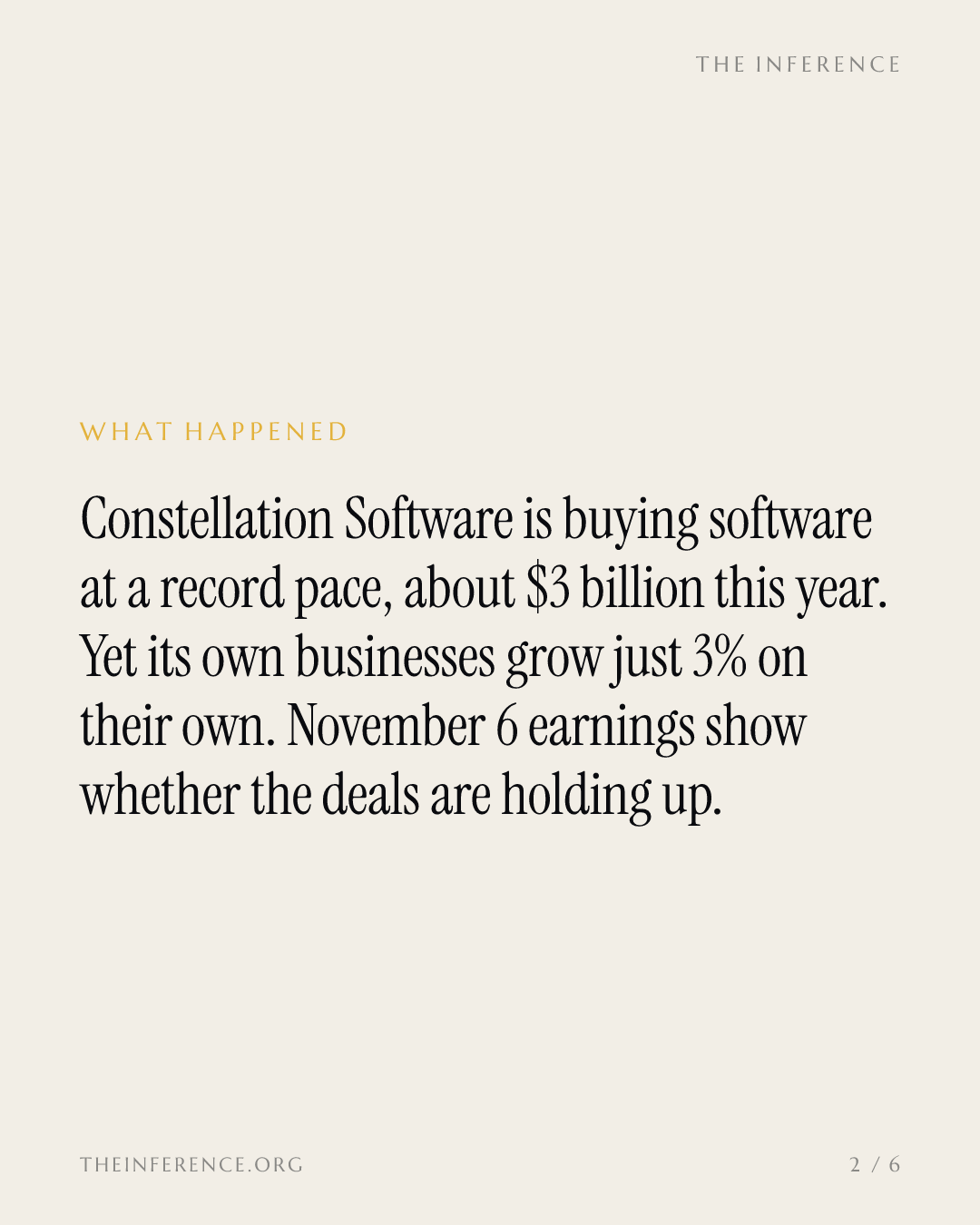
Constellation Software+0.72% — Constellation Software, up 0.72 percent today is deploying more capital on acquisitions than it ever has, in the very year investors began marking down the kind of software it buys. Third-quarter results are released after Toronto's close on November 6, with the call on November 9 1, and consensus expects US$3.5 billion of revenue, 18.7% growth 2, against a base growing organically at 3% 2. Friday's print has to show that the growth the machine bought is holding.
Record buying sits on a 3% organic base
Constellation, the Toronto serial acquirer of vertical market software (products for one industry at a time that businesses cannot easily swap out), was built by former venture capitalist Mark Leonard in 1995 to buy exactly that stickiness 2.
The playbook closed US$893 million of acquisitions in the second quarter alone, committed US$800 million more after quarter end, and puts 2026 on track for roughly US$3 billion against US$1.6 billion last year 2. Q2 revenue rose 17% to US$3.3 billion and free cash flow available to shareholders jumped 57% to US$345 million, the fuel the flywheel turns on 2.
Record capital going into acquisitions in 2026
- Estimate
Data
| Value | |
|---|---|
| 2024 | $1.8B |
| 2025 | $1.6B |
| 2026 (estimate) | $3B |
Q2's headline growth was bought: 17% total, 3% organic
Data
| Value | |
|---|---|
| Total revenue growth | 17% |
| Organic growth | 3% |
| Organic, constant currency | 1% |
The reprice feeds the buyer
The disruption camp had its biggest day yet this week: ServiceNow−3.86% — ServiceNow, down 3.86 percent today, the enterprise software giant, fell 27% on October 29, its worst day on record, reigniting fears that AI will upend traditional software business models 3. A widely shared X post counts Constellation down more than half from its all-time high 4; the Fool counts this month's bounce at 16% 2.
RBC's Paul Treiber, who carries the street's highest target at C$4,400 against consensus near C$3,880 56, says Q3 acquisition spending tracked below his own model yet still calls the shares discounted and expects organic growth to return to the company's 10-year average 5. Insiders are less cheerful: selling by the company's own executives has picked up relative to earlier this year 6.
Where the AI capital goes decides what Constellation becomes
On October 21 Constellation named Daan Dijkhuizen its Chief AI Officer, and handed him three hats at once: he keeps running Topicus+3.19% — Topicus, up 3.19 percent today, one of the operating groups through which Constellation manages its software subsidiaries, and keeps managing the VMS Ventures acquisition fund while pushing AI into the portfolio's 1,000-plus businesses, with VMS Ventures the vehicle for buying AI-native software 52.
Earlier in October the machine bought again: Penso Tecnologia, a São Paulo firm providing IT services from cloud computing to corporate email, picked up through Sysopen, a Brazilian credit-recovery software company Constellation itself acquired about two years ago, part of more than 20 Brazilian acquisitions since 2019 78.
The AI capital's payoff rests on an untested premise
The bear case and the record deployment are one market doing two things: investors marked down the price of the assets Constellation buys, and the Q2 and post-quarter figures show it spending at a record pace into that markdown 2. The company's answer, buying AI-native vertical software and pushing AI into a thousand existing products, is a bet, not a result.
If AI agents come to do the seat-priced work, vertical products are the layer they must integrate with, which would make a thousand integration points a position of leverage; the untested premise is whether agents erode vertical-market revenue at all. Organic growth on Friday, not headline revenue, is the line that settles the first round of that question.
Get Applications by email, free
How AI is changing the software people and companies use. In our daily email, every weekday.