Deepgram acquires Daily, the maker of Pipecat, as AssemblyAI prices a full voice agent at $4.50 an hour
The framework most voice agents are built on now sits inside the company that sells the speech models underneath it, while a rival published same-day benchmarks and $4.50-an-hour pricing that make the router optional. The money question is what "open forever" is worth when the new owner meters every other layer of the call.
 Vincent Jiang · 4 min read
The framework that routes every voice agent just changed hands
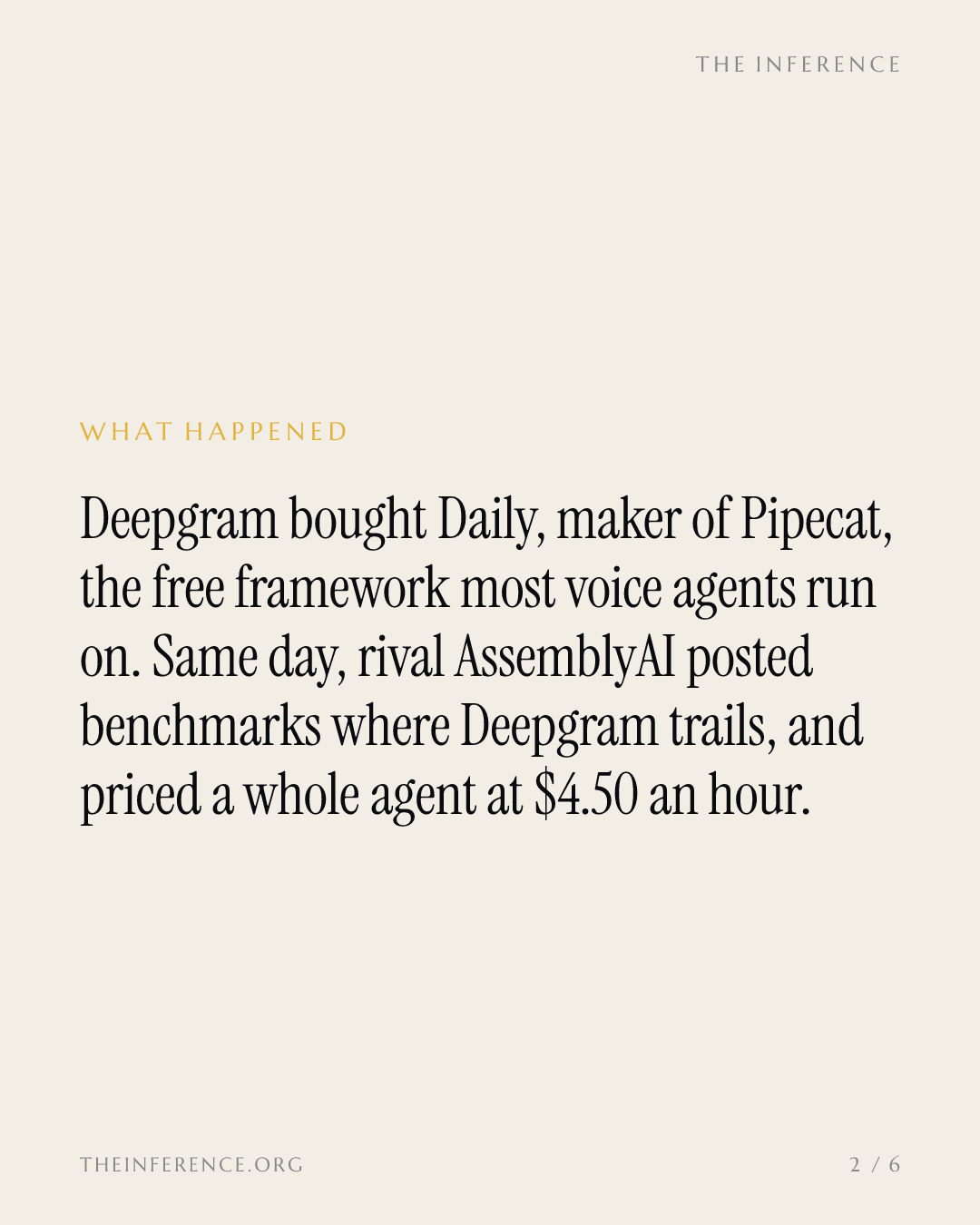
The free layer the voice industry builds on now belongs to a company that sells what runs underneath it. On October 29, Deepgram, a San Francisco speech-model maker, announced it is acquiring Daily, creator of Pipecat, the open-source Python framework that stitches speech recognition, language models and speech synthesis into live voice agents 2. The price is undisclosed 2.
Daily had raised more than $62 million from investors including Tiger Global, Nat Friedman, Lachy Groom and Kevin Weil; Deepgram reached a $130 million Series C and unicorn status earlier this year 1. The two founders shared a Y Combinator batch in 2016 1.
What Deepgram actually bought, and what it did not pay for
Daily is more than a repository. It runs a global real-time network of 75 points of presence built for the latency demands of live AI, plus the WebRTC and telephony libraries calls run on 2.
Pipecat itself was built by 18 engineers, has almost 400 contributors and more than 200 integrations, and its GitHub repository shows 16.9k stars, 359 contributors and a latest release, v1.15.0, dated October 29 34.
The deal terms are the safeguard. Pipecat stays free under its existing BSD V2 license, an independent Pipecat Foundation takes over governance with a steering committee that includes companies competing with Deepgram, and Deepgram adopts Pipecat as the core of its own voice products 23. Kramer, who joins Deepgram as Head of Open Source, said openness is "a commercial advantage" for a company sitting at the center of a fast-growing ecosystem 1.
The complication: the free part earns nothing, and the metered part is losing benchmarks
That is where the tension sits. Every part of Deepgram's stack except the framework is metered. The strategy earns only when a call stays on Deepgram's models, and the same day it announced the deal, a rival published numbers that argue against that 5.
AssemblyAI's English voice-agent benchmark, which the company says covers 12,460 scripted scenarios, puts its own Universal-3.6 Pro Realtime at a 5.19% word error rate and 14.4% entity error rate, against 8.64% and 26.1% for Deepgram Nova-3 and 13.50% and 30.1% for Deepgram Flux EN, last of the four models tested 5.
In AssemblyAI's benchmark, both Deepgram speech models trail the field on word error rate
Data
| Value | |
|---|---|
| Universal-3.6 Pro Realtime | 5.19% |
| ElevenLabs Scribe v2 | 7.78% |
| Deepgram Nova-3 | 8.64% |
| Deepgram Flux EN | 13.5% |
On the harder metric, named entities, the gap widens to nearly 16 points
Data
| Value | |
|---|---|
| Universal-3.6 Pro Realtime | 14.4% |
| Deepgram Nova-3 | 26.1% |
| Deepgram Flux EN | 30.1% |
AssemblyAI also published a guide to build the whole agent, listening, reasoning and speaking, on one API key, at $0.45 per hour of streaming speech recognition, $15 per million characters of speech synthesis, and an all-in voice-agent price of $4.50 per hour 5. A developer can wire that stack through Pipecat, but the guide's pattern makes the router optional. These are the seller's own numbers, benchmarked by the seller, and Deepgram will dispute them; that is the point of a trial, and the direction is what an investor should price.
One API key, $4.50 an hour
The demo shows the plan, and the counterpoint
Deepgram's own demo of its new Real-Time Context Standard, an open protocol launched alongside the deal that carries tone and speaking instructions between models, runs Pipecat's PhoneLLM Mini language model in the middle with ElevenLabs~$3.3B — ElevenLabs, private, latest valuation ~$3.3B doing the speaking, deployed on Pipecat Cloud 36. Pipecat's PhoneLLM examples likewise pair Deepgram Flux with an open-weights model 7.
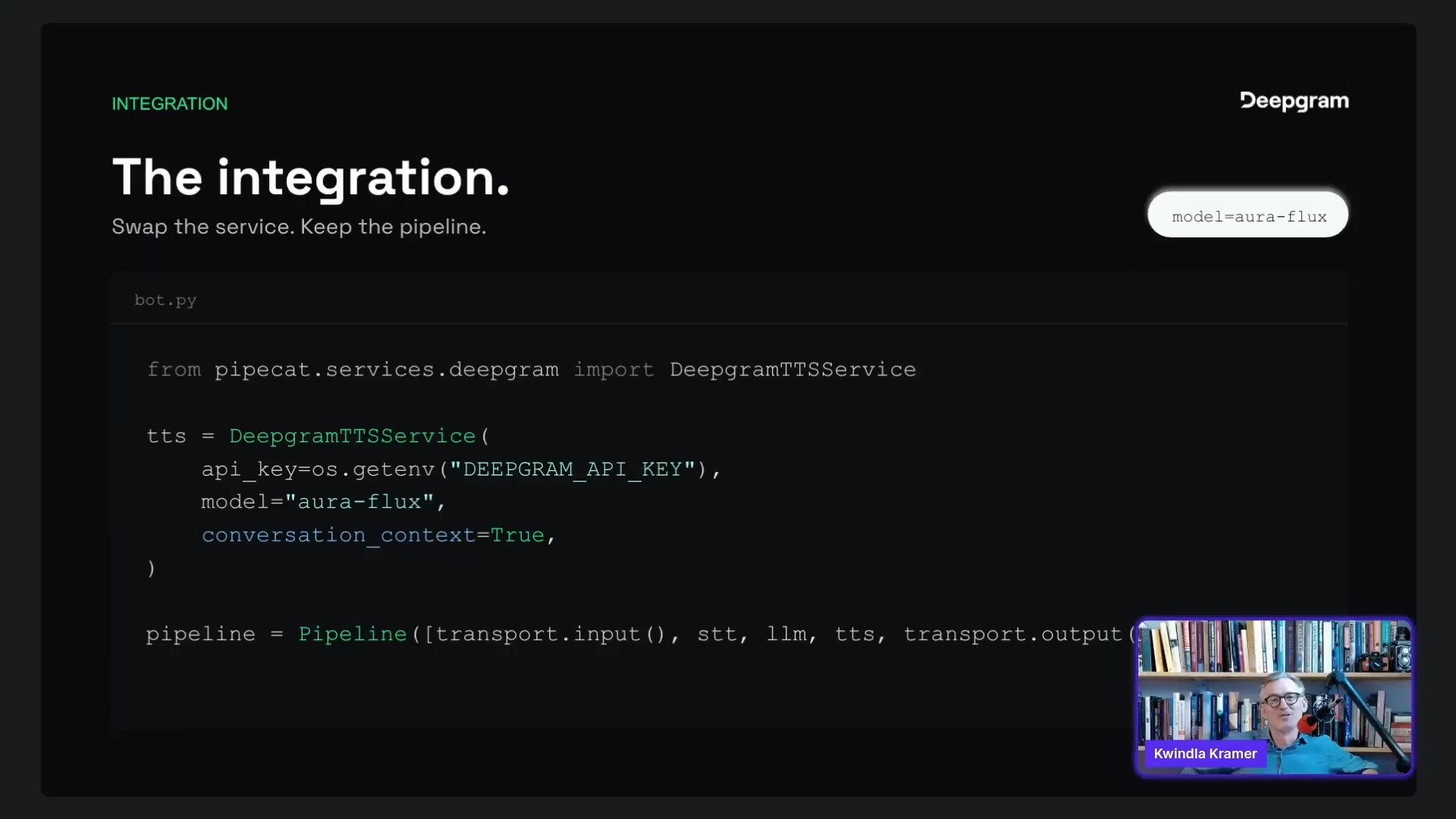
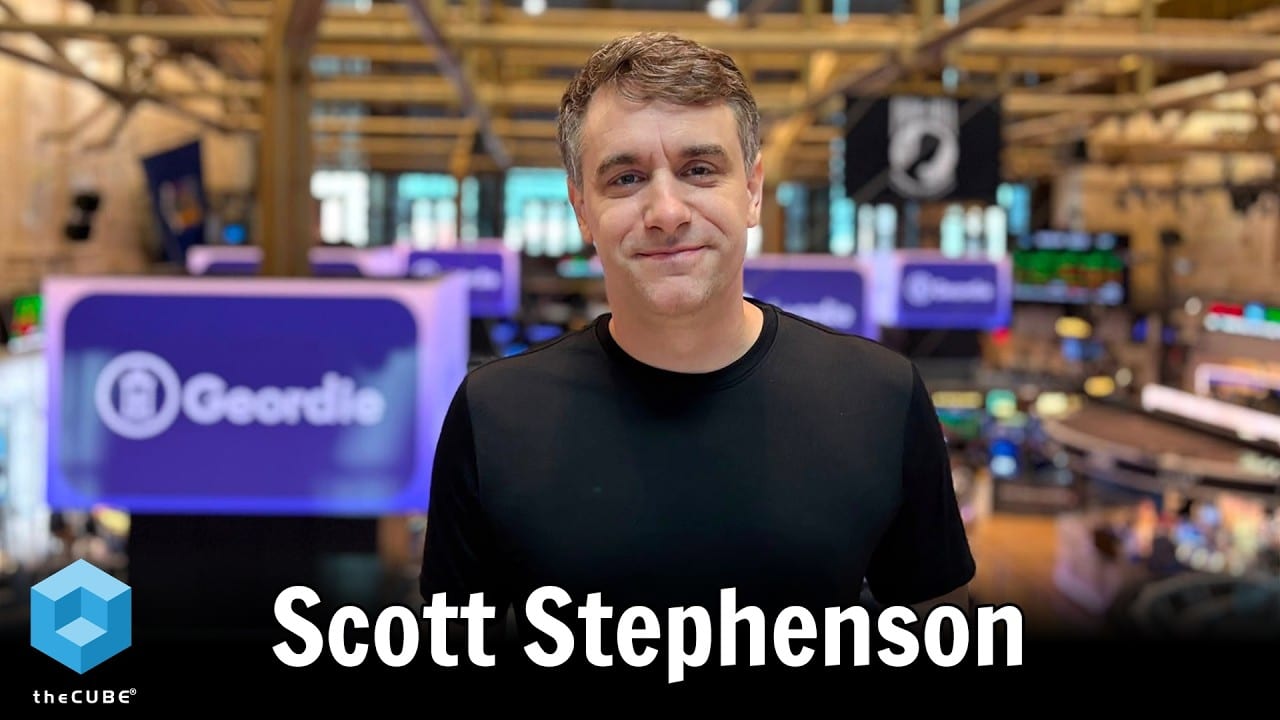
The counterpoint is the strongest one available: if Pipecat stays genuinely neutral, Deepgram gains the reach of a standard it does not fully control the revenue on, which is exactly what Kramer negotiated for 1. Stephenson, Deepgram's chief executive, said developers should use the best model for their use case, partners included, while Deepgram works to catch up in its weak areas 1.
The risks are the ones a metered owner cannot afford. If contributors or developers stop trusting Pipecat's neutrality, the community that gives Deepgram its reach drifts 5, and the benchmarks decide which meter the traffic actually lands on.
What an investor should price
For the buyer, this is a bet that owning the routing layer, even free, directs the next 650,000 developers and 5,000-plus organizations Deepgram cites toward its metered models and network 2. For the ecosystem, the test is scheduled and observable: the Pipecat Foundation's steering committee, its first governance decisions and the next independent voice benchmarks.
The router is free forever. The metering underneath is where the money lands, and the next check in voice belongs with the metered API and the app that owns the customer, not the router.
Get Platforms by email, free
The cloud, data and developer software AI is built on. In our daily email, every weekday.