Microsoft's Windows OEM revenue fell 22% as AI capex bid up memory prices for laptops
Microsoft's record Azure quarter carried the first consumer landing of the AI memory bill: Windows OEM revenue down 22% as datacenter demand helps bid up the chips that price laptops out of buyers' hands. The wires called the slump immaterial; the mechanism says it deepens into December.
 Richard Tang · 3 min read
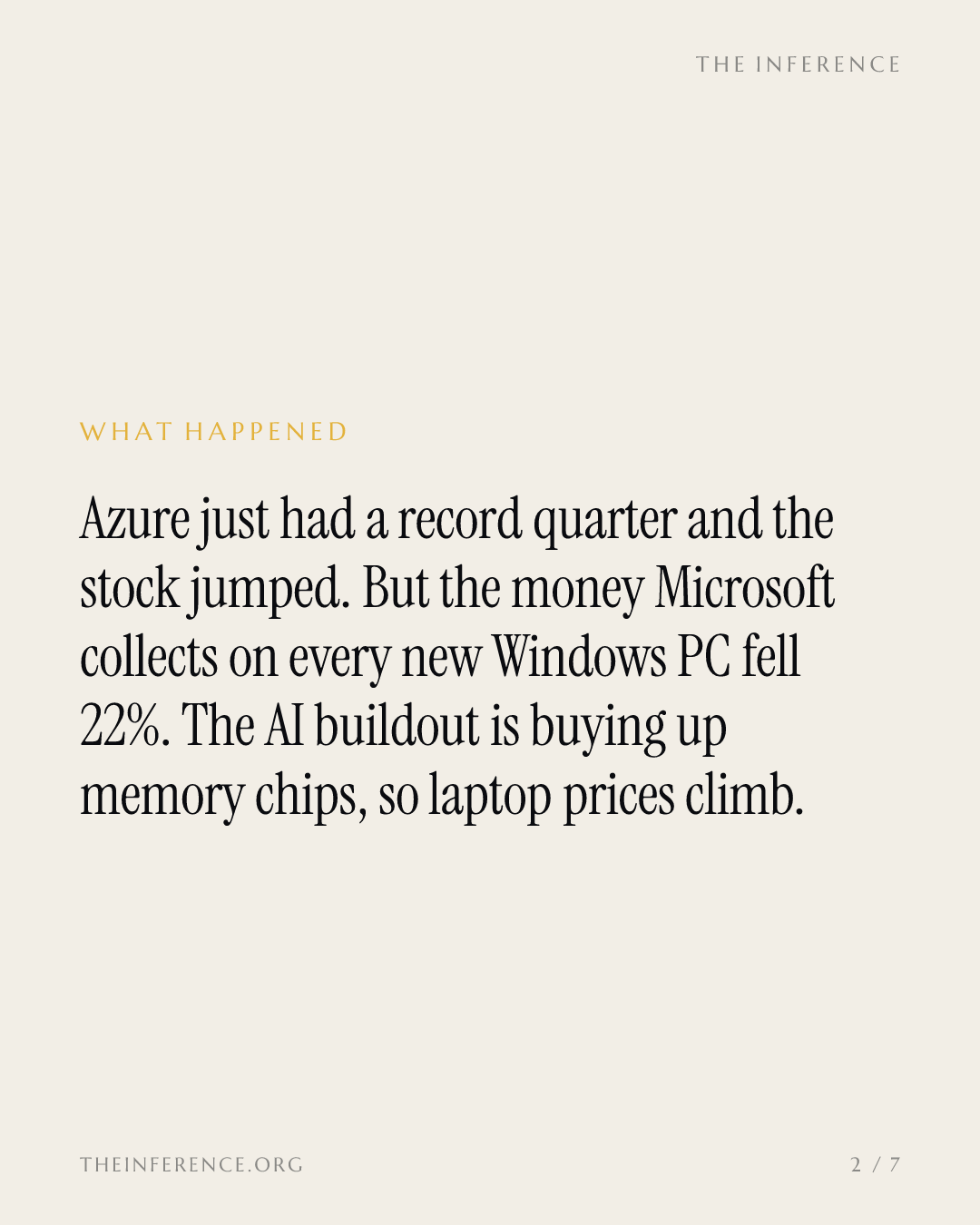
Microsoft−1.57% — Microsoft, down 1.57 percent today just printed its strongest AI quarter and, inside the same results, the first consumer landing of the AI memory bill. Azure grew 48% and the stock rose after hours on the beat 2. The backlog of signed cloud contracts grew 73% 1.
Then the other half of the company: Windows OEM and devices revenue, the rent Microsoft collects on every new PC, fell 22% in the quarter ended September 30 1. The cause runs back to the AI buildout itself. The AI bull pays its bill twice, once on the capex line and once in lost PC activations, and the second bill is the one this week's coverage waved off 1.
The memory bill leaves the datacenter and shows up in the laptop aisle
AI accelerators run on high-bandwidth memory, and a gigabyte of it consumes about three times the wafer area of the DDR memory inside a laptop 5. Memory makers redirected wafers to serve the datacenters, conventional DRAM became scarce, and its price exploded 5. Gartner+0.96% — Gartner, up 0.96 percent today projects average PC prices up 17% this year as the cost passes through 5. Buyers defer: a few hundred dollars on a laptop is the easiest purchase to postpone, and Windows is sold with new machines, so the deferred purchases vanish from Microsoft's Windows line 1.
CFO Amy Hood pre-flagged the mechanism in April, a "lower PC market as prices increase due to memory cost" 1, and it is the part that keeps running. TrendForce expects conventional DRAM prices to rise another 10% to 15% in the December quarter 6. SK Hynix−8.85% — SK Hynix, down 8.85 percent today said on its own earnings call that its memory production is effectively sold out through 2029 6.
Hood also pointed at last year's Windows 10 end-of-support upgrade rush 1, but that explains part of this quarter only. Xbox hardware sales fell 14% on the same memory and storage shortage 2. The memory mechanism, not the comparison, is what carries into next quarter.
Microsoft sits on both sides of the memory trade
Microsoft spent $45.2 billion on capital spending including finance leases this quarter 3, and Hood guided to $170 billion across fiscal 2027 2. That spending is part of the demand bidding up memory, so the company pays the price rise on one line while contributing to its cause on another. The labor mirror arrived the same week: voluntary buyouts offered to about 60,000 employees, roughly a quarter of the workforce 3.
Property and equipment spending doubled in the last four quarters
Data
| Property and equipment spending | |
|---|---|
| Q2 '24 | $13.9B |
| Q3 '24 | $14.9B |
| Q4 '24 | $15.8B |
| Q1 '25 | $16.7B |
| Q2 '25 | $17.1B |
| Q3 '25 | $19.4B |
| Q4 '25 | $29.9B |
| Q1 '26 | $30.9B |
| Q2 '26 | $35.8B |
| Q3 '26 | $39.4B |
The counterweight is real. OpenAI$500B — OpenAI, private, latest valuation $500B alone paid Microsoft $10 billion in the quarter, more than Windows and Xbox revenue combined 2. Copilot daily users grew more than five times in a year 4. Customers paying for Copilot by usage grew more than 75% 4. Azure's quarterly revenue now dwarfs the whole consumer segment 2. That's why the wires called the Windows slump immaterial 1. Small is not priced, though: nothing in the bull case accounts for a consumer annuity that keeps shrinking while memory stays scarce into 2027 1.
Every AI line grew in Microsoft's quarter; every consumer line shrank
Data
| YoY revenue growth | |
|---|---|
| Azure | 48% |
| Microsoft Cloud | 30% |
| M365 consumer | 17% |
| Devices & Consumer | -3% |
| Xbox content | -2% |
| Windows OEM & devices | -22% |
Price the consumer leg before the December print
The squeeze is guided to deepen. Microsoft plans to spend more than $50 billion next quarter 2. Azure is guided to grow 49% to 50% 2. TrendForce expects DRAM to rise another 10% to 15% 6.
Microsoft's own answer is to extract more intelligence per scarce chip: GitHub Copilot Fusion delivers frontier-level quality at up to 77% lower cost 4, and Nadella is wiring agents into Windows itself, so the installed base of older PCs becomes part of the AI estate instead of shelf inventory 4. That is where the consumer annuity gets rebuilt, not defended. Until it pays, judge the AI demand as proven, the capex as disciplined, and the Windows erosion as the transition's tax: worsening, and priced in nothing.
Get Platforms by email, free
The cloud, data and developer software AI is built on. In our daily email, every weekday.