DoorDash fell 14.5% on Prime's Uber Eats move; its $13 billion Instacart bridge may fall short
The 10-Q shows a $13.0 billion bridge loan sized to a maximum cash bill, zero third-quarter buybacks, and a close a year or more away, while the stock election that could lighten that bill just lost 14.5% of its value.
 Vincent Jiang · 2 min read
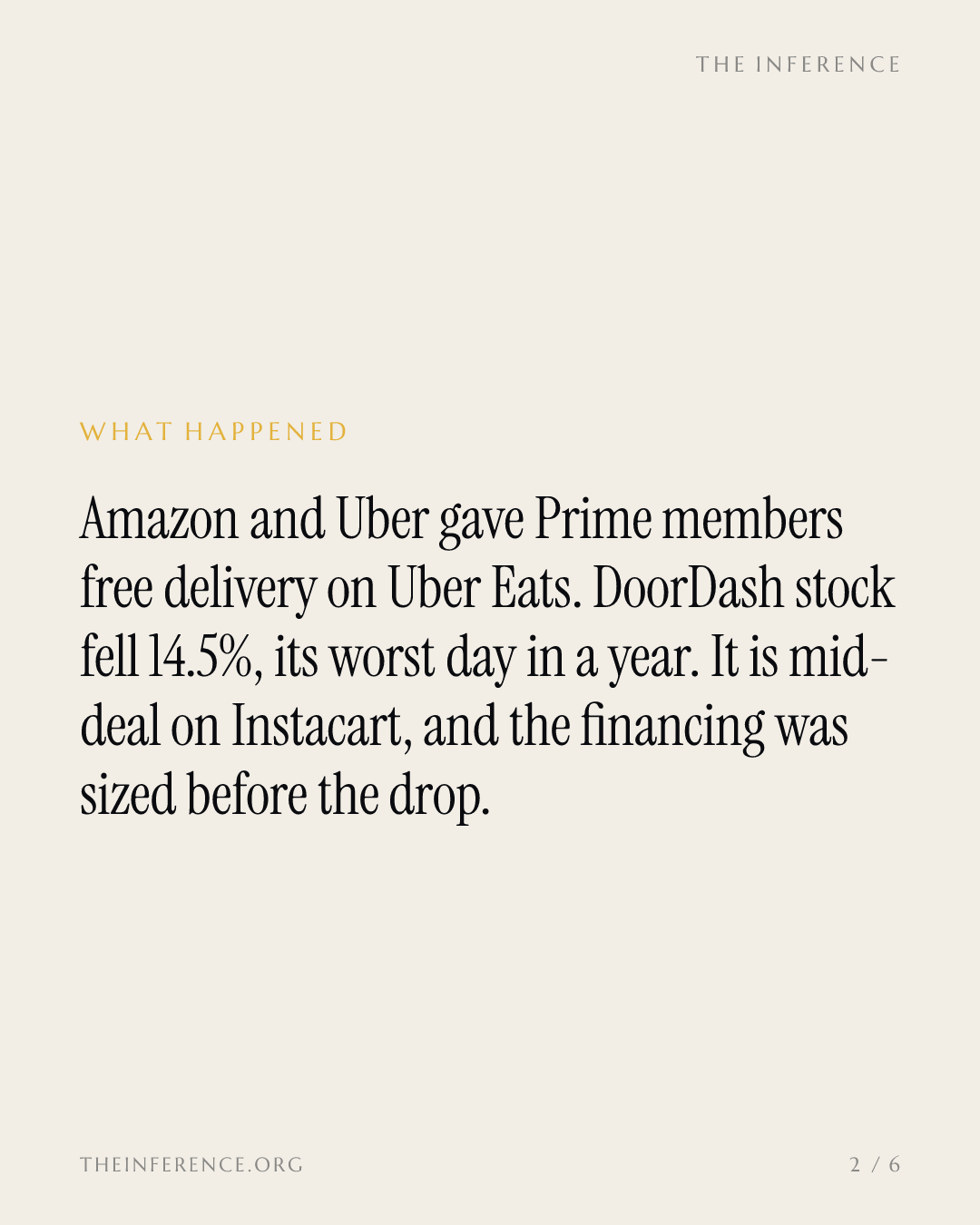
DoorDash−0.50% — DoorDash, down 0.50 percent today lost about 14.5% on November 5, its worst day in a year, after Amazon+0.92% — Amazon, up 0.92 percent today and Uber+0.21% — Uber, up 0.21 percent today gave Prime members a $0 delivery fee on Uber Eats orders of $25 or more 45. The merger financing behind the Instacart deal did not move with the stock. The 10-Q shows a JPMorgan commitment for a 364-day senior unsecured bridge loan of up to $13.0 billion, no share repurchases in the third quarter, and a closing no earlier than late 2027 1.
The cash need rises as the stock falls
Instacart holders choose $65.00 in cash, 0.3372 DoorDash shares, or $48.75 plus 0.0843 shares, but stock can be no more than 25% of the consideration 1. That caps the paper at roughly $4.25 billion and sets a cash floor of about $12.75 billion against a $17 billion equity value 1.
The bridge covers almost exactly that maximum, sized before the 14.5% drop 1. When the stock election is worth less than cash, a 14.5% fall would push holders toward the $65.00 dollars, likely lifting the cash need past the commitment 1. DoorDash held $5.1 billion in cash and $6.8 billion in cash and investments at September 30; the gap is debt 1.
The bridge is sized to the cash maximum, not the cash DoorDash holds
The $13.0 billion bridge barely covers the cash the deal must pay
- Estimate
Data
| Value | |
|---|---|
| Bridge commitment | 13 |
| Min cash need (estimate) | 12.75 |
| Cash + investments | 6.8 |
| Cash on hand | 5.1 |
The buyback went quiet first
DoorDash bought back no Class A shares in the third quarter, after $887 million in the second, leaving about $4.0 billion of the $5.0 billion authorization unused 1. The stock that fell on November 5 had no corporate bid under it 1.
The companies promise about $500 million of extra annual profit from fusing software and advertising arms 2; set that against $13 billion of bridge paper and the arithmetic decides the stock. The United Food and Commercial Workers union calls the deal a nightmare for workers, and the Federal Trade Commission has asked both firms how personal data sets prices 23.
Two settlement dates
The next signals are two dates, not the Prime perk: the Form S-4 registration statement DoorDash says it will file for the shares the deal may issue 1, and the take-out of the $13.0 billion bridge with permanent financing before closing 1. Until the permanent bonds price, any position underwrites a debt raise, a competition review, and a close 12 to 18 months out 11. The price on that take-out is the number to watch.
Get Applications by email, free
How AI is changing the software people and companies use. In our daily email, every weekday.