Pale Fire Capital bought $31 million of Coursera in three days, below Goldman Sachs's $5 target
Pale Fire Capital, the Prague fund run by Dusan Senkypl and Jan Barta, disclosed buying 8.36 million more Coursera shares for about $31 million over three days, at prices well under where the covering analysts set their targets.
 Vincent Jiang · 3 min read

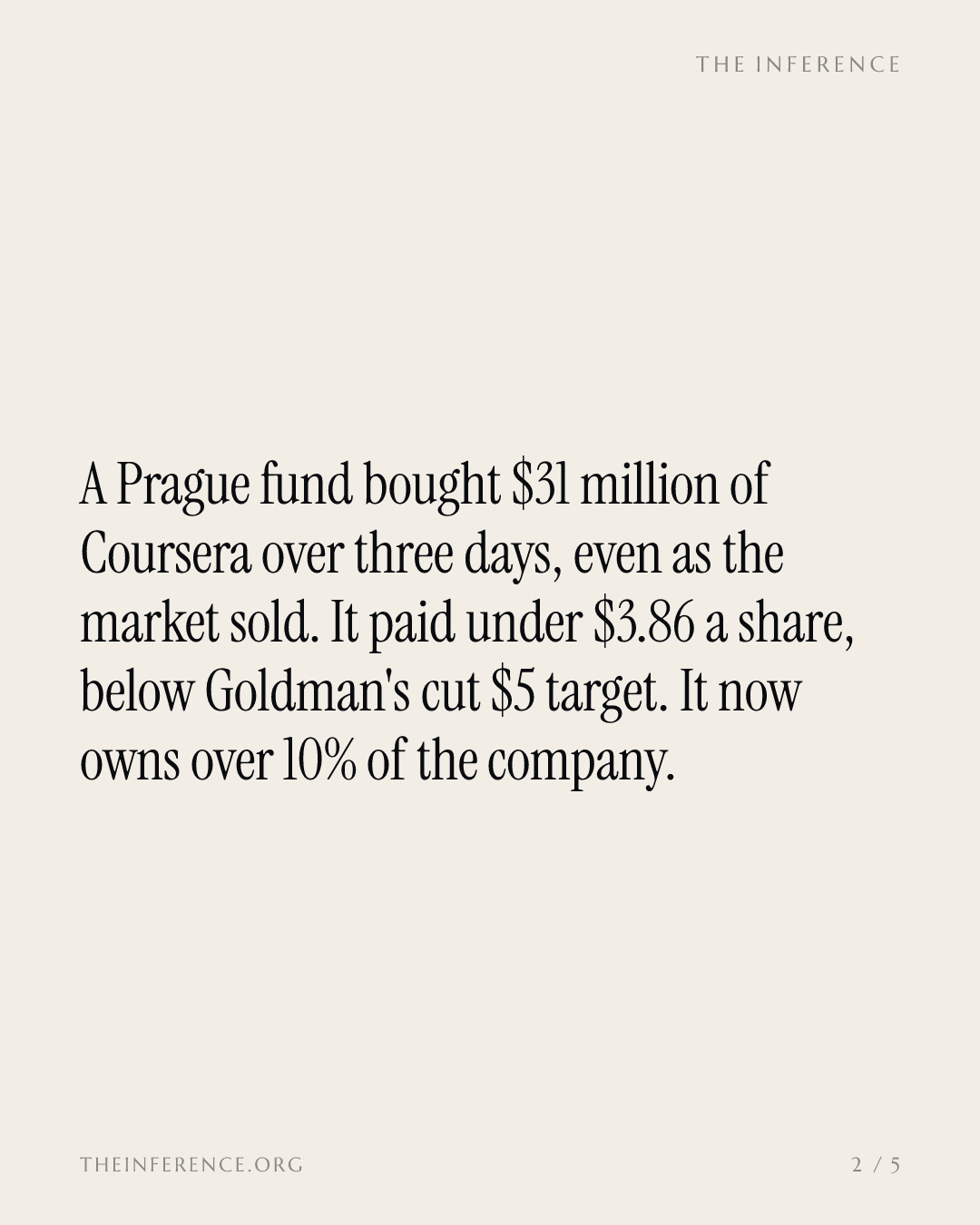
A Prague value fund spent three straight days this week buying a stock the rest of the market was leaving. Pale Fire Capital, the investment firm run by Dusan Senkypl and Jan Barta, disclosed in a Form 4 filed November 5, 2026, that it bought 8.36 million Coursera−0.67% — Coursera, down 0.67 percent today (COUR) shares for about $31 million across 3, November 4 and 5, taking the group to 37.2 million shares as a 10% owner 1.
The money: $31 million in three days, at the lows
The buying accelerated as the week went on: 2.53 million shares at a weighted $3.7209 on November 3, 2.70 million at $3.8537 on November 4, and 3.13 million at $3.7220 on November 5, the filing shows 1. The group held roughly 28.8 million shares before the week 1.
Every day's buying landed near $3.75, well under Goldman's $5 target
Data
| Weighted average price paid | |
|---|---|
| 3 Nov | $3.72 |
| 4 Nov | $3.85 |
| 5 Nov | $3.72 |
Every dollar went in below $3.86 3. That is well under the $4.66 close of October 29 that Goldman Sachs+0.74% — Goldman Sachs, up 0.74 percent today used as its reference point when cutting its target, meaning the fund bought at a discount even to the price the covering bank called cheap enough for Neutral 3. The stock was already under pressure from a deteriorating consumer business, which we reported on October 28: enterprise customers down at 91% retention heading into the first Udemy quarter 4.
Pale Fire's Coursera buying accelerated daily, to $11.6M on November 5
Pale Fire bought more each day as the week went on
Data
| Paid for COUR shares | |
|---|---|
| 3 Nov | $9.4M |
| 4 Nov | $10.4M |
| 5 Nov | $11.6M |
The complication: the tape says the opposite
The buying runs against a CEO sale under a pre-set plan and an analyst target cut. CEO Gregory Hart sold $36,994 of stock at $3.59 on November 2 under a 10b5-1 plan, the routine scheduled arrangement that lets executives sell on a clock; a $37,000 exit next to a $31 million accumulation is small money, but the timing is hard to miss 2.
Goldman Sachs kept its Neutral rating and cut its price target to $5 from $6.50 on November 4 3. The five most recent analyst targets on the stock span $5 to $6 3.
What the record shows
The fundamentals behind the divergence are real. Coursera's first full quarter with Udemy produced $377 million in revenue and a 16.3% adjusted EBITDA margin, but normalized revenue fell about 3%, consumer revenue fell 9% normalized, and management is planning for roughly flat-to-declining enterprise revenue and a low-double-digit consumer decline in 2027 5.
The company holds about $776 million in unrestricted cash with no debt, and its reported adjusted EBITDA margin expanded by more than 800 basis points year over year 5. Pale Fire's bet, on its face, is that a cash-rich company with expanding margins does not belong at $3.75 15.
The counter, and the door
The bear case deserves its day: an owner can be early, and guidance is guidance. The contrary argument is that Pale Fire is not a tourist. Its filings describe a Section 13(d) group, the arrangement that triggers public-disclosure duties once investors together cross 5% of a company, already above 10% before this week's buying 1.
What to watch: the group's next Form 4 or 13D amendment for continued daily buying, and Q4 results against the $358 million to $366 million revenue guide 5. When the largest outside holder buys every day, someone is making a statement about a floor.
Get Applications by email, free
How AI is changing the software people and companies use. In our daily email, every weekday.