DoorDash's DashOS owns the restaurant's customer data as fee-cutting rivals circle
With Olo and Matt Maloney's Bites undercutting marketplace commissions of up to 30%, DoorDash's DashOS platform moves the fight to restaurant software, straight into Toast's add-on business.
 Vincent Jiangthree-minute read

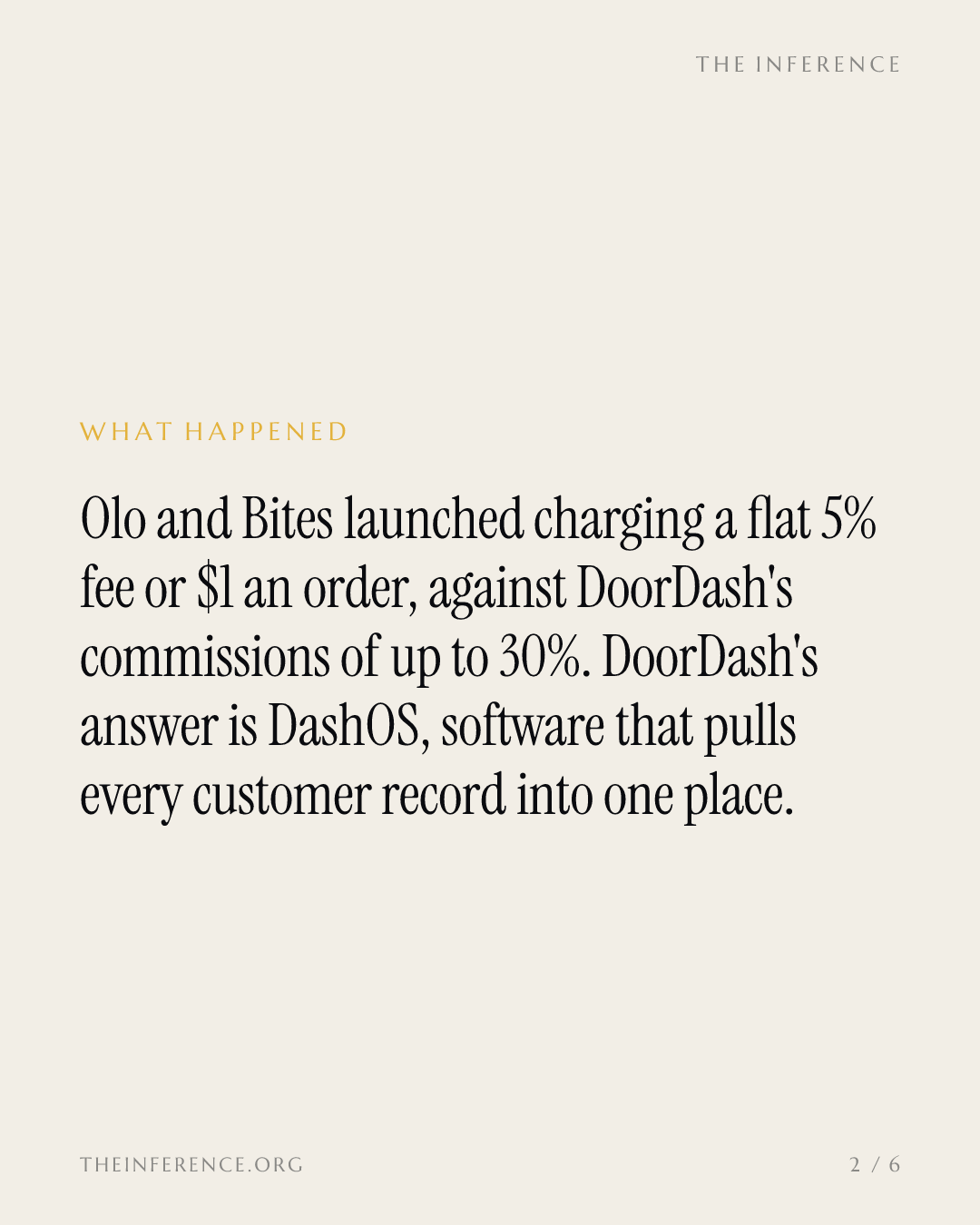
DoorDash−1.30% — DoorDash, down 1.30 percent today has a fee problem. Two startups launched this month promising restaurants escape from commissions that can reach 30% of an order, one run by Grubhub's co-founder 1. DoorDash's answer is DashOS, a platform that turns a restaurant's scattered customer contacts into one record the delivery company helps own 1.
The number behind the platform
The pitch is data. DashOS, unveiled at DoorDash's Dash Forward event on September 30 and recirculated by StreetInsider this week, links a diner's delivery orders, direct orders, reservations, loyalty enrolment and in-store visits into a single profile, layered over the point-of-sale system the restaurant already runs 18. DoorDash's own figures carry the argument: consumers enrolled in its omnichannel loyalty program order 1.8 times as often and spend about 1.75 times as much as those who are not, and more than 1 in 5 customers are now opting in, a share DoorDash says is growing weekly 138.
Loyalty members order 1.8 times as often and spend about 1.75 times as much
- Enrolled in omnichannel loyalty
- Not enrolled
Data
| Enrolled in omnichannel loyalty | Not enrolled | |
|---|---|---|
| Order frequency | 1.8x | 1x |
| Customer spend | 1.75x | 1x |
The rest of the receipts follow. AI-personalised recommendations lifted reservations more than 15% in a July-August test, SevenRooms marketing tools built on DoorDash Marketplace data drove more than $150 million in restaurant sales from January through August, and Voice AI averaged more than $10,000 in monthly revenue per restaurant 13. DoorDash's 2026 Industry Trends Report gives the opening: 40% of surveyed US operators juggle four or five separate technology systems, and 83% say better-connected systems would directly improve profitability 1.
Restaurants pay DoorDash up to 30 percent of an order; Olo's fee is 5 percent
Data
| Value | |
|---|---|
| DoorDash basic plan | 15% |
| DoorDash top plan | 30% |
| Olo service fee | 5% |
The squeeze from below
The platform is a reply, not a whim. Olo, the ordering-software company handling more than 3.5 million daily orders, opened a consumer app on October 20 with in-store menu prices and a flat 5% service fee, promising diners 15% to 30% savings against marked-up marketplace menus 5. Orders route straight into the restaurant's own point-of-sale.
Bites, an AI-native ordering startup whose founding team now includes Grubhub co-founder Matt Maloney, charges restaurants a $1 flat fee where DoorDash takes 15% to 30% in commissions 6. NYU professor J.P. Eggers told Inc. that direct-to-POS ordering "would have to make DoorDash nervous" 6. DashOS makes defection cheaper to resist: a restaurant that runs loyalty, reservations and marketing through DoorDash has less reason to move demand to a cheaper marketplace.
Who bleeds if it works
Toast−0.69% — Toast, down 0.69 percent today. Analysts at Truist+0.14% — Truist, up 0.14 percent today kept their Buy rating and $38 target on Toast this week but now name "competition from DoorDash's DashOS" outright, while defending Toast as the primary operating system for restaurants 2. Jefferies−2.31% — Jefferies, down 2.31 percent today draws the sharper line: DashOS is unlikely to displace Toast's point-of-sale terminals, but its marketing and customer-analytics tools overlap with IQ Grow, which Toast sells at $499 a month 4.
That overlap presses on exactly the add-on revenue where Toast grows 4. Fiserv's−0.60% — Fiserv, down 0.60 percent today Clover, by contrast, sits in DoorDash's partner column, one of seven integrators through which more than 80,000 restaurants get access starting in 2027 13. Simply Wall St counts DashOS as feeding DoorDash's core catalyst, higher-margin software and advertising revenue tied to better merchant data 9.
DoorDash reports Q3 on November 4 7. DashOS pricing varies by restaurant and does not touch marketplace delivery pricing, so the strategy's first hard reading is the take rate and any software attach in that print 8. Until then, the tape's verdict on the stock stands at SELL (= Flat) at $185.94 1. The landlord is still collecting rent; the question is whether the tenants sign a second lease.
Get Applications by email, free
How AI is changing the software people and companies use. In our daily email, every weekday.