Duke Energy's North Carolina rate ask is cut in half; a $42 monthly credit for 80,000 homes ends Dec. 31
Duke halved its North Carolina rate ask to staged increases of about 9.5% and 6.8% from January, while the $42-a-month credit for 80,000 low-income households dies on Dec. 31 without a commission decision. The commission is now the only lever left, and the data-center demand behind the ask keeps growing.
 Richard Tang · 3 min read

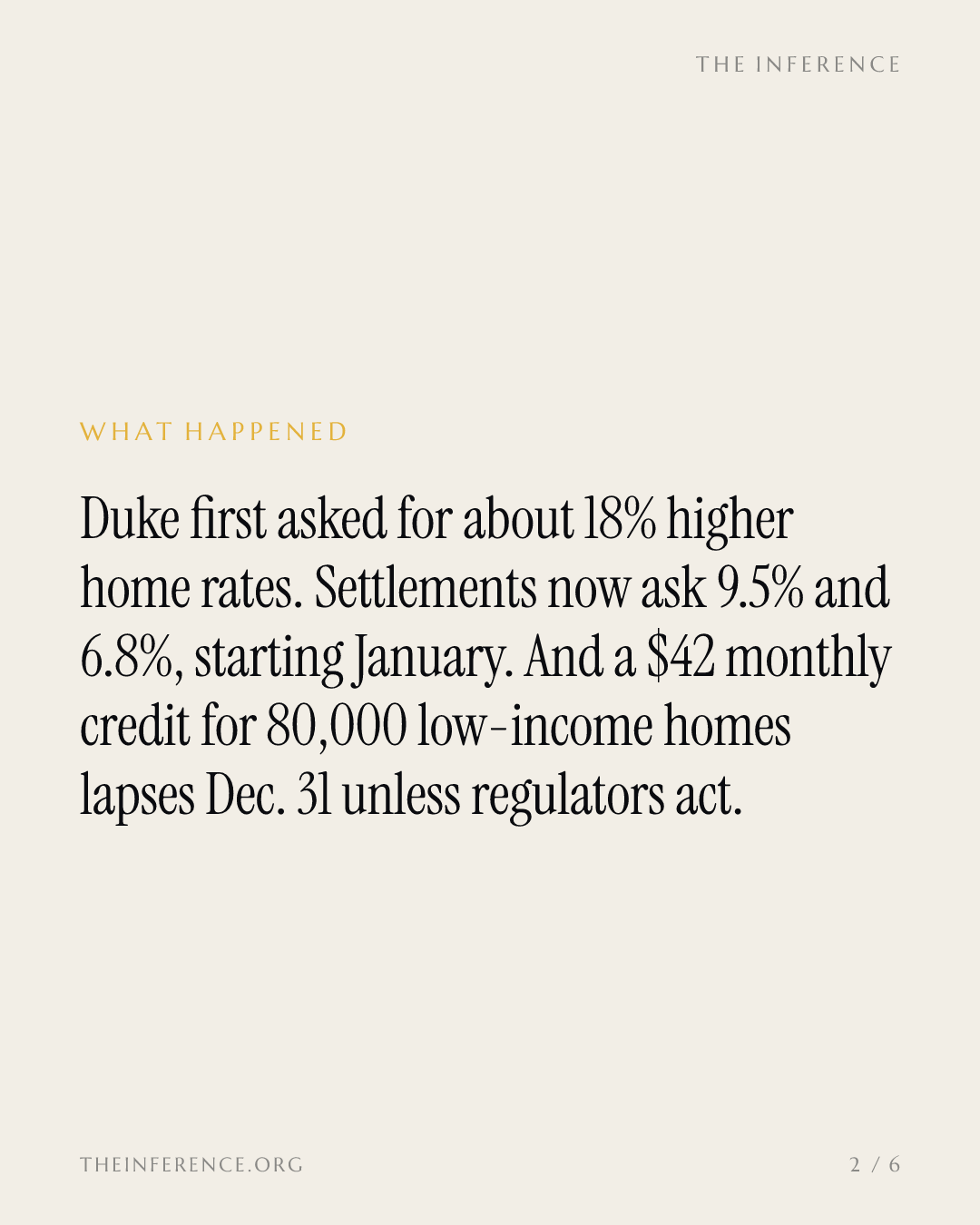
Duke Energy−0.65% — Duke Energy, down 0.65 percent today has cut its North Carolina residential rate ask in half, and the state utilities commission now decides what 4 million households pay and whether a $42 monthly credit for 80,000 low-income homes survives past Dec 1. 31 1. Duke first sought about 18% over two years; the settlements now before the North Carolina Utilities Commission would raise residential rates about 9.5% at Duke Energy Carolinas and 6.8% at Duke Energy Progress, staged from Jan 1. 1, 2027 1.
Duke halved its North Carolina residential rate ask
Data
| Residential rate increase | |
|---|---|
| Duke Energy Carolinas, settled | 9.5% |
| Duke Energy Progress, settled | 6.8% |
| Original two-year ask | 18% |
Attorney General Jeff Jackson refused to sign and is urging rejection, arguing Duke does not need that much from ratepayers to meet demand over the next two years 1.
The people at the end of the chain have no lever left to pull
Andrew Hefner of North Carolina spent years insulating his home, upgrading appliances and installing a heat pump. He uses less electricity and owes more, because the costs moving onto bills are not use-driven: they are the price of grid buildout and growing demand 1.
That is the hop most coverage skips. Data centers do not raise a fixed-income household's bill directly; the chain runs from large new load, through Duke's capital plan, through a rate case, to a thermostat nobody is touching. Hefner has already cut animal rescue work from his budget to pay for electricity 1.
On Jan. 1 the credit that buffers the lowest-income 80,000 customers expires unless the commission acts; a household losing the full $42 a month loses $504 a year even before the staged increase arrives 1. Duke's answer is $20 million of shareholder money for bill assistance and weatherization 1. Real help, but a one-time fund does not match a recurring credit, and it does not guarantee replacement payments for current participants 1.
Who pays is the trade
The demand side is real. Duke posted $1.077 billion of second-quarter net income, up from $971 million a year earlier, and the stock rose 3.9% to $125.40 on Oct 13. 22, a rise the settlement itself de-risks by locking the earnings path 13.
Duke's net income has held between about $1.0 billion and $1.6 billion a quarter for two years
Data
| Net income ($B) | |
|---|---|
| Q3 '24 | $1.28B |
| Q4 '24 | $1.21B |
| Q1 '25 | $1.38B |
| Q2 '25 | $0.98B |
| Q3 '25 | $1.42B |
| Q4 '25 | $1.18B |
| Q1 '26 | $1.55B |
| Q2 '26 | $1.09B |
The earlier data-center tariff we covered, where Amazon−0.40% — Amazon, down 0.40 percent today, Google, Meta−0.86% — Meta, down 0.86 percent today and Microsoft+0.56% — Microsoft, up 0.56 percent today prepay their own grid connections for loads of 50 megawatts and up, was supposed to close exactly this gap between new load and old customers 4. The Rowan County rally on Oct. 19 shows ratepayers do not believe it has closed: they demanded a two-year statewide data-center moratorium and a bar on Duke passing expansion costs into customer rates 2.
What the commission should test
Approve the settlements, and large-load protections plus the tariffs stand or fail on whether data centers truly cover their own costs. Reject, and 2027 estimates move down with the cut. Either way, the $42 credit expires Dec. 31 without a decision, and that is the number I would watch, not the stock.
The verdict I would hand the commission: let the companies building the demand pay for the wires they need, on the record and verifiably, before a single additional dollar lands on a fixed-income bill. Everything else in this case is negotiation.
What happens next
DUKHow much do residential bills rise, and does the commission replace the credit?
The case for
The halved ask locks an earnings path and de-risks the stock's 3.9% rise on Oct. 22
The case against
Staged increases of about 9.5% and 6.8% land on bills that rise even when households use less electricity
- December 31, 2026The $42 monthly credit for 80,000 low-income homes expires.
- January 1, 2027Staged increases of about 9.5% and 6.8% begin if approved.
Get our follow-up when these land
Free. We'll email you when we publish on Duke Energy, and send our free weekday newsletter. Unfollow in one click.