Eli Lilly's 79% ovarian cancer response rate came from a dose its Phase 3 won't use
Lilly's headline response rate at ESMO was measured at 4 mg/kg; the Phase 3 runs 3 mg/kg, and the combination result at that dose is unpublished. A day earlier, Genmab posted a positive Phase 3 on the same payload class.
 Richard Tang · 3 min read

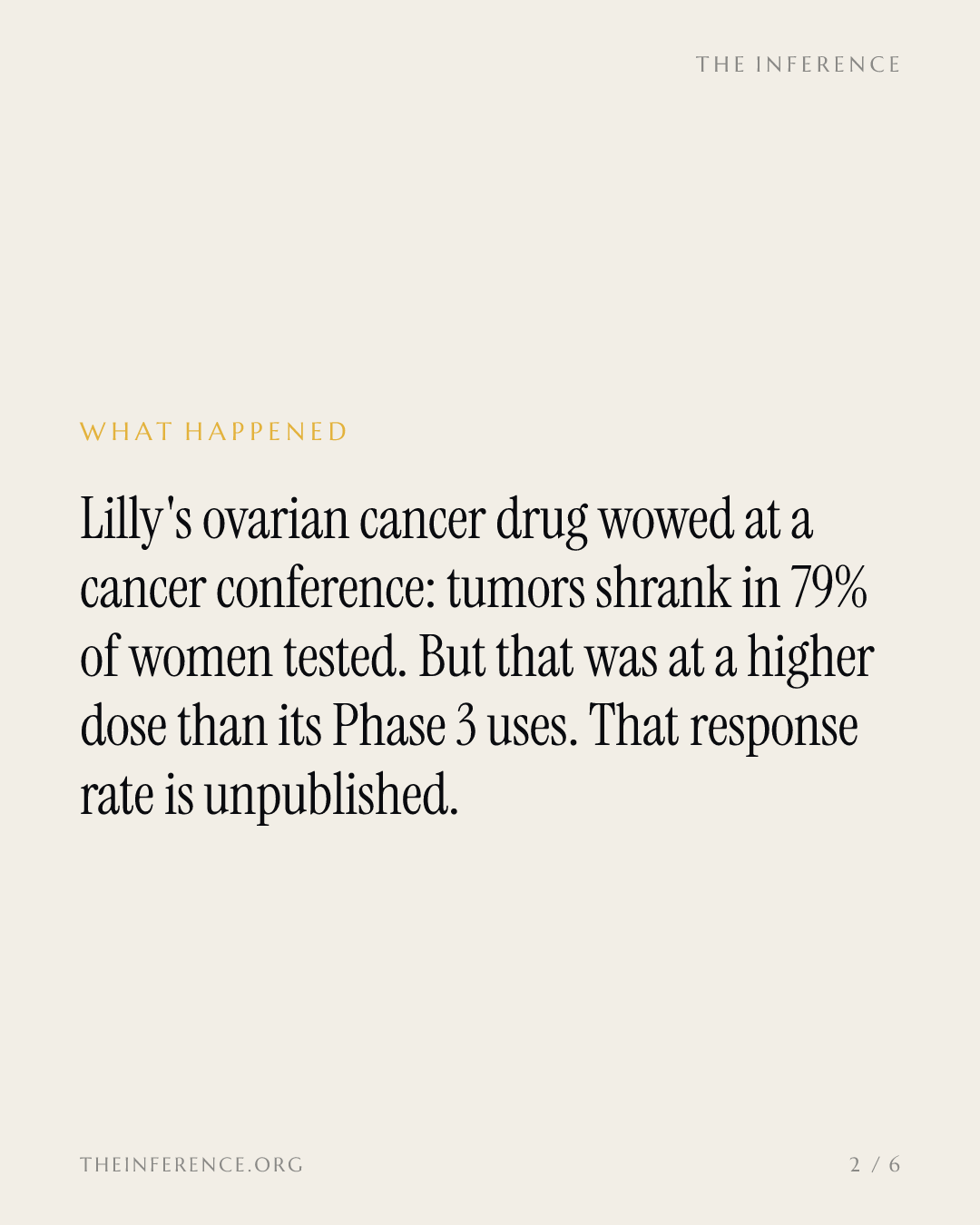
The most-quoted number from today's ESMO cancer congress in Madrid is real, and it is not the number Eli Lilly−2.12% — Eli Lilly, down 2.12 percent today will file. The company reported on October 24 that sofetabart mipitecan (Sofe-M) plus bevacizumab, an existing cancer medicine, produced a confirmed response in 79% of women with platinum-sensitive ovarian cancer and controlled the disease in all of them 1. That study tested a 4 mg/kg dose 1. The Phase 3 program that will support any approval runs 3 mg/kg, and the combination response rate at that dose has not been published 1.
The dose is the story
Lilly's own dose-selection data explain the switch. In monotherapy testing, severe treatment-related adverse events and dose reductions both fell sharply at the lower dose, while the response rate stayed level 1. The platinum-sensitive result that made the headlines came from the higher-toxicity arm. It shows what the molecule can do at its most aggressive, not what the filed drug will do.
Severe toxicity fell sharply at the dose Lilly took into Phase 3
- Grade ≥3 treatment-related adverse events
- Dose reductions
Data
| Grade ≥3 treatment-related adverse events | Dose reductions | |
|---|---|---|
| 4 mg/kg | 56.4% | 41% |
| 3 mg/kg | 35.3% | 23.5% |
The bar is low, the race is on the clock
Sofe-M is an antibody that ferries a poison: it binds folate receptor alpha, a protein sitting on almost all ovarian tumors, and releases the cell-killer exatecan inside 1. The bar it must clear is modest. After maintenance with PARP inhibitors, the standard follow-on drugs, published real-world data put response to another round of platinum at 41.9% 1.
Genmab, a Danish antibody company, announced on October 23 that its Phase 3 of rinatabart sesutecan, a conjugate built on the same exatecan payload, met both survival endpoints in the platinum-resistant form of the disease with a 57% lower risk of death, and said it will take the data to regulators 2.
Genmab already lists two Phase 3 trials of the same drug in platinum-sensitive disease 2, and AbbVie−0.06% — AbbVie, down 0.06 percent today, whose Elahere is approved in the resistant setting, has its own trial there with primary completion estimated for April 3. AstraZeneca joined the same race in September 3. Because the new candidates share a payload class, tumors that resist one may resist the next, so the first approval is worth more than the higher number 3.
The money is already in the ground
On October 22, Lilly broke ground on a $5 billion plant in Goochland, Virginia, more than double the original plan, its first site to carry antibody-drug conjugates from raw ingredient to finished medicine under one roof, with artificial intelligence and machine learning built into operations and completion set for 2030 4.
It extends the manufacturing spree that includes the Dutch factory we profiled this month 55. Nvidia's−0.54% — Nvidia, down 0.54 percent today newly released open protein-design model, RFD4-Proteina, ships to a partner list that does not include Lilly 5; Lilly's own AI bet is the co-innovation lab with Nvidia announced in January, worth up to $1 billion over five years 5.
Lilly's quarterly revenue has more than doubled in ten quarters
Data
| Revenue | |
|---|---|
| Q1 '24 | $8.77B |
| Q2 '24 | $11.3B |
| Q3 '24 | $11.44B |
| Q4 '24 | $13.53B |
| Q1 '25 | $12.73B |
| Q2 '25 | $15.56B |
| Q3 '25 | $17.6B |
| Q4 '25 | $19.29B |
| Q1 '26 | $19.8B |
| Q2 '26 | $22.97B |
Obesity pays the bill; December has to justify it
Obesity drugs pay for the whole chain, and that revenue line is what Goldman expects to lift again when Lilly reports on October 29 67. The bank carries the stock at 28 times forward earnings, and the December 7 investor event is where a pipeline beyond obesity has to start justifying them 6.
Treat the 79% as a demo, not a drug. It will be judged at 3 mg/kg, against rivals on the same payload, in a market that pays whoever files first. The quarter on October 29 and the investor day on December 7 are where Lilly's second act has to arrive on time.
Get Health by email, free
AI in medicine, pharma and biotech. In our daily email, every weekday.