Salesforce's Braze bid is 6.8 times revenue as public go-to-market software trades near 2.7x and Clay at 35x
SaaStr's October 31 tally puts Salesforce's Braze bid at 6.8 times trailing revenue, nearly double its market price, while public go-to-market software sits at a 2.7x median and Clay's private mark is about 35x. The gap shows where agents take the revenue, and what Clay's valuation now has to prove.
 Richard Tang · 3 min read
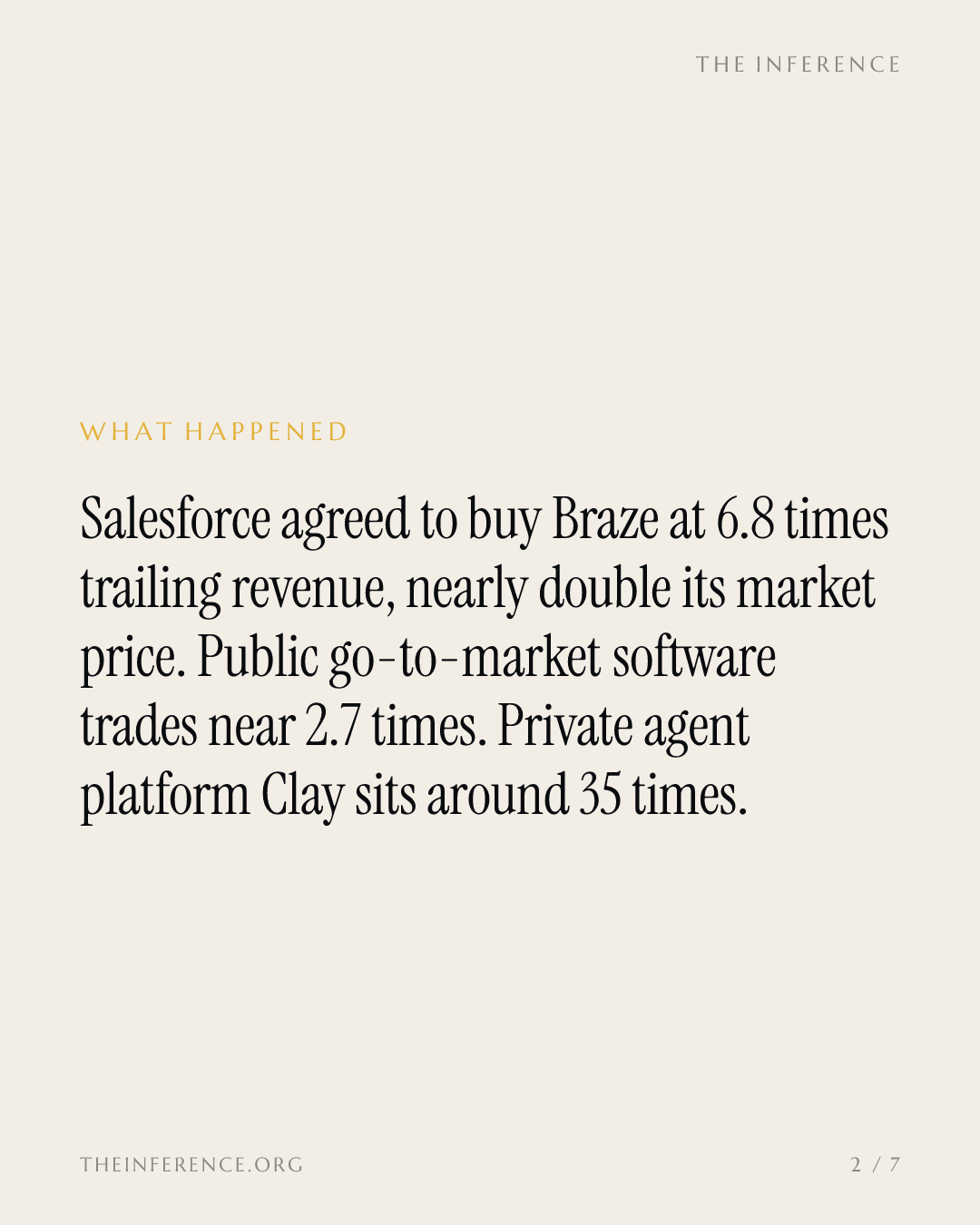
The new reading of the Braze−0.22% — Braze, down 0.22 percent as of its last quote deal is a spread, not a price. SaaStr, the B2B software community and blog run by Jason Lemkin, counted Salesforce's agreed price for Braze at 6.8 times trailing revenue on October 31, nearly double the 3.7x Braze traded at the day before the bid 2. Public go-to-market (GTM) software as a group trades near a 2.7x median 2.
Clay~$3.1B — Clay, private, latest valuation ~$3.1B, the New York agent platform, carries a private mark of roughly 35x 2. The bid itself landed October 20; this outlet priced it at 6.2x forward revenue on October 26 6. What is new since is the trailing count, and Clay's own answer to it.
The public market prices seats, and agents unmake seats
The multiple gap is billing, not product quality. Every AI agent makes API calls, stores data and generates logs, and Cloudflare−5.24% — Cloudflare, down 5.24 percent today, Datadog−8.19% — Datadog, down 8.19 percent as of its last quote and Snowflake−4.67% — Snowflake, down 4.67 percent today bill for all three on consumption; the GTM apps charge per seat or per contact, which an agent cuts. SaaStr runs its own company with three humans and more than 20 AI agents, most of which need no seat in a GTM tool 2. The public market is discounting revenue it expects agents to remove later.
Seat-priced GTM trades near 3x; the agent platform's private mark is 35x
- Estimate
Data
| Value | |
|---|---|
| ZoomInfo (ticker GTM) | 2 |
| HubSpot | 3.1 |
| Klaviyo | 3.1 |
| Braze at deal price | 6.8 |
| Clay (private) (estimate) | 35 |
Clay's 35x is a bet on billing by usage
The September round valued Clay at $7.1 billion 3, which our October 15 piece measured at about 71x the $100 million of annual recurring revenue TechCrunch reported in February. Chief executive Kareem Amin then told Reuters annualized revenue would reach about $200 million this quarter, which SaaStr counts as roughly 35x 2.
A cheaper row is the bet the 35x rides on
That is still ten times HubSpot's−0.59% — HubSpot, down 0.59 percent as of its last quote multiple, so the mark depends on the revenue model holding. Twilio+1.25% — Twilio, up 1.25 percent today, the one usage-billed company near GTM, charges per message and trades at 6.8x, the same multiple Salesforce−1.40% — Salesforce, down 1.40 percent today just paid 2. Clay moved onto that basis on October 27: per-row model routing is now the default for its Claygent research agent, so each row of a table runs on the cheapest model that meets a quality floor, which Clay says cut cost 47% on production traffic 4. A cheaper row makes always-on agent workflows affordable to run, and the bill scales with how much the agents do rather than with headcount.
The clearing buyer and the test to watch
Braze brings Salesforce about 2,770 enterprise customers and a 58.1% premium over the prior close 5, alongside the $3.6 billion Fin deal this year 1. Agentforce, Salesforce's own agent line, passed $1.5 billion in annual recurring revenue this quarter 5. SaaStr's argument for holders: at 2 to 3x revenue, an IPO rarely clears the private mark, so strategic acquirers and private equity become the main buyers 2.
That matters for Clay paper on both sides at once. Salesforce is the system of record Clay's customers keep 3, so the consolidator is distribution while it is not yet the bundle. The test that decides whether the 35x survives contact with the public market is disclosure: if Clay reports usage-priced revenue as its own line, attach rate and growth become checkable the way a bundled figure never was 3.
Get Applications by email, free
How AI is changing the software people and companies use. In our daily email, every weekday.