Goldman's fund desk is underweight the $420 billion AI debt wave Goldman itself forecasts
Goldman Sachs Asset Management is underweight hyperscaler bonds into a projected record $420 billion of 2027 supply, and the demand math is moving its way: cover ratios have fallen from five times to under two. JPMorgan's fund arm still says the market can absorb $1.5 trillion more.
 Vincent Jiang · 3 min read
The desk that stepped aside
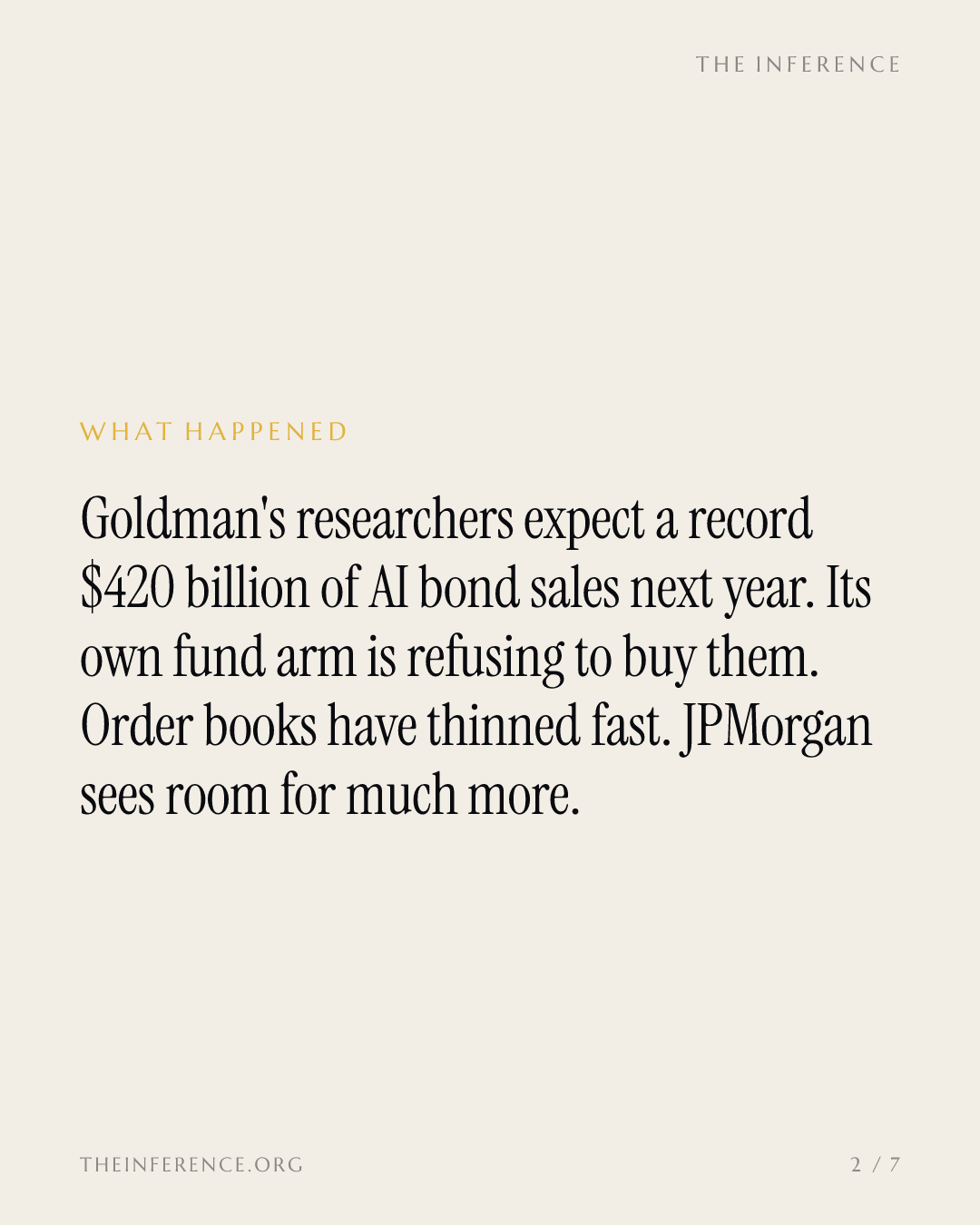
Lindsay Rosner, head of multi-sector fixed income investing at Goldman Sachs Asset Management, said the quiet part on television on September 24: "For that sector at large we are underweight knowing more issuance will come" 1. Goldman's researchers tally what is coming: a record $420 billion of hyperscaler bond sales in 2027, marked up from roughly $400 billion in July and 60% above this year's pace 23. One Goldman arm counts the wave. Another is declining to ride it.
The demand math moved first
This is not a default call. Portfolio managers are not worried the giants will fail to pay; the worry is the sheer volume and unpredictability of borrowing, and concentration 2. BlackRock's Russell Brownback describes some deals as double-A credits pricing closer to triple-B spreads, investors lending to highly rated companies at compensation normally paid to weaker borrowers 2.
Orders for new hyperscaler bonds fell from nearly five times deal size in February to below two in July, Apollo data show 3. Median new-issue concessions rose to 12 basis points this year from 2.25 in 2025 3. By late July, 78 of 91 hyperscaler bonds sold in 2026 were trading wider than they priced 3. AI issuers pay about 115 basis points over risk-free rates, against 78 for the wider investment-grade market 2.
Buyers of AI debt now demand a bigger premium on both measures
Data
| Basis points | |
|---|---|
| New-issue concession, 2025 | 2.25 bp |
| New-issue concession, 2026 | 12 bp |
| Wider IG spread, now | 78 bp |
| AI issuer spread, now | 115 bp |
The tally keeps outrunning the forecast
Goldman's own tally keeps climbing. AI-related borrowing has already reached $489 billion this year, against the $322 billion the bank forecast 4. Morgan Stanley sees nearly $570 billion for the full year 45. Gross leverage has doubled to about 1.8x in six months, with some $3 trillion of lease and purchase commitments off balance sheet 4.
AI borrowing outran the forecasts that framed it
- AI-related debt issuance, 2026
- Estimate
Data
| AI-related debt issuance, 2026 | |
|---|---|
| Goldman 2025 forecast (estimate) | $322B |
| Sold, Jan-Oct 2026 | $489B |
| Morgan Stanley FY26 forecast (estimate) | $570B |
The buyers of last resort
JPMorgan Asset Management's Stephanie Aliaga sits on the other side. The six largest hyperscalers could raise another $1.5 trillion, she says; their debt burden is well below the market average, and the top three are signing client contracts faster than they spend 6. Her math holds so far, with 2026 hyperscaler capex of about $750 billion still inside roughly $778 billion of operating cash flow 3.
The ECB's objection is for everyone else. US big tech is already just shy of 10% of this year's euro bond issuance by non-financial companies, and its borrowing could raise financing costs for issuers in unrelated sectors 7.
The Fed cannot referee this
Goldman vice chairman Rob Kaplan, on the bank's own podcast, notes the AI boom "is being done with debt and in some cases equity along the yield curve," borrowing a policy rate sitting at 3.75 to 4% never touches. He expects one more increase, to 4 or 4.25%, then a pause 8. Tightening lands on the lenders, not the builders.
The break-even revenue has not arrived
The strain lands on revenue that has not arrived. Goldman's break-even math wants roughly $300 billion of annual AI revenue; cloud sales are running about $70 billion above the pre-AI trend 9. The next marker is the FOMC on October 28, with the heaviest issuance still to be priced 10. Until then, an underweight looks like what Thornburg's Lon Erickson describes: skip the new issues, hold cash, buy wider later 2. What the bank's underwriters earn selling the wave is broken out nowhere; that is the one number Goldman does not publish.
Deepdive
AI-generated from this story and its cited sources. Not investment advice.