Goldman Sachs is short DocuSign, growing 9% a year near 42 times earnings; December 3 earnings settle it
Goldman's new Anti-AI Replacement basket shorts DocuSign as seat-priced software agents will rebuild; DocuSign prices its growth engine per agreement and opens its platform to every agent. The December 3 earnings print shows which of them is right.
 Richard Tang · 3 min read
Goldman Sachs−1.40% — Goldman Sachs, down 1.40 percent today has picked a side on DocuSign+0.97% — DocuSign, up 0.97 percent today, and the December 3 earnings print picks the other 1. On October 20 the bank launched an "Anti-AI Replacement" basket: long the companies selling to AI, including Cloudflare+7.99% — Cloudflare, up 7.99 percent today, CrowdStrike+8.33% — CrowdStrike, up 8.33 percent today, Palantir+0.40% — Palantir, up 0.40 percent today, Oracle+0.29% — Oracle, up 0.29 percent today and Microsoft+0.64% — Microsoft, up 0.64 percent today; short the seat-priced workflow software agents may automate or rebuild, with DocuSign named alongside Salesforce−0.84% — Salesforce, down 0.84 percent today, Monday.com, Accenture−3.82% — Accenture, down 3.82 percent today and ServiceNow+1.27% — ServiceNow, up 1.27 percent today 1. Two days later the stock set a 52-week high of $81.90 2.
Either Goldman is wrong that agents shrink DocuSign's fee base, or the market is wrong to pay a growth price for a 9% grower, and the next quarterly report decides which.
The bear case is priced in, and it is the arithmetic
The bet Goldman is pressing is the bear case everyone knows: a company growing revenue about 9% a year, priced near 42 times trailing earnings by one tally and 45 times by another, with the average analyst target below the price 34. Zacks' average of 15 analysts' targets stands at $71.00, 4.89% below the October 16 close 4.
Meanwhile the AI story is still a slice of the income statement: Intelligent Agreement Management, the platform that charges per agreement volume instead of per seat, grew from 12.6% to 15.1% of recurring revenue in the September quarter, with more than 300 million documents loaded 3.
IAM's slice is climbing fast, but total growth is still about 9%
Data
| Value | |
|---|---|
| IAM share, prior quarter | 12.6 |
| IAM share, latest quarter | 15.1 |
| Total revenue growth | 9 |
DocuSign is selling the agent layer, not fighting it
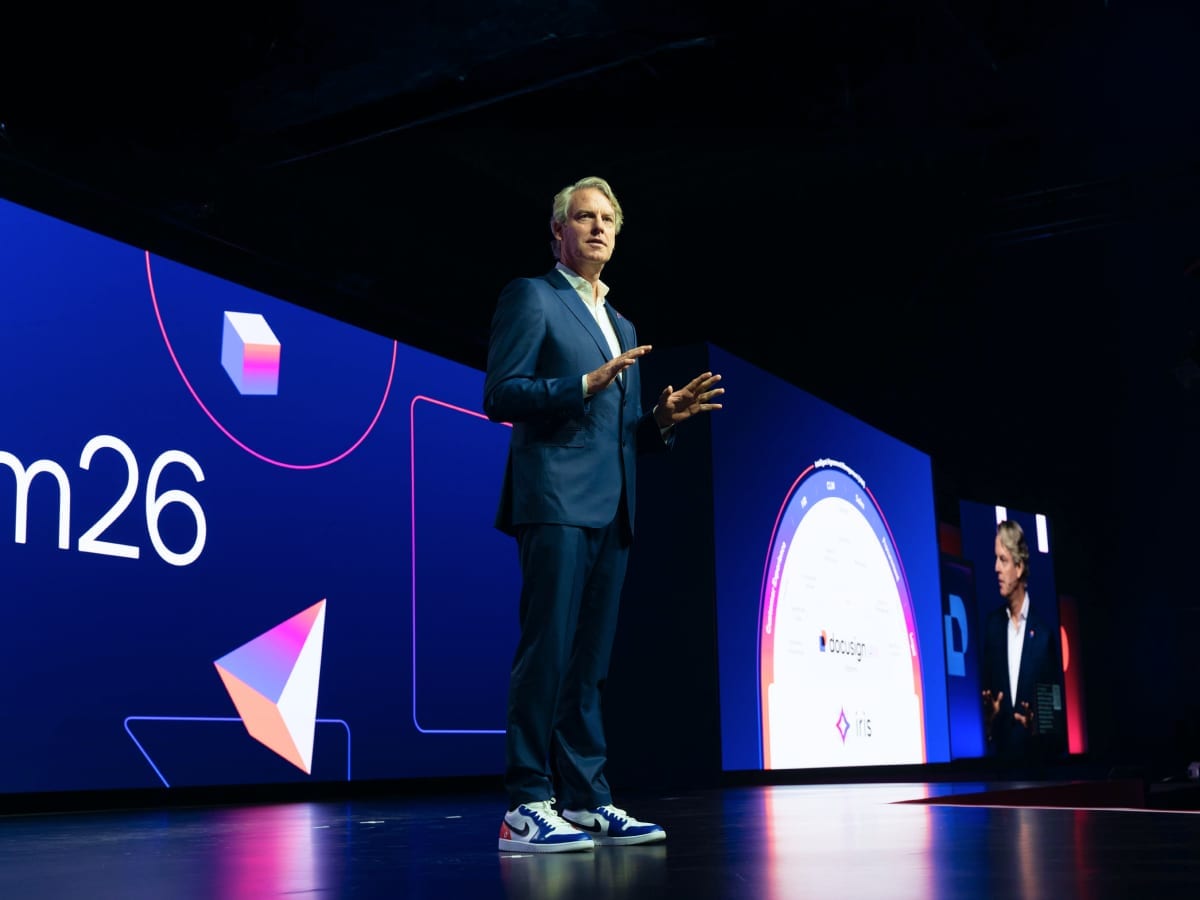
DocuSign's answer is that agents do not kill the agreement layer, they feed it. It embedded IAM natively into Salesforce, Agentforce and Slack in mid-October 5, won a second straight Inc. Power Partner award while touting its Iris AI engine for agreements 6, and reports partnerships with OpenAI$500B — OpenAI, private, latest valuation $500B and Anthropic$350B — Anthropic, private, latest valuation $350B. Its Model Context Protocol server, an open interface any AI agent can call, is generally available, and connectors let business owners work agreements from ChatGPT and Claude 6. If agents multiply agreements, a per-agreement fee collects on each one.
The judgment benchmark is both shield and clock
The evidence on agent judgment, though, says not yet. Ivo, a contract-technology company, and micro1, a data lab, tested seven leading AI models on 350 real-world contract-review tasks: the best scored 58.3%, and the strongest finisher among the leaders completed just 80.8% of its rollouts 7. Agents cannot yet do the judgment work DocuSign sells, so the per-agreement fee can survive; the same benchmark is the clock on when it cannot.
What December 3 decides
Watch the December 3 print 4 for one thing: whether IAM's share of recurring revenue keeps climbing while total growth inflects toward double digits. If it does, the agent layer is real and Goldman's short leg bleeds. If it does not, a premium price gets repriced to the 9% business it still is 3.
Get Applications by email, free
How AI is changing the software people and companies use. In our daily email, every weekday.