Spotify jumped 11.1% betting agents cannot cancel it; December's bar is 10 million net additions
Spotify rebuilt itself as an agent Muse, ChatGPT and Claude can talk to, keeping playback and data in-house; LightShed's Rich Greenfield posed the churn case on the same call. The December quarter, the first full one under the price rises behind a 9.3% ARPU gain, settles which camp priced the stock right.
 Vincent Jiang · 3 min read
Spotify+0.04% — Spotify, up 0.04 percent today used its October 22 earnings call to declare an answer to the AI-agent wave: the service has been rebuilt as an agent itself, one that Meta's−1.36% — Meta, down 1.36 percent today Muse, OpenAI's$1.18T — OpenAI, private, latest valuation $1.18T ChatGPT and Anthropic's$350B — Anthropic, private, latest valuation $350B Claude can talk to, while playback, recommendations and user data stay on Spotify's own servers 12.
The mechanics are concrete. A Muse user can ask for a running playlist built on Spotify's record of their listening history; a ChatGPT user can ask an agent to assemble a personalised AI podcast, summarizing exam notes or the day's news, and have it filed straight into their Spotify library 2. In every case the third-party assistant sends the request in and Spotify's own systems "do the reasoning over everything we know about you and then decide what to play" 2.
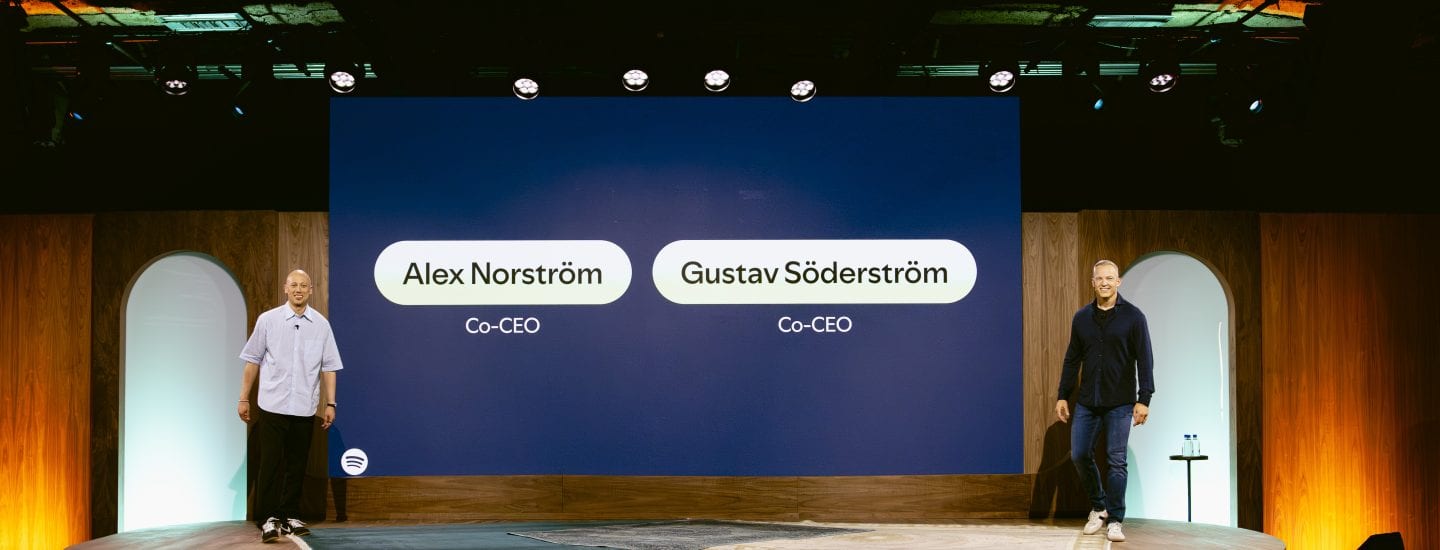
Co-CEO Gustav Söderström called the result a tailwind and a "positive data loop": Spotify learns things about listeners it would not otherwise have known, and no music, data or customer relationship leaves the building 12. The market bought the story on a hard day for AI-linked stocks: the shares jumped 11.1% to $583.66 on the print, on a day the Nasdaq fell 2.6% 4.
The counterparty sat on the same call
LightShed's Rich Greenfield pressed the opposite case to Söderström's face: agents that own the interface can compare subscription prices, switch services seamlessly or cancel the ones that go unused, reducing Spotify to a licensed-catalog pipe with the agent holding the customer and the data 1. What Spotify would lose in that world is specific: pricing power, since the agent shops on price; the direct data loop the company is betting on; and the margin structure Premium funds.
Söderström's reply was a bet, not a rebuttal: Spotify will never bet on breakage or on subscribers forgetting their subscriptions, and it will be "the last thing that you unsubscribe from" 1.
What the December quarter has to carry
That bet is load-bearing right now. Average revenue per subscriber rose 9.3% to €4.95 on price increases, and the December quarter is the first full one under those higher prices 4. Management guided to about 10 million net additions, 316 million paying subscribers and €5.2 billion of revenue, on Premium revenue that grew 17% to €4.49 billion against ads up 10% to €482 million 34.
If agents arbitrage subscriptions, the ARPU gain and that guide carry the churn risk first, and family plans sit at the sharp end: the household QR checks reported earlier this month raise the same who-is-still-listening question inside the home that a price-comparing agent raises outside it. Amazon's refusal to let Muse shop its platform−0.72% — Amazon's refusal to let Muse shop its platform, down 0.72 percent today shows the counter-move exists, and that platforms with something to lose are already deploying it 2.
Inside Spotify's walls, the machine already chooses
The shift agents would complete outside Spotify is already running inside it. Editorial playlist listening slipped in Q3, while nearly 40 million Premium users now listen to algorithmically mixed playlists, consumption up 90% quarter over quarter 3. Headline growth remained solid across the reported lines, with human curation the one number moving backwards.
Every Spotify Q3 growth line ran 9 to 17 percent, all on the back of a 9.3 percent price rise
Data
| Value | |
|---|---|
| Premium revenue | 17% |
| Total revenue | 16% |
| Operating income | 15% |
| MAUs | 11% |
| Ad revenue | 10% |
| ARPU | 9.3% |
| Paid subscribers | 9% |
The fork in December
Watch the December-quarter print against the 10 million net-add guide 4: additions against 10 million, ARPU against €4.95, and any first disclosure of agent-originated listening. The 10-million guide is the churn bar, €4.95 is the ARPU bar 4. If subscribers stay, Spotify keeps its pricing power and the agent channel becomes its next growth line. If agents start switching families between services, Greenfield priced SPOT right, and management's tailwind means churn arriving through the very channel the company called a growth line.
Get Applications by email, free
How AI is changing the software people and companies use. In our daily email, every weekday.