AppLovin's Axon now takes 53% of iOS ad revenue while the stock sits at a 52-week low
Tenjin's Q3 benchmark gives AppLovin's bulls their best exhibit yet: 53% of iOS ad revenue and first place on Android, while the stock sits at a 52-week low. Investors must decide before the November 16 class-action deadline and the Q3 print whether Axon's growth is self-learning or engineer-directed.
 Richard Tang · 3 min read
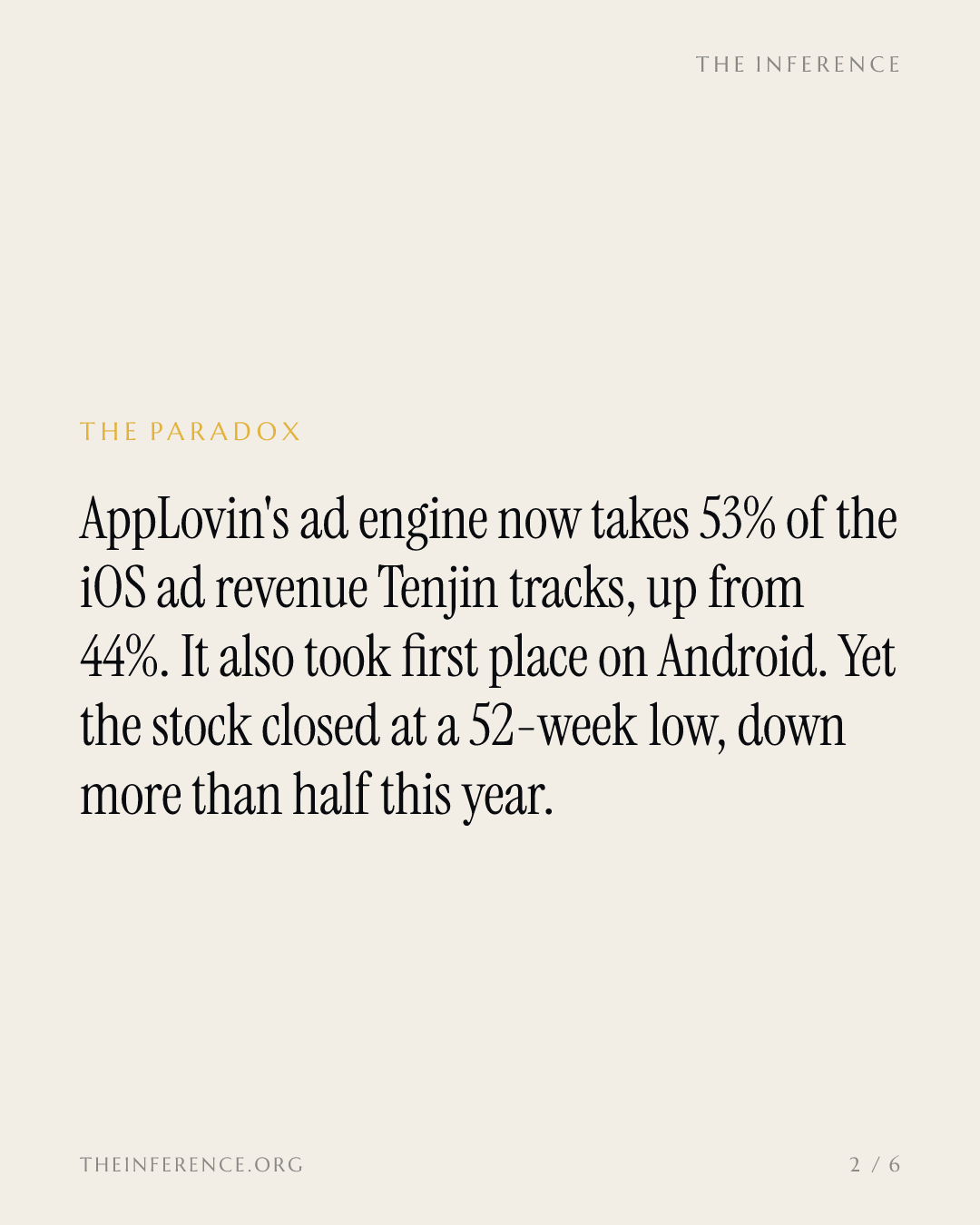
AppLovin−1.54% — AppLovin, down 1.54 percent today now takes more than half of the iOS ad revenue measured by analytics firm Tenjin, and it just took first place on Android too. The stock closed at a 52-week low of $260.50 on October 23 3, down more than half this year 1. The market is not disputing the share gains; it is disputing the growth machine behind them, and with a November 16 class-action deadline and a Q3 print ahead, that question has to be answered now 31.
The machine works; the belief in it does not
Here is the chain. AppLovin's AI recommendation system, Axon+1.78% — Axon, up 1.78 percent today, decides which ad each user sees. Better ad-to-user matching raises advertisers' return on spend, so they shift budgets onto the platform; in June 2026 AppLovin opened that platform to all advertisers under the AppLovin Ads name 1.
Tenjin's Q3 benchmark, published October 24, is the first third-party check since that launch, and it shows the machine working: 53% of iOS ad revenue in its dataset, up from 44%, and the top Android position at 29% 1. That matters for app developers and marketers, because one company now sets the effective price of reaching users at scale on both platforms.
The P&L agrees with the share data. Revenue grew from $835 million in the third quarter of 2024 to $1.92 billion in the second quarter of 2026, at an 84% adjusted EBITDA margin 14.
AppLovin's revenue has more than doubled in two years
Data
| Revenue ($B) | |
|---|---|
| Q3 '24 | 0.84 |
| Q4 '24 | 1 |
| Q1 '25 | 1.16 |
| Q2 '25 | 1.26 |
| Q3 '25 | 1.41 |
| Q4 '25 | 1.66 |
| Q1 '26 | 1.84 |
| Q2 '26 | 1.92 |
What the market refuses to believe
The class action, with its lead-plaintiff deadline on November 16, is about the link above the model: whether Axon largely improves itself 2. We reported the quotes at the center of that suit when it surfaced 2; what is new since is Tenjin's print, six firms cutting price targets between October 8 and October 19, and the deadline itself. In May, CEO Adam Foroughi called a new model's uplift "quite substantial" and pointed to a "big acceleration" 2. In August, management said the pace of meaningful model improvement was lighter than normal 2.
A downgrade, a cheap multiple and a test in the guidance
Bank of America's−0.88% — Bank of America, down 0.88 percent today downgrade argues growth is engineer-directed, not self-learning 1. A flywheel that needs engineers is still a good business, and it is priced like one, at about 15 times forward earnings against a five-year average near 26 1. Q3 guidance of $2.055 to $2.085 billion in revenue will show which story holds 1.
The position, plainly: the share data and the P&L make AppLovin a strong business at a discounted price, and the lawsuit attacks the flywheel claim, not the machine's output. The engineers, not self-learning, now carry the burden of proof. Tenjin itself cautions its shares describe its dataset, not the whole market 1.
Get Applications by email, free
How AI is changing the software people and companies use. In our daily email, every weekday.