Google books Blue Origin's New Glenn for 2029 launch of its orbital AI satellites
Google's binding constraint is electricity, and the moonshot answer is a rack-per-satellite constellation on a rented rocket. For Alphabet shareholders it is a marker on the cost of compute, not an earnings event.
 Vincent Jiangthree-minute read
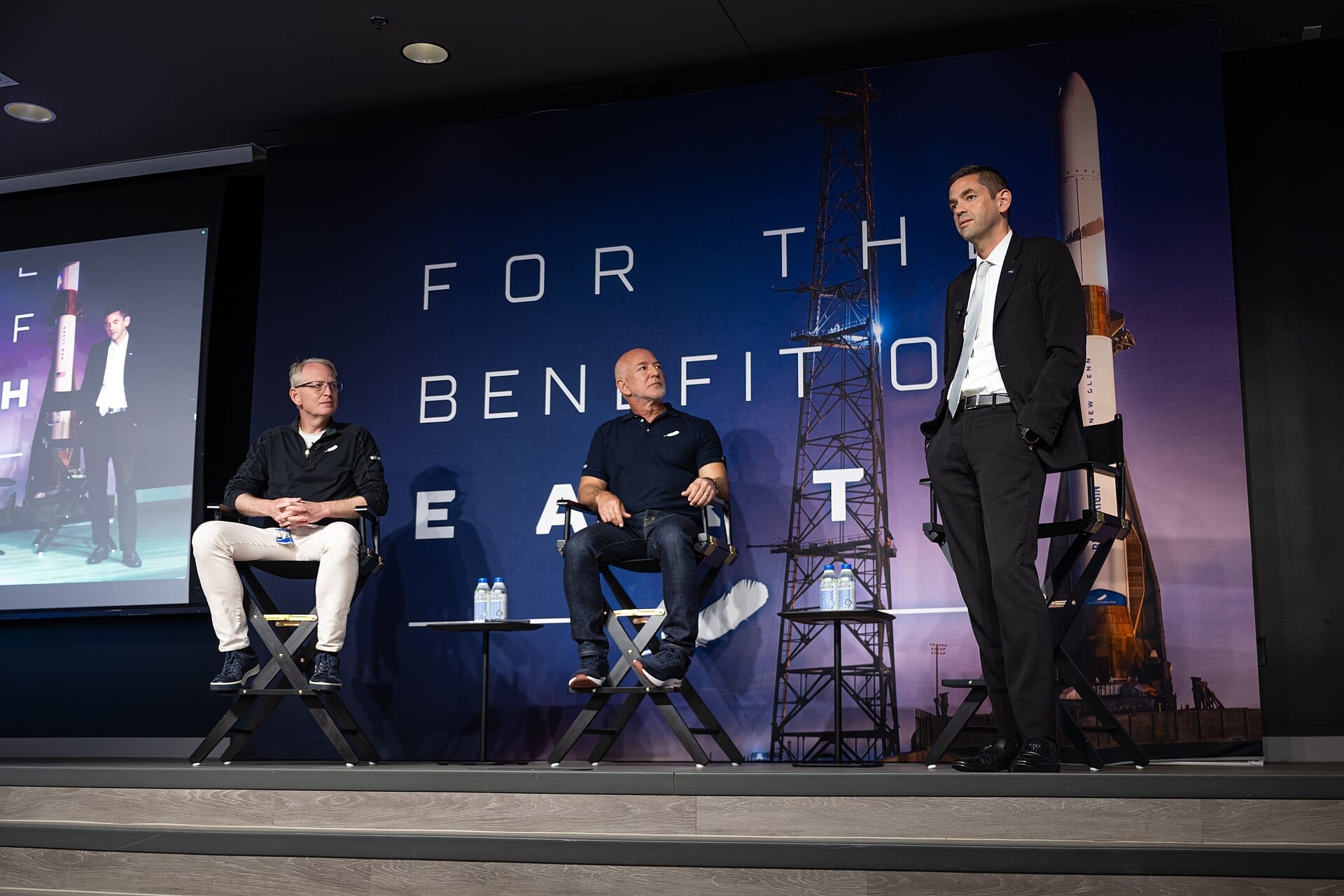
Google has booked Jeff Bezos' Blue Origin to fly its AI compute into orbit. Under an agreement announced November 19, 2026, a New Glenn rocket will carry Project Suncatcher satellites into sun-synchronous orbit in the first quarter of 2029, each holding Google's−1.04% — Google, down 1.04 percent today Tensor Processing Unit chips with roughly the computing capacity of a data-center rack 12. It is Google's first dedicated heavy-lift launch for the project. 12
Electricity is the binding constraint
Data-center electricity demand rose 17 percent in 2025 and doubles to 1,000 terawatt-hours by 2030, the International Energy Agency said on November 19; planned capacity in Northern Virginia and Texas already far exceeds what those grids can support. 3 Alphabet has answered with capital: $51.4 billion of capex in the third quarter of 2026, up 114 percent in a year, almost $160 billion across four quarters. 4
Alphabet's quarterly capex has almost quadrupled in two years
The ground buildout Suncatcher relieves now runs near $51 billion a quarter
Data
| Quarterly capex | |
|---|---|
| Q2 '24 | $13.19B |
| Q3 '24 | $13.06B |
| Q4 '24 | $14.28B |
| Q1 '25 | $17.2B |
| Q2 '25 | $22.45B |
| Q3 '25 | $23.95B |
| Q4 '25 | $27.85B |
| Q1 '26 | $35.67B |
| Q2 '26 | $44.92B |
| Q3 '26 | $51.36B |
Alphabet's capex has outrun its operating cash flow for two quarters
- Operating cash flow
- Capex
Data
| Operating cash flow | Capex | |
|---|---|---|
| Q4 '24 | $39.11B | $14.28B |
| Q1 '25 | $36.15B | $17.2B |
| Q2 '25 | $27.75B | $22.45B |
| Q3 '25 | $48.41B | $23.95B |
| Q4 '25 | $52.4B | $27.85B |
| Q1 '26 | $45.79B | $35.67B |
| Q2 '26 | $39.07B | $44.92B |
| Q3 '26 | $42.29B | $51.36B |
Orbit is the escape hatch. Google claims a panel in low-Earth orbit makes up to eight times the energy of the same panel on the ground, a figure one analysis cuts to five; on Earth, at least 75 data-center projects worth about $130 billion were blocked or delayed in the first quarter of 2026 alone. 5
A grounded rocket, sold by a rival
New Glenn has flown three times, none since a static-fire explosion on May 28, 2026, wrecked its only launch pad 678. Return to flight has slipped to January 2027, past the November target the company was still quoting in late October. 678 Google booked the rocket anyway. The alternatives are worse.
A $200-per-kilogram launch cost, Google's target for the mid-2030s, likely requires an optimized SpaceX−6.35% — SpaceX, down 6.35 percent today Starship, and SpaceX is reserving Starship for its own Starmind orbital data centers. 6 The same week, lenders on SpaceX's $43 billion Project Saturn debt package were reported seeking safeguards to keep the Nvidia−10.86% — Nvidia, down 10.86 percent today chips securing the loans out of orbit. 9
Blue Origin is no neutral vendor either: it reported a $10 billion first outside funding round in July 2026 at a $130 billion pre-money valuation, and it plans its own orbital constellation, Project Sunrise. 510 Google has rented a ride to orbit from a company building the same thing. 6
A cheap option, and what decides it
The skeptical case is real. The first Suncatcher prototype, launched in October 2026 with Planet Labs on a SpaceX rocket, has run one early model test in orbit; a two-satellite link follows in 2027. 211 Almost everyone agrees orbital data centers lose to ground-based ones without launch costs that do not yet exist. 6 One booked launch is cheap optionality.
Three ways out: hope Rocket Lab, Relativity or Stoke builds a bigger rocket and stays out of orbital compute; buy a launch company; or start building engines a quarter-century behind. 6 January's return to flight shows whether the rocket exists. The next Suncatcher order, or an acquisition, shows whether Google keeps renting.
Get Data Center by email, free
Who is building AI's data centers, and who is paying for them. In our daily email, every weekday.

Reader comments
0 comments