Infineon is inside Nvidia's 800-volt AI racks and Enphase's 900-volt transformers; Nov. 10 decides the margin
Infineon's GaN power chips are now named into Nvidia's 800V racks and Enphase's AI transformers, but the November 10 results decide whether that design slot is profit or just revenue.
 Richard Tang · 2 min read

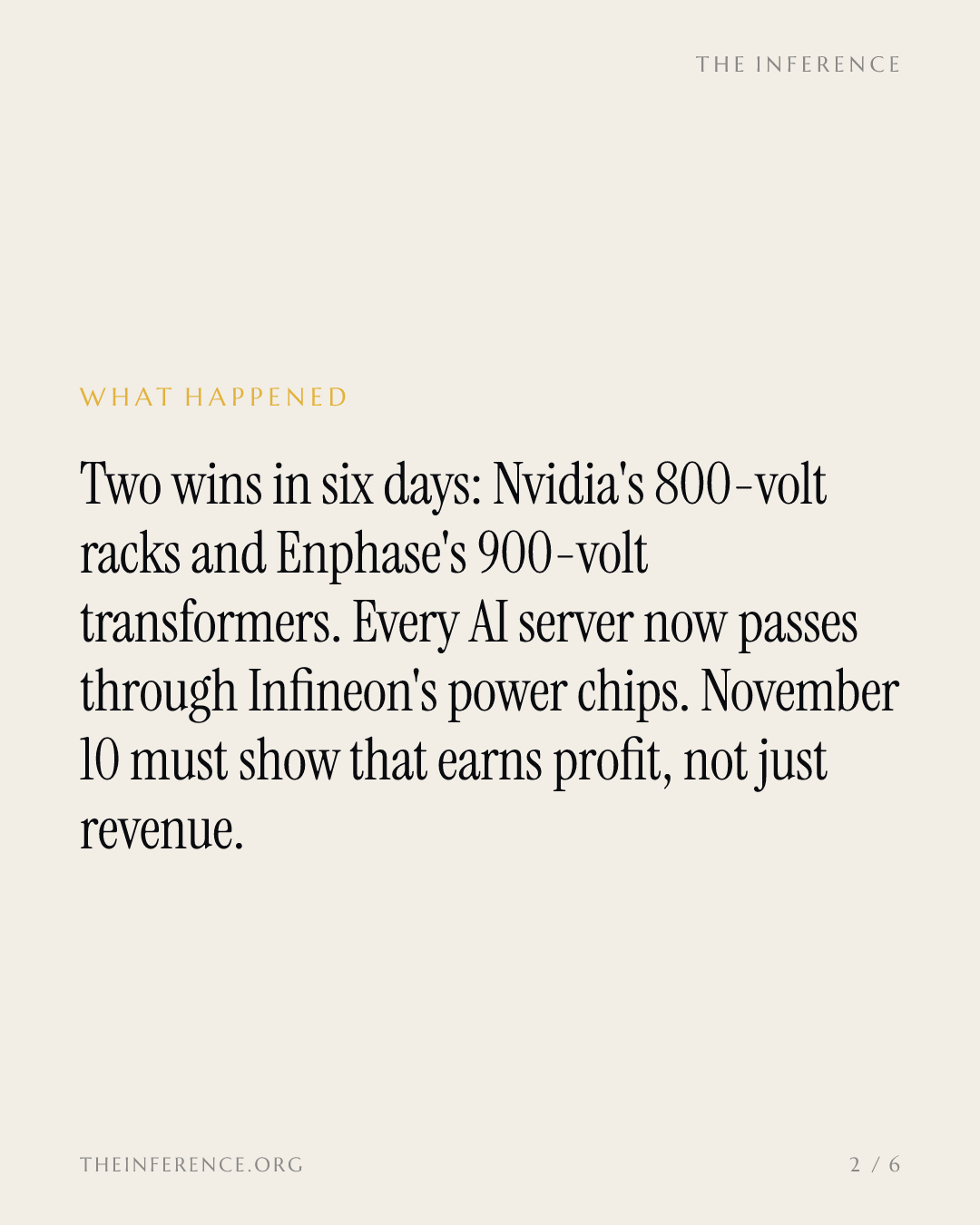
Infineon landed two named AI-power customers in six days, and on November 10 it has to show what that power earns. On October 21 the German chipmaker said it will supply gallium nitride chips for Nvidia's 800-volt DC datacenter racks, and today Enphase named Infineon's world-first 900V GaN bidirectional switches for its AI-datacenter solid-state transformers. The world's largest power-chip maker is no longer selling components into AI; it is being designed into the power architecture itself.
The Nvidia slot deepens
Nvidia+2.46% — Nvidia, up 2.46 percent today is rebuilding the datacenter from AC to 800V DC delivery, because a megawatt rack loses too much power and copper on the old approach 1. Infineon's chips sit in the intermediate bus converters that step 800V down to the 50, 12 and 6 volts boards use, switching up to 1MHz so transformers and inductors shrink and more compute fits the same rack 1.
A year ago Infineon supplied the rack protection circuits; now it owns a conversion layer every AI server passes through. That is a compounding position, not a one-off order. Enphase−3.96% — Enphase, down 3.96 percent today extends the same GaN line to 900V, keeping components under 1kV while cutting the number of converters in the power path 2. Behind both customers sits supply: a multi-year 200mm SiC wafer deal with Wolfspeed, extending a 20-year relationship 5.
The tailwind is priced, the profit is not
Analyst houses see power devices, the chips that convert and condition all this electricity, growing steadily through 2031, with wide-bandgap SiC and GaN designs doubling their share of market value to 31% 6. Chinese suppliers such as TanKeBlue are meanwhile raising billions to scale 6. The tailwind is real.
Analysts see the power device market growing well past $40 billion
- Estimate
Data
| Value | |
|---|---|
| Yole Group, by 2031 (estimate) | $41.3B |
| Mordor Intelligence, by 2031 (estimate) | $43.6B |
| IDTechEx, ten-year horizon (estimate) | $56.2B |
But the market has priced Infineon's story, not its profit: AI-server revenue is projected at roughly EUR 1.5 billion in 2026, growing over 100%, while shares fell 3.1% this month on doubts about how customers' capex is financed 34. The valuation already demands a large earnings jump through 2027 3.
November 10 referees
Everyone can name the customers now. The November 10 print has to answer the harder question, whether AI power is margin or marketing. Watch it, because whoever turns AI's power problem into profitable silicon is doing the work that makes the whole buildout run.
Get Chips by email, free
How AI demand is reshaping chipmakers, memory and the fabs behind them. In our daily email, every weekday.

More about NVIDIA
NVDA · Fiscal Q2 2027Revenue rose 106% to $96.2B, 92.5% of it from Data Center, “driven by the ramp of our Blackwell Ultra infrastructure”. Gains on equity stakes of $7.8B lifted net income to $59.7B.
Show as a table
| Line | Value |
|---|---|
| Revenue | $96.2B |
| Gross margin | 75.0% |
| Operating margin | 66.2% |
| Net income | $59.7B |
| Hyperscale | $48.7B |
| AI clouds & enterprise | $40.3B |
| Data Center | $89.0B |
| Edge Computing | $7.2B |
| Gross profit | $72.1B |
| Cost of revenue | $24.1B |
| Other income | $7.8B |
| Operating income | $63.7B |
| Operating expenses | $8.4B |
| Tax | $11.8B |
| R&D | $7.1B |
| SG&A | $1.4B |