Intel down 25% premarket on a weak PC guide; its filing books $23 billion of stock and demand it cannot fill
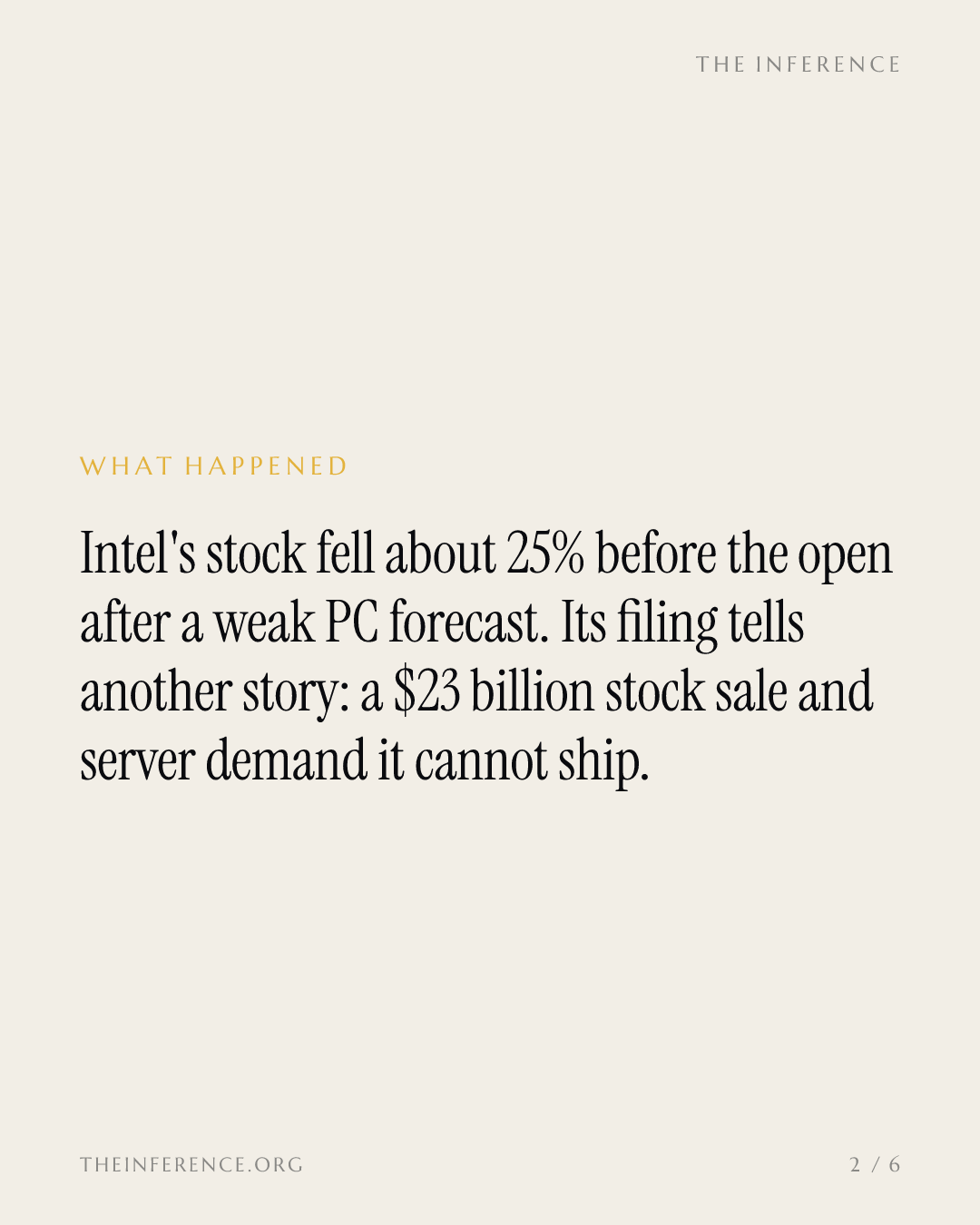
The market read October 29's print as a PC trough and marked Intel down about a quarter. The filing Intel sent the SEC that night books a completed $23 billion stock sale, a server business that cannot ship enough, and a 2027 of heavy spending with no positive free cash flow.
 Richard Tang · 3 min read

Intel−28.04% — Intel, down 28.04 percent today lost more than a fifth of its value after the bell on October 29 on a weak December guide, and the reason given everywhere was the PC 2. The company guided fourth-quarter revenue to $15 billion to $16 billion against a consensus of $17.1 billion 7. By October 30 the stock was quoted down about 25 percent in premarket trading 39.
Consensus wanted $17.1 billion; Intel guided $15–16 billion
- Revenue
- Estimate
Data
| Revenue | |
|---|---|
| Q2 '26 actual | $16.13B |
| Q4 '26 guide (estimate) | $15.5B ($15–16B) |
| Q4 '26 consensus (estimate) | $17.1B |
The 8-K, the earnings filing Intel sent the SEC that night, describes a different company 1. It books a completed $23 billion stock sale, a server business growing 78 percent that chief executive Lip-Bu Tan says he could not supply, and a 2027 that management calls an investment year with no positive free cash flow 14. The after-hours move priced weaker PC demand. The filing describes a company that cannot build capacity fast enough for the demand it already has.
The bottleneck has moved from demand to wafers
Agentic AI systems, in finance chief David Zinsner's words, are moving beyond prompt-based responses toward multi-step reasoning, orchestration and autonomous action, and that coordination runs on CPUs alongside the GPUs 4. Tan's own estimate, offered on the call, is a server CPU market heading toward more than $200 billion within five years, largely on agentic workloads 4.
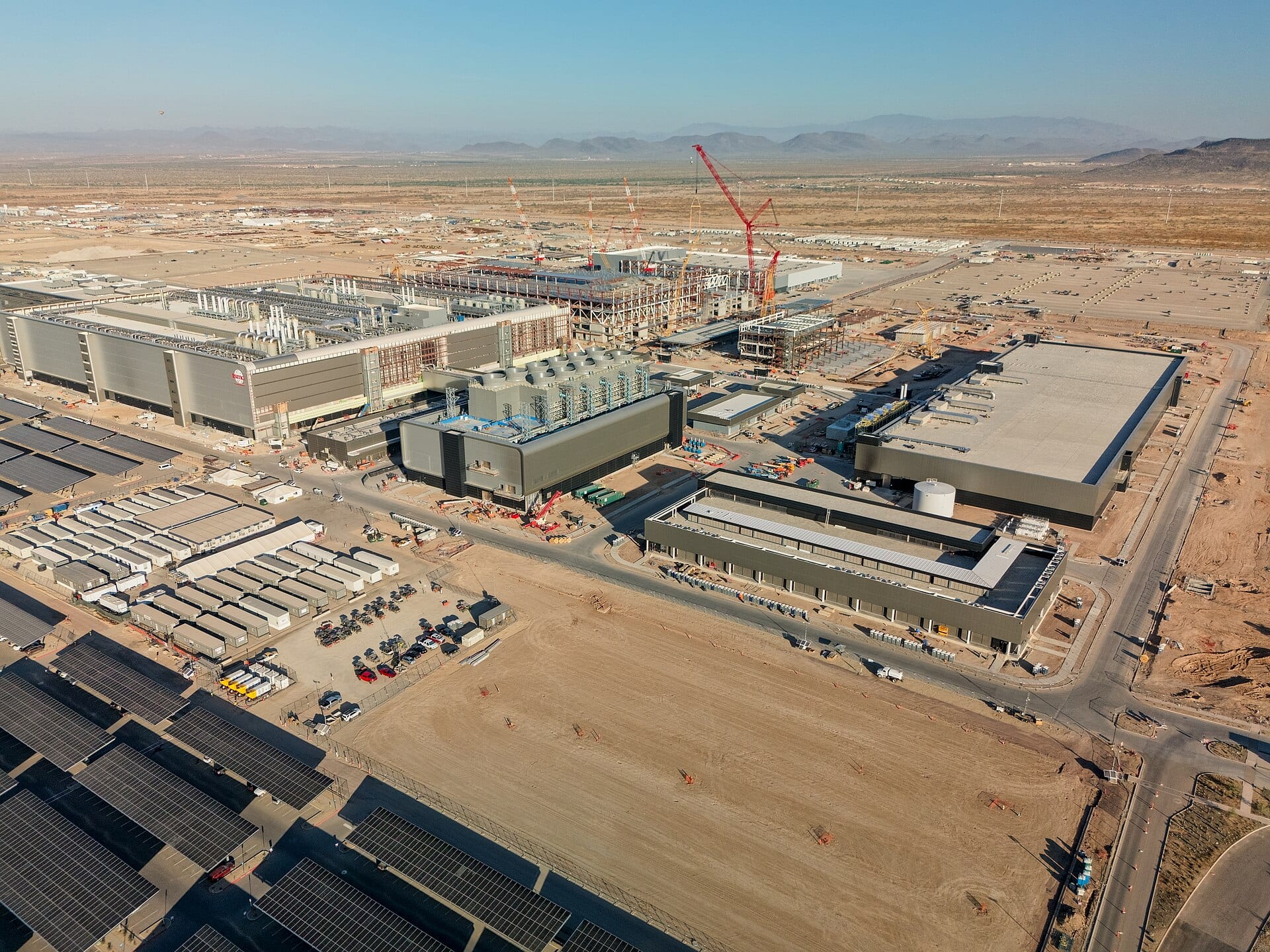
The constraints he named are physical: wafer output on Intel 3, the company's current chip-manufacturing process, an industry-wide shortage of the advanced substrates its chip packaging needs, and the two-week shutdown of Fab 28, its plant in Israel 4.
The PC business is genuinely weaker, and the call carries the mechanism: memory prices and availability have pushed system prices up, so customers are cutting weeks of inventory 4. It is the half of the company that is not sold out.
The build eats the cash before the wafers ship
Meeting the server demand is a construction project, and it is funded. Intel priced the August offering at $95 a share 5; the filing books the completed deal at $23 billion 1.
Zinsner reaffirmed $20 billion of capital spending for this year and said 2027 spending rises strongly, with firm purchase orders to equipment suppliers up almost 40 percent in the quarter 4.
The demand side has named buyers. The filing announces a multiyear Oracle−4.82% — Oracle, down 4.82 percent today collaboration to expand Xeon computing on Oracle Cloud Infrastructure, including planned X14 offerings powered by Diamond Rapids, its next-generation server processor, and new facilities with the chip-equipment makers Lam Research−5.11% — Lam Research, down 5.11 percent today and Applied Materials−6.00% — Applied Materials, down 6.00 percent today 1. At the October 30 quote, August's buyers at $95 were roughly a quarter under water 3.
After two years of cuts, Intel's capital spending turned back up
- Capital spending
- Cash from operations
Data
| Capital spending | Cash from operations | |
|---|---|---|
| Q4 '24 | $5.83B | $3.17B |
| Q1 '25 | $5.18B | $0.81B |
| Q2 '25 | $3.55B | $2.05B |
| Q3 '25 | $2.43B | $2.55B |
| Q4 '25 | $3.49B | $4.29B |
| Q1 '26 | $3.64B | $1.1B |
| Q2 '26 | $2.56B | $7.01B |
| Q3 '26 | — | $5.08B |
The bet resolves in late 2027
Even the supply Intel has secured arrives late. About 40 percent more substrate capacity mostly lands in the second half of 2027, and the added Intel 3 capacity in Oregon comes after that 4. Fab 28 shows what a missing plant costs: roughly $600 million of revenue across two quarters, nearly all of it 10-nanometer server product, which Intel's other factories cannot fully replace 46.
PC weakness is real and runs at least into the first half of 2027 2. That is not the decision the drawdown asks. The filing's question is whether a server business whose demand, in Intel's words, meaningfully exceeds its supply, in a market growing more than 30 percent in units next year, is worth a year of no positive free cash flow 4.
Suppliers get paid first, shareholders last
In the sequence the filing and the call describe, the equipment suppliers are paid first 14, management says the debt still comes down in 2027 4, and the shareholders, August's buyers included, collect last.
Get Chips by email, free
How AI demand is reshaping chipmakers, memory and the fabs behind them. In our daily email, every weekday.