Intel's $20 billion stock sale at $95, first since 1971, left buyers underwater before the October 29 report
Intel raised $20 billion at $95 a share in August, its first public sale since 1971, and closed October 23 at $86.96, leaving the chief executive's own purchase about $846,000 underwater. Thursday's third-quarter report must set 2027 capital spending, and no 14A customer has published an order.
 Vincent Jiangthree-minute read
The chief executive bought at the offering price
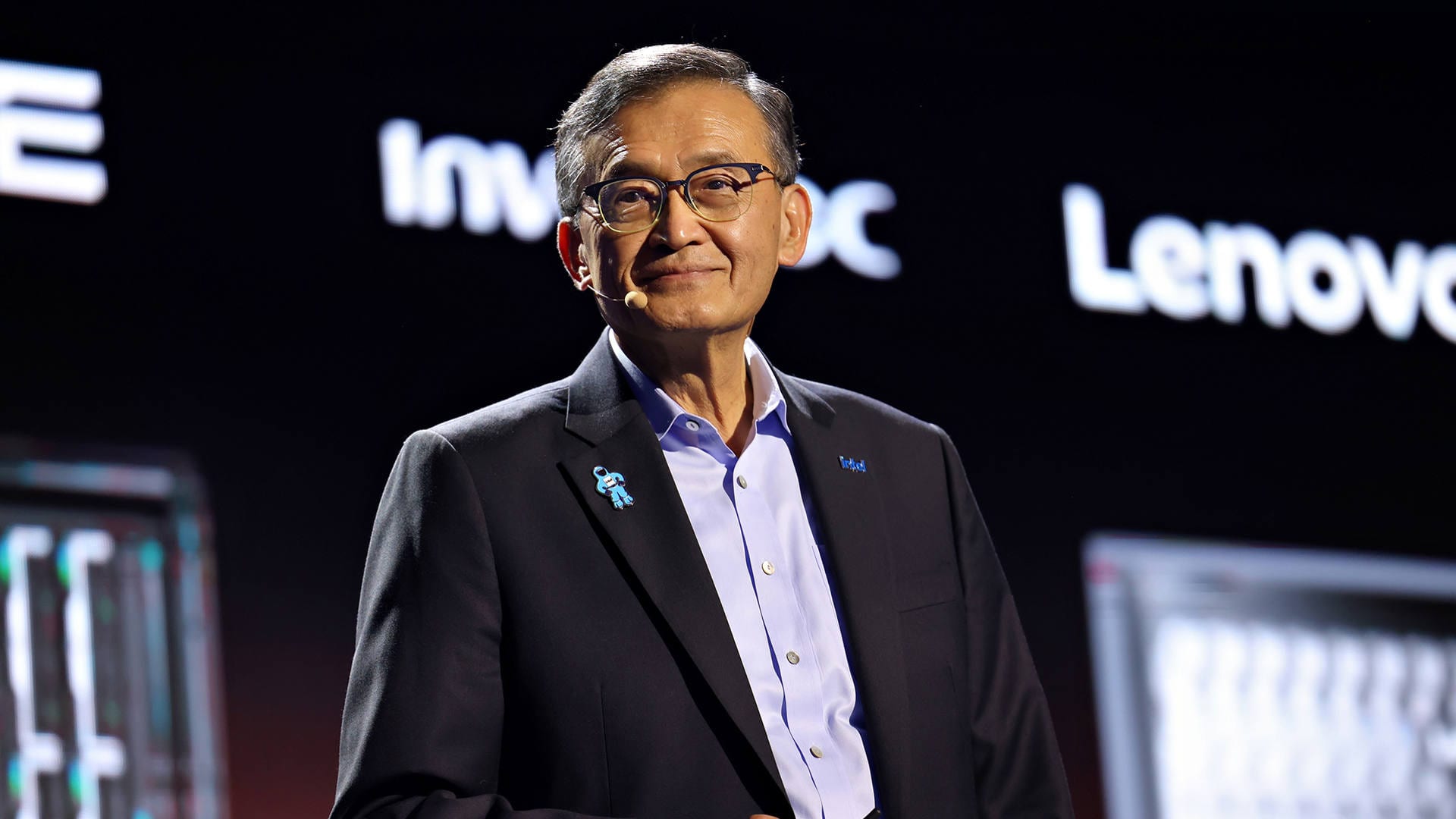
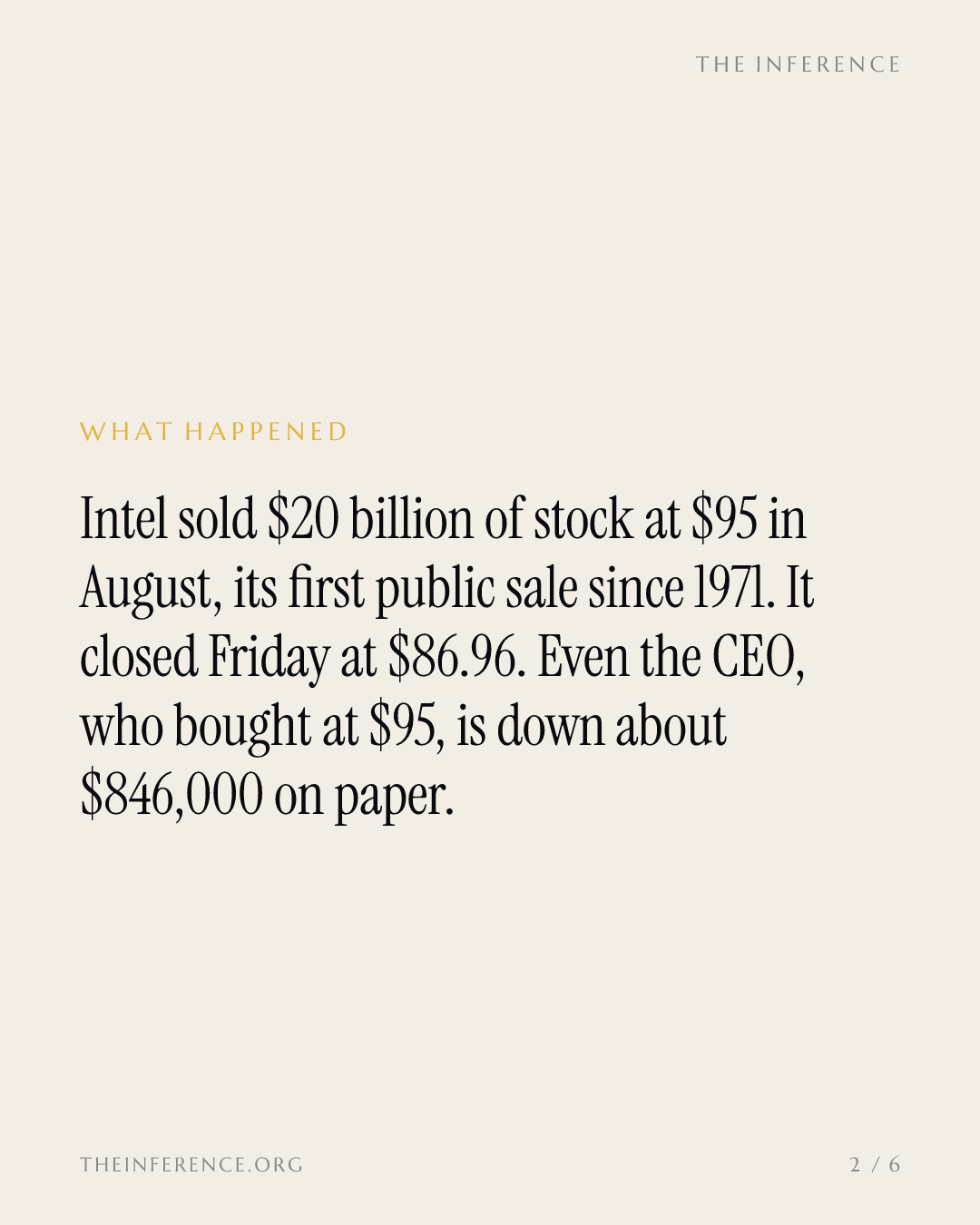
On August 11 Intel−10.39% — Intel, down 10.39 percent today priced its first public share sale since its 1971 listing: 210,526,315 shares at $95, raising $20 billion after an upsizing from $15 billion 1. Lip-Bu Tan, Intel's chief executive, bought 105,263 shares at that same $95 through a family trust the same day, lifting his holding to 1,314,669 shares 2. At the October 23 close of $86.96, 8.5% under the offering price and far off the September 24 close of $127.39, his roughly $10 million purchase shows a paper loss of about $846,000 2.
What the $20 billion bought in the second quarter
Second-quarter results show both halves of the trade. Data Center and AI revenue rose 59% year on year to $6.26 billion at a 39.5% operating margin, on the strongest server CPU growth in fifteen years 4. Intel Foundry booked $5.77 billion, but outside customers paid only $293 million of it, against a $2.09 billion operating loss 4.
Intel's custom silicon line, fielded against Broadcom−4.02% — Broadcom, down 4.02 percent today, Marvell−7.44% — Marvell, down 7.44 percent today and Alchip in a market it sizes at $100 billion, runs at $2 billion a year 4. Broadcom sold $16.7 billion of AI semiconductors in a single quarter and guides $21.7 billion for the next 6.
It has also agreed to lend Anthropic$350B — Anthropic, private, latest valuation $350B, the AI lab whose IPO filing disclosed the deal, up to $42 billion against a $125.2 billion five-year lease of Google-designed TPU compute: an undrawn, convertible ceiling for the customer expected to be its largest next year 7. Intel funded its factories with shareholder cash. Broadcom is offering its customer a credit line.
Broadcom's AI silicon quarter dwarfs everything Intel Foundry sells outside
- Estimate
Data
| Value | |
|---|---|
| Broadcom AI semis, FQ4 guide (estimate) | $21.7B |
| Broadcom AI semis, FQ3 | $16.7B |
| Intel Data Center and AI, Q2 | $6.26B |
| Intel Foundry external, Q2 | $0.29B |
Bulls count wafers and a Tesla headline
The bull case is physical. Output of 18A, Intel's newest high-volume process, ran 25% above target last quarter, management says demand exceeds available supply, and 14A is due for risk production in the second half of 2027 45. An October 24 report said Tesla−2.84% — Tesla, down 2.84 percent today has agreed to become a 14A foundry customer, with no chip, volume or date named 8.
The Street has not followed the stock down: the mean target holds at $117.14 1 after cuts to $95 at TD Cowen and $105 at Susquehanna 23, against a new JPMorgan target of $85, below the offering price, on a stock near 50 times forward earnings 32.
Analysts kept targets above $95 while the stock fell below the price Intel sold at
Data
| Value | |
|---|---|
| JPMorgan target | $85 |
| Close, Oct 23 | $86.96 |
| Aug 11 offering | $95 |
| TD Cowen target | $95 |
| Susquehanna target | $105 |
| Street mean target | $117.14 |
The number that decides Thursday
Intel reports after the close on October 29 against its own guidance: revenue of $15.8 billion to $16.8 billion, adjusted earnings of $0.38 a share and a 42% gross margin 12. The figure that decides the stock is 2027 capital spending, after this year's plan was raised to $20 billion and chief financial officer David Zinsner called next year's outlay "up meaningfully" 12.
A big number with no customer revenue attached reopens the selloff that followed the July report 1. Whether that ramp can ship at all was this page's October 21 question; Thursday settles who pays for it 1. Owning Intel into the print is a bet on who pays for 14A 1.
Get Chips by email, free
How AI demand is reshaping chipmakers, memory and the fabs behind them. In our daily email, every weekday.



Reader comments
0 comments