Judge lets Runway's YouTube scraping suit proceed; Universal and Sony seek up to $150,000 a work at Suno
A New York judge let the class action over Runway's YouTube scraping proceed on November 2, and music discovery has already attached a count and a per-work price to the identical practice at Suno. Every major AI video valuation was set before any court priced the training corpus.
 Richard Tang · 4 min read
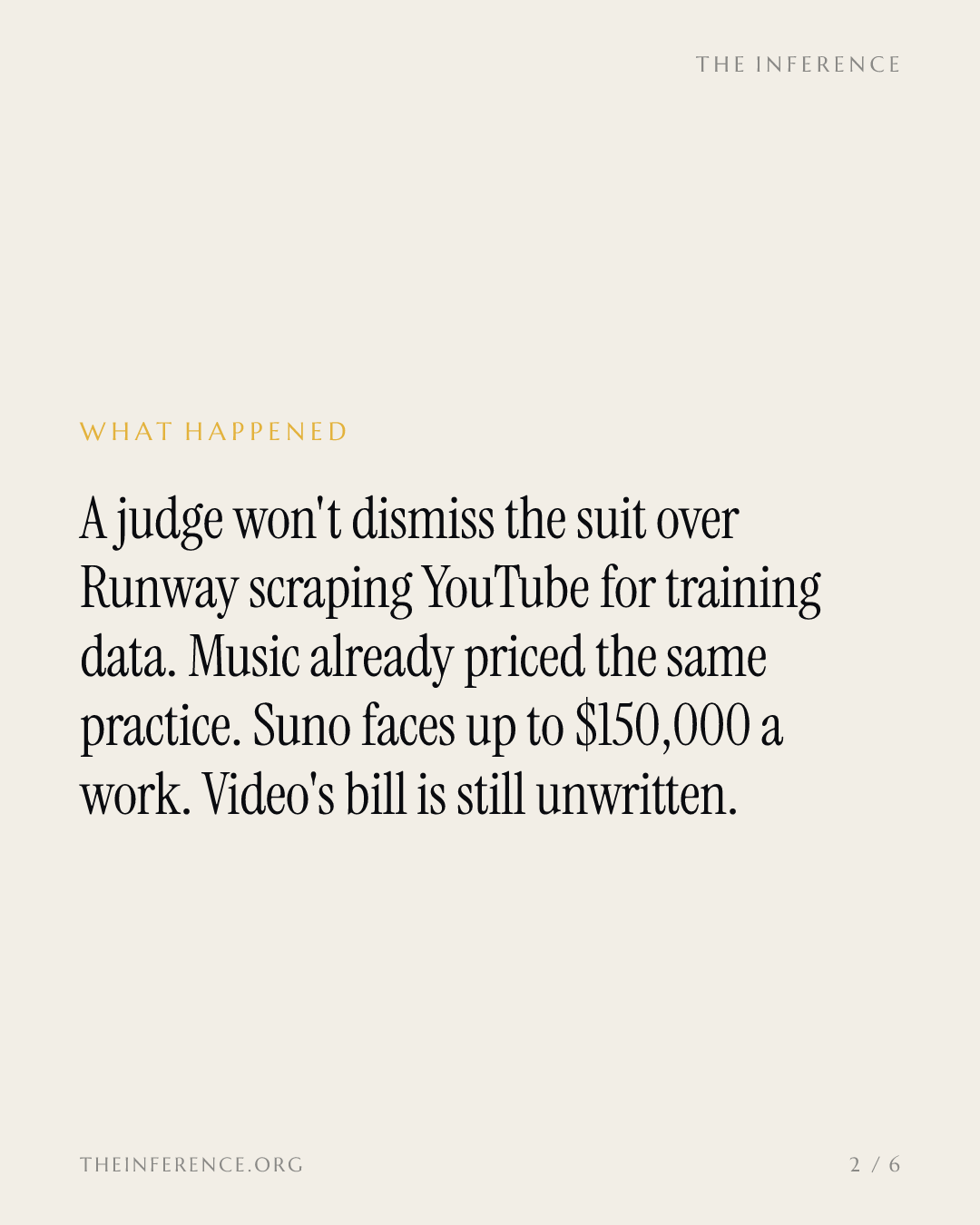
A federal judge in New York refused on November 2 to dismiss a proposed class action accusing Runway AI of scraping videos that YouTube+0.24% — YouTube, up 0.24 percent today users posted, to train its models 1. That matters more than one ruling: the AI video trade has been valued on the assumption that the training corpus was free, and a judge has now declined to throw out the claim that says it was not.
The suit, before Judge Lewis A. Kaplan in the Southern District of New York, rests on federal copyright law, and the judge found the allegations good enough to proceed 1.
Music already has a price list
The video case has no number attached yet. Music does. Universal Music Group and Sony−0.47% — Sony, down 0.47 percent as of its last quote Music filed a second suit against Suno in September listing 60,202 sound recordings they say sit in Suno's~$2.45B — Suno, private, latest valuation ~$2.45B training files, and they seek up to $150,000 per infringed work in statutory damages 3.
Suno's October 20 answer admits it pulled YouTube audio with the downloader YT-DLP, and leaked material reported by 404 Media showed a file named 'youtube_music' holding more than 2 million ingested clips 4. The labels did not guess at that list. Under court-authorized discovery, their experts entered Suno's facilities, read the source code and training data, and matched audio fingerprints, the technique behind Shazam, against recordings they own 4.
A market to pay for training data already exists
The complaint also argues that Suno's own licensing deals with Warner, BMG and Believe prove a market already exists for paying to train on recordings 6. A German court already rejected Suno's fair-use framing in a suit by rights group GEMA, which largely prevailed in July 4. The same discovery machinery runs on video; the video list simply has not been written yet.
The marks were priced before any of this
Compare the round dates. Runway raised $315 million at a $5.3 billion valuation in February, with Nvidia+3.84% — Nvidia, up 3.84 percent today in the round; Kling AI, owned by Kuaishou, raised $2.8 billion at about $15 billion this summer; Higgsfield raised $400 million at $5.4 billion in August and now carries Nvidia and TCV in its extension 2. All of it landed before any court tested the cost of the data.
AI video marks were priced before any court tested the cost of training data
Data
| Value | |
|---|---|
| Runway AI | $5.3B |
| Higgsfield | $5.4B |
| Kling AI (Kuaishou) | $15B |
Where the liability lands
The capability is real, and improving fast. Runway's chief executive Cristóbal Valenzuela says its models now pass a test of whether people can tell generated video from real, and the company plans to release most of the interactive systems it demoed within 8 to 12 months 5. Higgsfield, which aggregates about 35 rival video models behind one subscription, is on track for $1 billion in annualized revenue on more than 40 million registered users 2. None of that is in dispute.
Who pays for the data underneath
What is now in dispute is the input. Music shows what a licensing requirement does: Suno kept selling subscriptions, and three labels chose to be paid rather than to sue. The business model that survives is the one that can cover a data bill from revenue or sign its own deals, as Suno has started to do 6.
The damages ceiling Suno faces is already the size of an AI video mark
Data
| Value | |
|---|---|
| Suno statutory ceiling | $9.03B |
| Runway AI | $5.3B |
| Higgsfield | $5.4B |
| Kling AI (Kuaishou) | $15B |
The lab that treated everyone's footage as free inventory faces a new line in its cost structure, and that line passes through to the marks built on its output, including Kuaishou, the listed company holding Kling 2. The other side of that ledger is the corpus owner: Alphabet's YouTube for video, Universal for music.
Any of three events reprices every mark
These are among the most useful creative tools ever shipped, and learning to use them remains the right move; the open question is who pays for the data underneath them. Watch three things: the first named list of videos in Runway's discovery, the next filing in the class action, and whether any video lab follows Suno's path and signs a licensing deal before it is forced to. Any one of those turns the corpus from an assumption into a line item, and reprices every mark in the chart.
Get Model by email, free
The AI labs, their models, and the business behind them. In our daily email, every weekday.