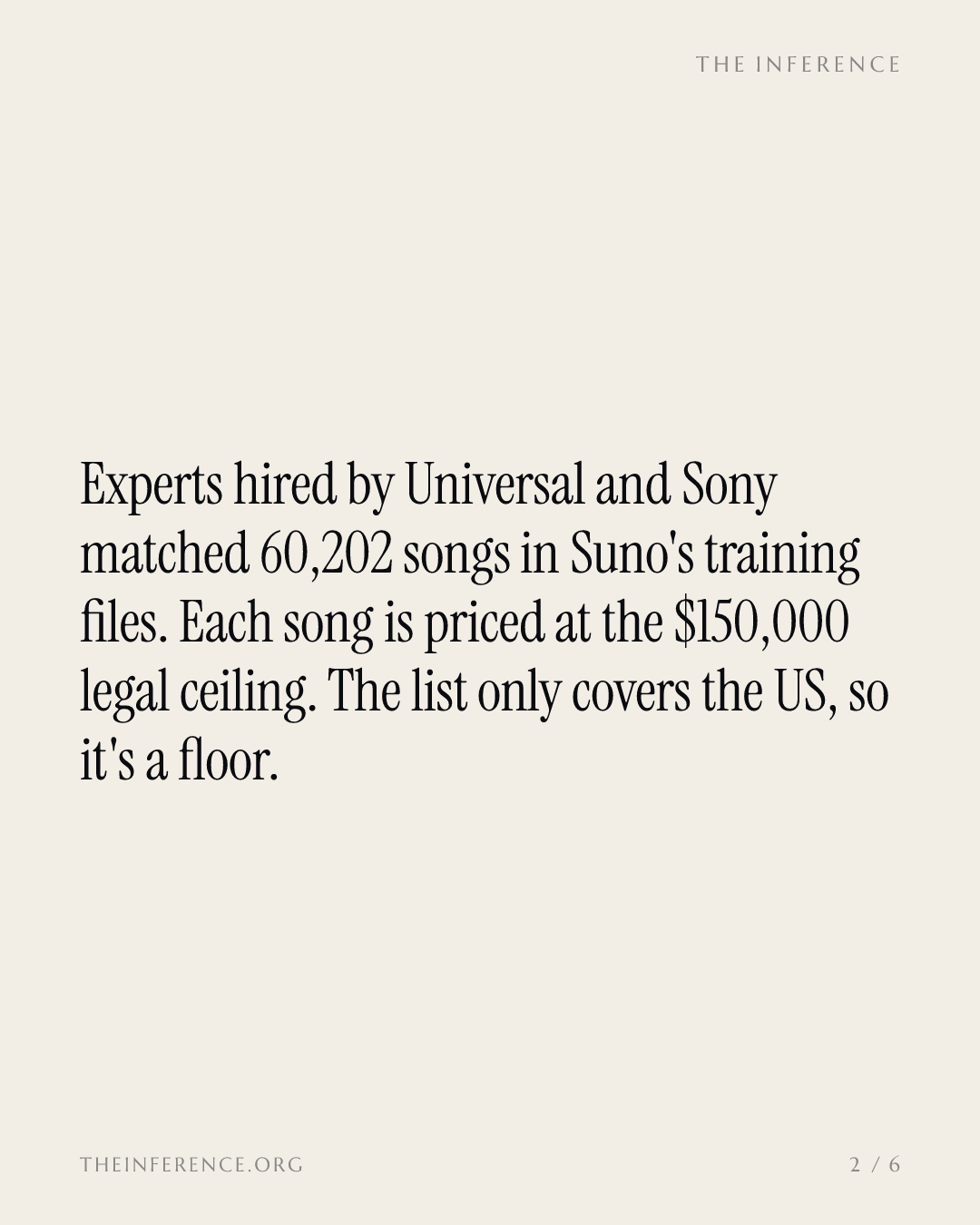
Universal and Sony matched 60,202 songs in Suno's training files, at up to $150,000 each
Reservoir, the Presley estate and Universal and Sony are filing priced song lists at $150,000 per work, backed by Suno's own admissions. Licensing, the road Udio took, now reads as cheap insurance.
 Richard Tang · 3 min read

Music publishers have stopped arguing that AI training infringes copyright in the abstract. This month they filed price lists: specific songs, specific counts, each priced at the $150,000 statutory ceiling for a willfully infringed work 123. Suno's~$2.45B — Suno, private, latest valuation ~$2.45B own court filings confirm much of the conduct underneath, and Anthropic$350B — Anthropic, private, latest valuation $350B has already paid once at scale. For anyone holding music rights, litigation has become a quantifiable asset; for unlicensed AI music platforms, the invoice is written.
The complaints arrive with invoices attached
On October 21 Reservoir Media, the Nasdaq-listed publisher behind Joni Mitchell and Johnny Cash copyrights, sued Suno over 1,050 compositions, seeking $157.5 million on the main count and $186.4 million total, and sued Anthropic over 853 lyrics used to train Claude, seeking $151.4 million 12. CNET totals the pair at $338 million 12.
Two days later the owners of Elvis Presley's songs sued Anthropic over 274 recordings for $41.1 million 3. Then on October 28 the sharpest document surfaced: in Universal and Sony's−2.01% — Sony, down 2.01 percent today Massachusetts case, audio experts the labels hired, granted access to Suno's security facilities under the court's discovery process, matched audio fingerprints from Suno's own training files against the labels' catalogs and produced a list of 60,202 songs, from BTS's "Bad Decisions" to Psy's "Gangnam Style" 4.
Three October complaints, priced at the $150,000-per-work ceiling
Data
| Value | |
|---|---|
| Reservoir v. Suno | $186.4M |
| Reservoir v. Anthropic | $151.4M |
| Presley holders v. Anthropic | $41.1M |
Suno's scale sets the size of the claim
The 60,202-song list covers only what Universal and Sony control in the United States, so it is a floor, not a ceiling 1. The leaked Suno code reported by 404 Media points at the wider pool: over two million artist records pulled from YouTube+0.92% — YouTube, up 0.92 percent today Music and nearly seven million Genius lyric pages, amounting to roughly 114,000 hours of audio 1.
Reservoir's complaint prices willful infringement at the statutory maximum per work; applied across a catalog that size, the $9 billion ceiling we set out when Universal and Sony filed their expanded claim in September, itself the plaintiffs' maximum arithmetic rather than an expected award, starts to look conservative 15.
Suno's own filings shrink its room to argue
Suno's position is narrowing, not holding. Its October 20 response admits audio data came from YouTube via YT-DLP, an open-source downloading tool, while still calling the pipeline "quintessential fair use" 4. A German court already rejected that defense in GEMA's case in July, finding Suno stream-ripped the training data 1. Anthropic, which paid $1.5 billion last year to settle authors' claims over pirated books, says it will defend vigorously 23.
Udio took the other exit
The counter-case is Udio. Sued alongside Suno by the majors, it settled with Universal and agreed to launch a licensed platform 1, then signed the music publishers' first industry-wide licensing deal with a major AI company, one that values songs and sound recordings equally 6. Licensing once looked like surrender. At $150,000 per work, it reads as cheap insurance 16.
What to watch next is whether the per-work rate survives: statutory damages sit within a range, and the $150,000 ceiling requires a willfulness finding a jury has not yet made 1. Suno's answer to the 60,202-song list, and whether Korean labels, whose artists appear on it without having sued, join the queue, will tell us how long the price list gets 4.
Get Model by email, free
The AI labs, their models, and the business behind them. In our daily email, every weekday.