OpenAI wants data centers called 'compute campuses'; the power bill still decides the buildout
OpenAI confirmed on Sunday it wants data centers called "compute campuses," two days before midterm elections that could hand Democrats Congress. The new name changes no electric bill, and the bill, not the vocabulary, is what now gates the AI buildout.
 Richard Tang · 3 min read
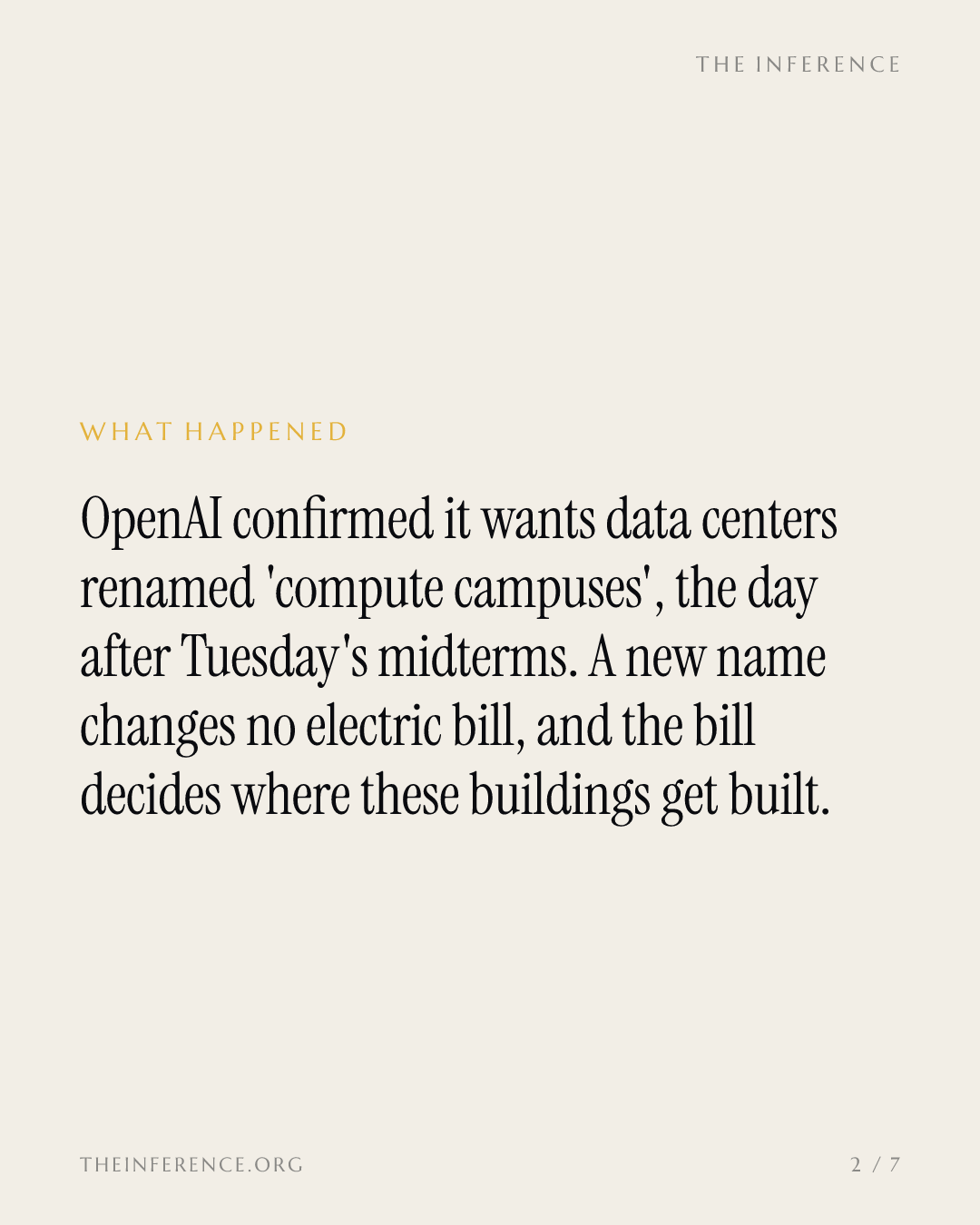
OpenAI$1.18T — OpenAI, private, latest valuation $1.18T does not want to call them data centers anymore. A spokesperson confirmed on Sunday that the ChatGPT maker wants its industry's most contested building renamed the "compute campus," a "long-term investment in computing, energy infrastructure and skilled work" 1. The campaign launches the day after Tuesday's midterm elections, with Democrats favored to win back the House and possibly the Senate, and OpenAI's chief global affairs officer Chris Lehane calling the vote "a bit of a movie trailer" for 2028 23.
The rename aims at the wrong link. The unpopularity it must move is real and local: majorities of Americans oppose a campus nearby, expect one in their electric bill and call the buildings bad for the environment, and 35 data-center measures reach local ballots on Tuesday, most of them in Ohio 4.
The opinion wall a rename has to move
Data
| Value | |
|---|---|
| Worry AI will raise electric bills, Reuters/Ipsos, June | 77% |
| Oppose a data center nearby, Gallup, May | 70% |
| Oppose one in their community, UMass Amherst, Sept | 65% |
| Call them bad for the environment, Pew | 54% |
The bottleneck is who pays for the power
Follow the chain that actually gates the buildout: chips need campuses, campuses need grid connections, connections are financed through utility tariffs, tariffs land on bills, and bills become votes. In PJM, the grid operator serving 65 million people across the mid-Atlantic and Midwest, the independent market monitor calls data centers "the primary reason" capacity prices spiked 5. Ratepayers there are set to pay an extra $7.3 billion this delivery year 5. Ohio households are paying about $16 a month more 5. Texas halted as many as 1,800 pending proposals in August 7.
Big loads pay their own way, on both sides of the aisle
Both parties now converge on one rule: big loads pay their own way. The House passed the Ratepayer Protection Act 417-3 in September, Virginia's governor proposes to bar the nondisclosure agreements that kept local deals secret, and Lehane himself says communities should hold companies accountable 62. Amazon−1.20% — Amazon, down 1.20 percent today and Microsoft−1.38% — Microsoft, down 1.38 percent today have dropped those agreements, and Meta−1.65% — Meta, down 1.65 percent today, Amazon and Microsoft are paying host communities directly 21. Rivals chose money and disclosure; OpenAI chose a word.
Consent is an input cost, not a vocabulary problem
The buildout should happen, and quickly. But a rename works on the news cycle, a tariff works on the bill, and only one of those moves a county commission. A campus that pays for its own wires and opens its terms buys its permit; a name buys a week.
For anyone long the 2027-28 campus pipeline (utilities, data-center REITs, contractors), the political risk sits in state utility dockets and county ballots, not only in Washington 8. Sixty-two percent of investors in Bloomberg's survey expect stricter AI rules to hurt US stocks 8, but the rules that bite first arrive as tariffs, not statutes. Our election-week coverage stopped at the crypto side of Tuesday's vote 8. The builder who first converts local opposition into permits deserves to win the pipeline, and probably will.
Get Data Center by email, free
Who is building AI's data centers, and who is paying for them. In our daily email, every weekday.