Salesforce paid $5.66 billion for Braze; Zeta's answer puts its consumer data inside AI models
Salesforce paid 6.2 times forward revenue for Braze; Zeta answered with two tuck-ins that put its consumer identity data inside models built to influence AI shopping agents. One builds the moat, one opens an exposure no peer carries.
 Richard Tang · 2 min read

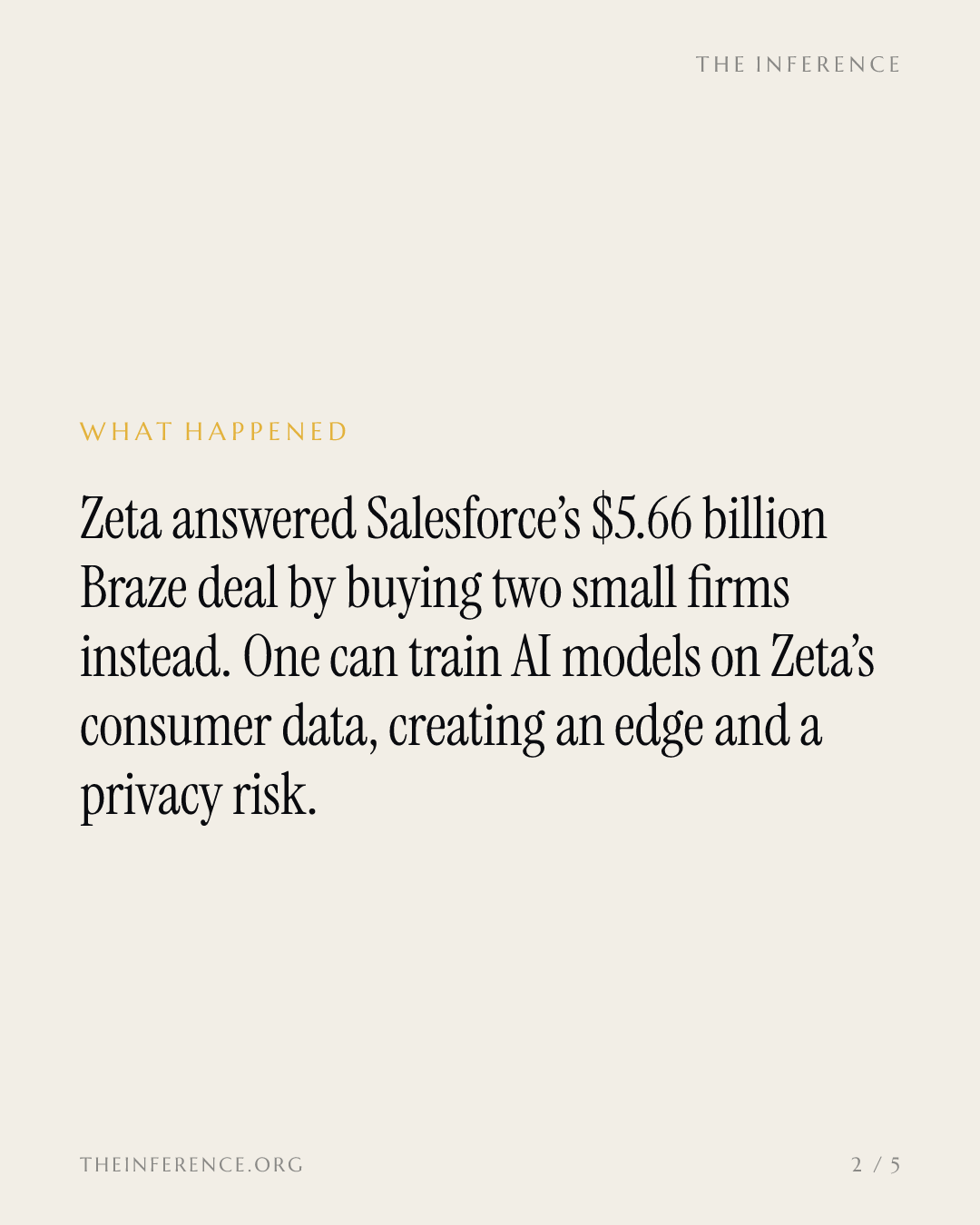
Zeta Global−1.03% — Zeta Global, down 1.03 percent today has answered Salesforce's−1.29% — Salesforce, down 1.29 percent today takeover of Braze−0.03% — Braze, down 0.03 percent today not with a rival bid but with two cheap acquisitions that do something a rival bid could not: they put Zeta's consumer data cloud inside models built to influence the AI agents that will act as personal shoppers. That builds the moat investors want. It also opens a privacy exposure none of Zeta's peers carries.
The comparison that frames the money: Salesforce agreed to buy Braze for about $5.66 billion, 6.2 times forward revenue, while Zeta trades at 4.4 times with roughly twice the scale and stronger cash generation 3. Our October 14 article covered the two acquisitions and Zeta's 52-week high; what is new since is the chief executive's own explanation of why he bought rather than partnered, and the reversal it implies for the company's data promises 3.
Zeta told investors its data never trains outside models. Owning Senso changes that
David Steinberg, Zeta's chief executive, told the ad-trade publication AdExchanger that Zeta never shares its Data Cloud with any third party or feeds it into frontier models. Owning Senso, he said, means Senso can use the full breadth of that data cloud to train models, with its engineers sitting inside Zeta's AI lab 2.
Senso is the startup behind Zeta's GEO product, generative engine optimization, which helps brands show up in AI chatbot answers; the same interview put Digital Audience, a Netherlands-based data-infrastructure firm, to work on deterministic identity 2. This is likely a real competitive advantage: an intelligence layer rivals cannot rent. For a company that sells identity resolution, it is also a new risk surface, and regulators read data flows, not org charts.
Who bears the risk, and what to ask
The unprovable part is consent: whether consumers who opted into Zeta's marketing uses expected their identity-resolved data to train models aimed at shopping agents. No sourced document answers that. What investors can check is disclosure. If Zeta spells out how the intra-company training loop is governed, what consent covers, and what regulators could read into it, the 4.4x discount looks like a bargain. If it stays silent, the exposure is priced wrong in both directions.
Zeta trades below Salesforce's multiples on revenue and cash flow
- Salesforce / Braze
- Zeta Global
Data
| Salesforce / Braze | Zeta Global | |
|---|---|---|
| EV / forward revenue | 6.2x | 4.4x |
| EV / free cash flow | 97x | 32x |
The acquisition logic is sound, and buying the agentic layer cheap beats buying Braze expensive. The Senso integration is the trade to watch.
Get Applications by email, free
How AI is changing the software people and companies use. In our daily email, every weekday.