SK hynix files a one-month clock on Solidigm's reported $45 billion US NAND plant
A filing today acknowledges the ₩60 trillion figure for Solidigm's US NAND plant and starts a one-month disclosure clock. The money would come from the balance sheet the board just promised to shareholders, and the licenses that govern Dalian expire with the year.
 Vincent Jiang · 3 min read
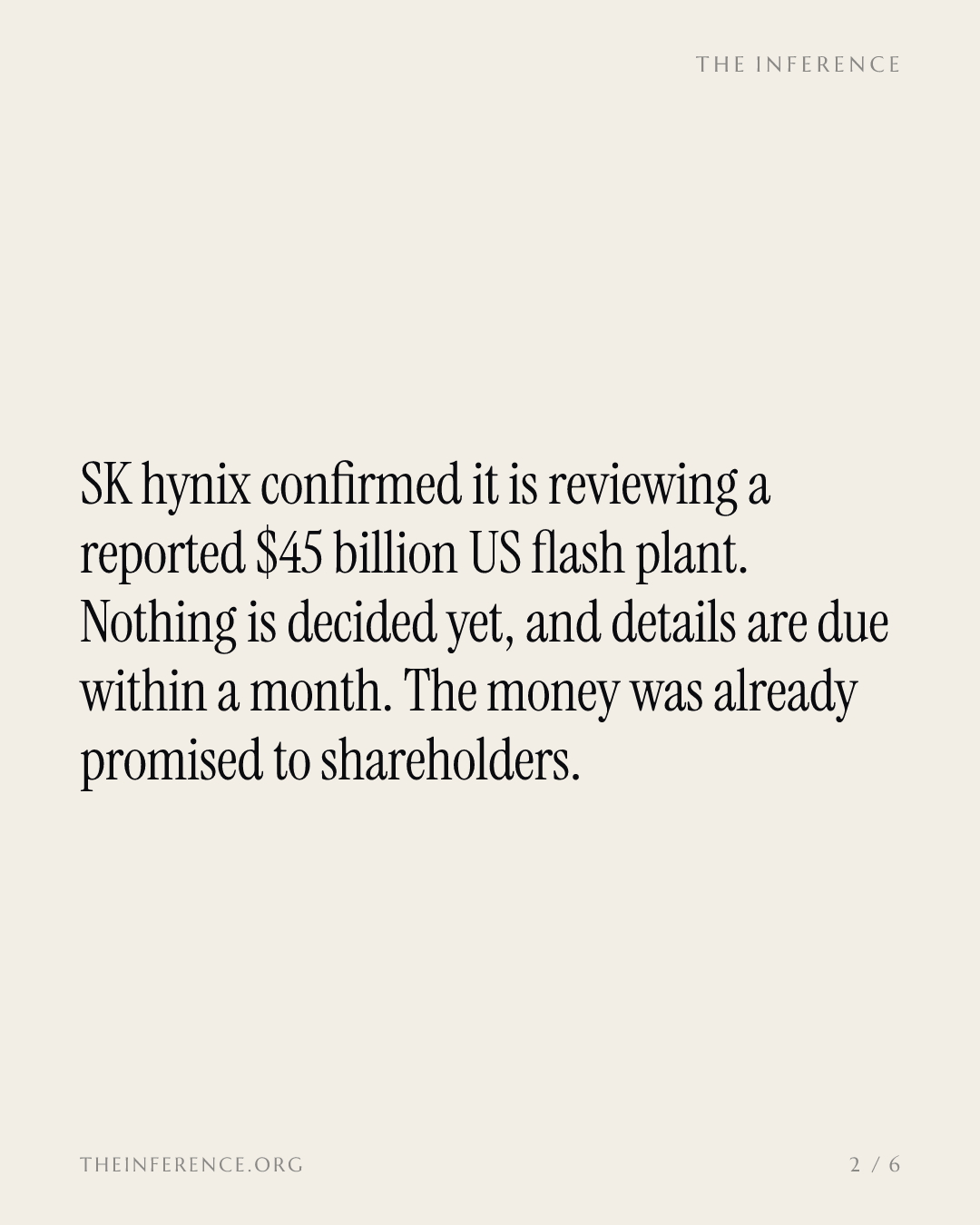
SK hynix−0.89% — SK hynix, down 0.89 percent today put a number on Solidigm's American plans this morning, and a deadline beside it 1. A US securities filing acknowledges a Korean newspaper report that Solidigm, its flash-memory unit, is pursuing about ₩60 trillion, roughly $45 billion, for a new US NAND flash factory 1. The subsidiary is "reviewing various measures" to expand capacity, "no matters have been determined," and a fuller disclosure comes when details are confirmed or within one month 1.
A bargain reported, not confirmed
The report behind the filing describes a trade: Solidigm is in talks with the Commerce Department over the plant, and wants permission to export equipment to upgrade its Dalian factory in China, whose added output would help finance the American one. Total US investment could eventually reach $100 billion, with construction in New York penciled in for 2027 2.
The money is already spoken for twice
The review lands on a committed balance sheet. Third-quarter revenue was a record ₩104.6 trillion, the first quarter above ₩100 trillion; operating profit was ₩83.3 trillion, up from ₩11.4 trillion a year earlier, at a margin above 80 percent 34.
The board has promised about ₩100 trillion of 2026 shareholder returns, ₩30 trillion in dividends and ₩60 trillion in buybacks, and approved a ₩14 trillion quarterly dividend 34.
The listing meant to fund the unit was suspended on October 23, citing market conditions, after shareholder opposition 56, leaving the fab with no named funding plan, as covered here on October 24. The stock closed 10.89 percent higher on the results, after losing more than half its value between June and Tuesday's close 6.
The fab under review is priced at most of a year of shareholder returns
- Estimate
Data
| Value | |
|---|---|
| Q3 2026 operating profit | ₩83.3 tn |
| FY2026 shareholder returns | ₩100 tn |
| US fab under review (estimate) | ₩60 tn |
Dalian runs on licenses that expire with the year
NAND, which stores data without power and fills the drives behind AI servers, is made for Solidigm at one site: Dalian, bought with Intel's−3.77% — Intel, down 3.77 percent today NAND business in 2021 7. Washington said in 2025 it did not intend to license technology upgrades or capacity expansion at the Korean plants in China; SK hynix is authorized at Dalian up to 240 layers, from 192 today 7.
Beijing's approval of the Intel sale required five years of rising output, terms that run through December 8. The extra tools would fill a building finished in 2023 but never equipped; the authorization covers 2026 only, and nothing yet covers 2027 9. Yangtze Memory Technologies, China's champion, took 38.5 percent of China's NAND market in the second quarter, up from 28 percent in 2025, while SK hynix slid to 17 8.
YMTC took China's NAND lead while the freeze held SK hynix in place
- 2025
- Q2 2026
Data
| 2025 | Q2 2026 | Change | |
|---|---|---|---|
| YMTC | 28.0% | 38.5% | +37.5% |
| Samsung | 36.0% | 33.5% | -6.9% |
| SK hynix | 20.0% | 17.0% | -15.0% |
The shortage makes the case without the politics
The company's own numbers argue for building anyway: demand should exceed supply through 2030, DRAM and HBM, the high-bandwidth memory used beside AI processors, are sold out through 2029, and agreements with 14 customers cover more than half of 2027 and 2028 capacity 345. Chief executive Kwak Noh-Jung calls the shift "earnings stability and mid-to-long term demand visibility" 6.
A fab at shortage prices needs no political case; the exposure is one still standing, priced in Washington, when prices normalize. The filing's clock runs to November 29, and Beijing's terms and Dalian's 2026 license expire with December. November decides whether ₩60 trillion becomes a factory or stays a bargaining chip.
Get Chips by email, free
How AI demand is reshaping chipmakers, memory and the fabs behind them. In our daily email, every weekday.