Tesla's first Optimus robots will work in mines and refineries, Musk says
Elon Musk has named the first workplace for Tesla's Optimus robot: mines and refineries, working around the clock. A dedicated robot factory is rising beside the Texas car plant, funded from a capital budget Tesla has already cut once this year.
 Richard Tangthree-minute read
The first workplace is a mine, and Tesla's money is already committed
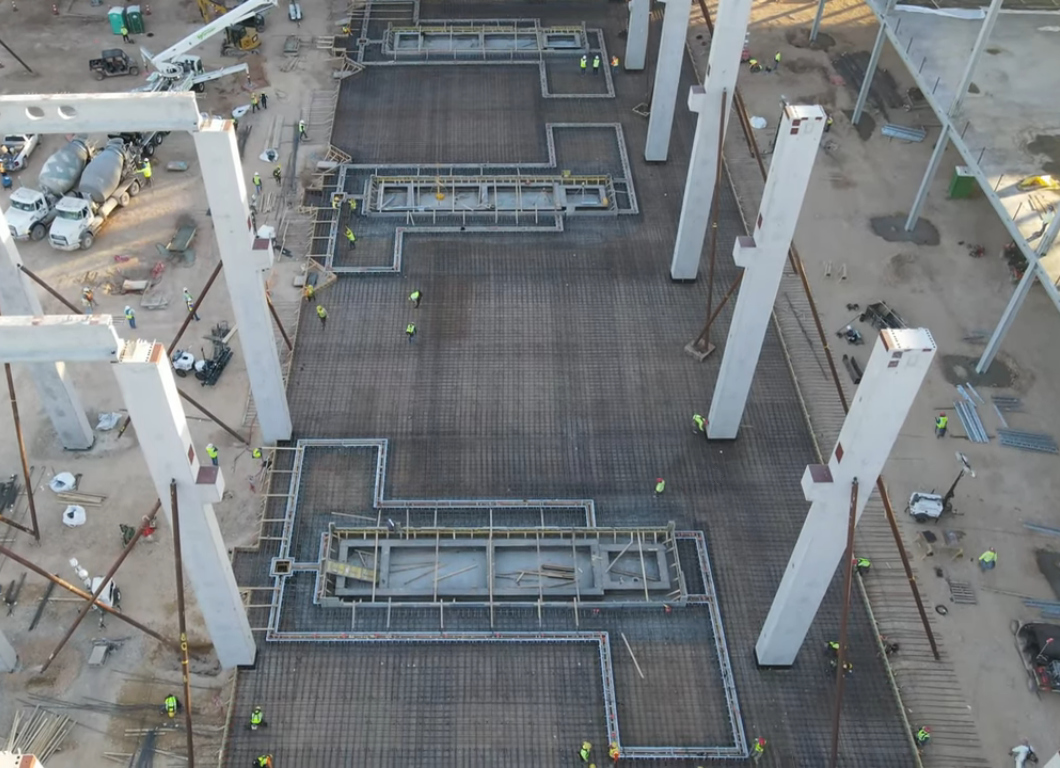
The week's Optimus news is construction, not a demonstration. Construction watchers at Giga Texas, Tesla's−6.32% — Tesla, down 6.32 percent today car plant in Austin, posted four reinforced foundations on its southeast side taking frame mounts for IDRA Giga Presses, the house-sized casting machines installed the same way as the presses in the vehicle casting section 1. Those foundations are paid from a capital budget that finance chief Vaibhav Taneja cut to about $20 billion in October 2.
The first workplace came from Musk via the prediction-market account Polymarket: the robots "will initially be deployed in heavy industry, including mining & refining, working 24 hour days, 7 days a week" 3.
The rest of the sequence comes from his remarks at a conference on November 18, as Yahoo Finance reported them: household chores "in about 12 to 18 months," a capability date rather than a ship date, and then first deliveries to outside companies, which will not be households, around the end of 2027 4. No report names a buyer, or says whether the mine deployments are robots sold to mining companies or units Tesla runs itself 34. The sizes and start dates circulating on X, first output later this year among them, are observers' claims, not Tesla's 1.
The presses are what turn a demo into a sellable robot
A Giga Press casts one huge part where a car body would otherwise be an assembly of stamped pieces, and observers say the Texas presses will make robot components such as arm joints "in single shots, mirroring the efficient methods used for vehicle underbodies" 5. Tesla is hiring die-casting and actuator engineers 5.
A first line already runs in Fremont, California, in former car-building space, where the shareholder letter calls the robots coming off it "the first production-quality bots" Tesla has manufactured 6. That is the unglamorous hop in robotics: a robot that works in a video becomes a robot cheap enough to build at volume.
A mine buys running hours, and no mine is named
An industrial first customer is the right test and the hardest. A refinery buys running hours, not demos, and no mining or refining company appears in any report 34. Musk named the constraint himself on the October earnings call: a delivered robot "can't, like, wear out after a month," with "still quite a lot of work" left on the AI for open-ended tasks 6.
His timelines have slipped before; in January he expected significant Optimus volume by the end of this year 4. XPeng, the Chinese electric-vehicle maker racing Tesla to a humanoid, says its robot is "accelerating toward the mass-production milestone by year-end" 4. Tesla's answer to that race is the factory.
The deployment order is sound; the revenue is not
Sending the first robots into industry is sound engineering: a buyer that measures a robot in running hours forces the reliability work, and a machine hardened to survive a refinery is the one a household can later trust. The exposure is timing. Taneja's cut came from a plan above $25 billion, and he said capital spending keeps rising as Tesla scales Optimus 2; the budget covers AI computing capacity and the Texas robot factory 4.
Capital spending stepped up hard in 2026, before any robot revenue
- Capital expenditure
- Operating cash flow
Data
| Capital expenditure | Operating cash flow | |
|---|---|---|
| Q2 '24 | $2.27 | $3.61 |
| Q3 '24 | $3.51 | $6.26 |
| Q4 '24 | $2.78 | $4.81 |
| Q1 '25 | $1.49 | $2.16 |
| Q2 '25 | $2.39 | $2.54 |
| Q3 '25 | $2.25 | $6.24 |
| Q4 '25 | $2.39 | $3.81 |
| Q1 '26 | $2.49 | $3.94 |
| Q2 '26 | $5.79 | $4.7 |
| Q3 '26 | $4.73 | $6.26 |
Operations still covered the spending in the latest quarter, as in most quarters shown 7. What breaks that is a run of quarters like mid-2026, when capital spending outran operating cash 7, against consensus estimates that carry almost no Optimus profit through 2028 4. The late-January earnings report can show what the story lacks: a named first customer and a weekly output figure 4. Until there is one, cash leaves the balance sheet for concrete and presses before any robot carries an invoice.
Get Robotics & Defense by email, free
Robots, self-driving vehicles, drones and AI in defense. In our daily email, every weekday.
Reader comments
0 comments