The $120 Billion Reactor Deal Is Real. Brookfield Renewable's Cut of It Is a $54 Million Line Item
A $120 billion Korean reactor framework made Brookfield Renewable look like a nuclear AI winner. The Q3 filing shows a 16% segment, a likely diluted 11% stake, and a deal that is not signed yet.
 Vincent Jiangthree-minute read
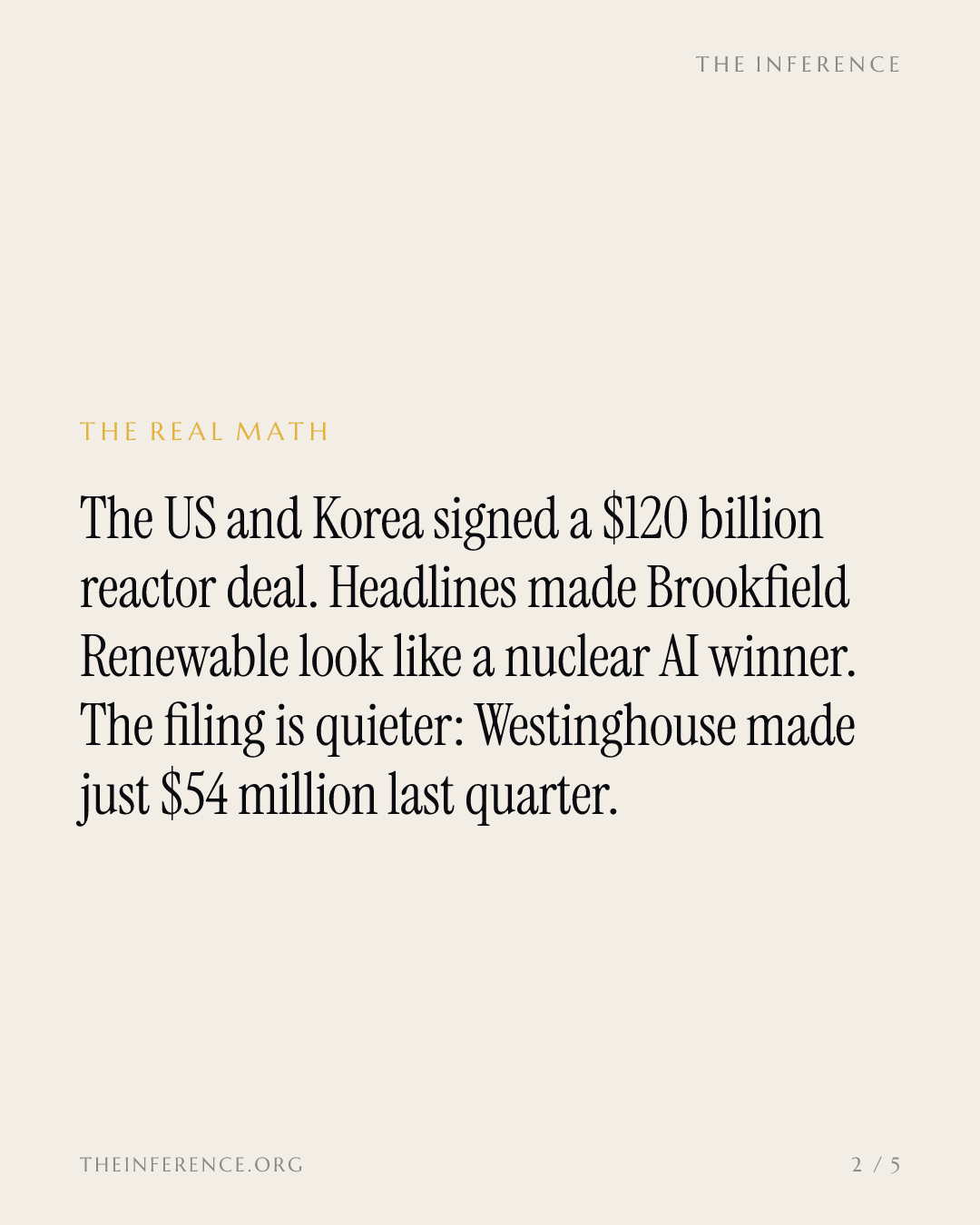
The documents are less excited than the headlines. On September 30 the United States and the Republic of Korea signed a framework committing up to $120 billion of Korean money to build eight large reactors on US federal sites: six Westinghouse AP1000s and two Korean APR1400s built on Westinghouse technology 1. Westinghouse expects about $2 billion per reactor in licensing, engineering and fuel services, and the terms are non-binding, subject to final negotiations 1. Bulls wrote it up as a windfall for Brookfield Renewable+1.63% — Brookfield Renewable, up 1.63 percent today, which co-owns Westinghouse with Cameco, the uranium producer 2.
Brookfield's nuclear stake is a rounding error, and shrinking
The arithmetic is plain. Brookfield Renewable's segments holding Westinghouse produced $54 million of funds from operations in the third quarter, 16% of the partnership's $346 million total 23.
Cameco, with 49% of Westinghouse, booked C$143 million from its share in the same quarter, up from C$124 million, more than twice Brookfield Renewable's entire segment 4. Brookfield and its institutional partners hold 51%, but Brookfield's actual stake is closer to 11%, and the framework brings a 5% to 10% cornerstone stake for Korea plus a possible US government position, so that 11% will likely be diluted 2.
Brookfield Renewable's Westinghouse stake sits in a $54M corner of a $346M quarter
The segments holding Westinghouse produced $54M of BEP's $346M quarterly FFO
Data
| Q3 2026 FFO | |
|---|---|
| Hydro | $214M |
| Solar | $187M |
| Wind | $56M |
| Distributed & storage | $31M |
| Sustainable solutions | $23M |
| Corporate | -$165M |
The last build cycle ended in bankruptcy
The bullish read leans on history not repeating. Last time, Westinghouse carried fixed-price construction risk: Vogtle's $14 billion estimate became more than $30 billion, V.C 2. Summer was abandoned at $25 billion after $9 billion was spent, and Westinghouse filed for bankruptcy in 2017 2.
This time it collects fees without carrying overruns, a genuinely safer position. But Brookfield Renewable itself funds growth by selling assets and borrowing: $2.8 billion of asset sales since the second quarter closed the $3 billion Aypa storage purchase, and asset-recourse borrowings rose from $31.2 billion to $37.0 billion in nine months, against a market cap of $5.67 billion 35. Its nuclear upside arrives through a non-binding framework, an eventual IPO valuation it does not set, and a smaller ownership slice.
Two dates settle it
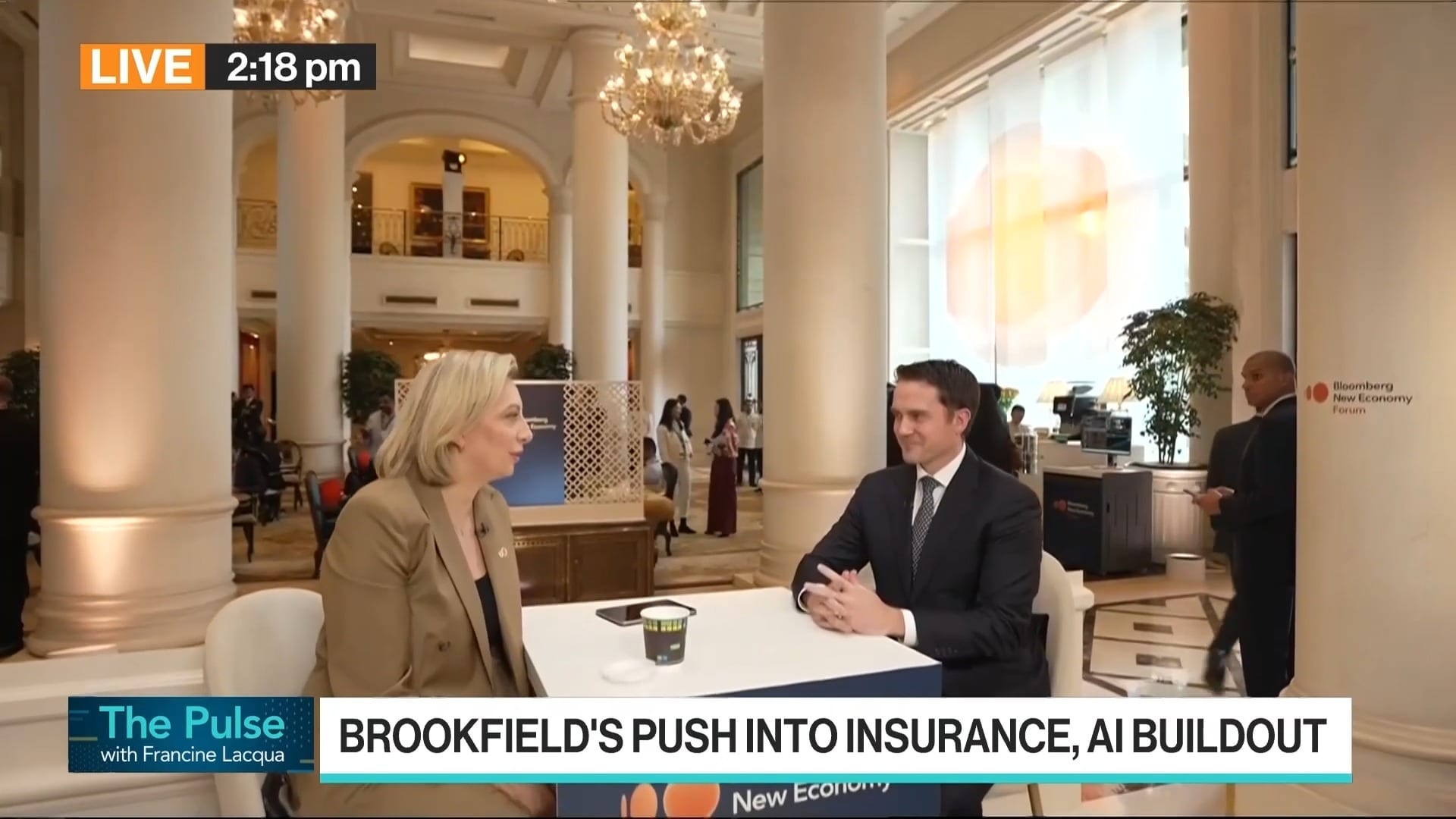
CEO Connor Teskey told Bloomberg the "social license to operate is critical" after an election that showed resistance to data centers, and separately said public markets overestimate rate risk 67.
The nuclear premium is a story for the IPO filing, not this quarter. Watch November 25, when BEP unitholders must reach the two-thirds threshold on the corporate simplification (99.7% of votes cast so far are in favor, but turnout is short), and the year-end signing of 20-year, inflation-linked Ontario hydro agreements 73. An earlier Inference piece, "Brookfield's $95/MWh hydro deals put a price on AI power hunger" (theinference.org), priced the other half of the same demand story 73.
Get Power by email, free
How AI's hunger for electricity moves utilities, power plants and the grid. In our daily email, every weekday.