Brookfield's $95/MWh hydro deals put a price on AI power hunger
Two 10-year hydro PPAs at about $95/MWh are the clearest price yet on AI-era power demand, even as Brookfield sells pieces of that same fleet to fund batteries and new build.
 Richard Tang · 3 min read
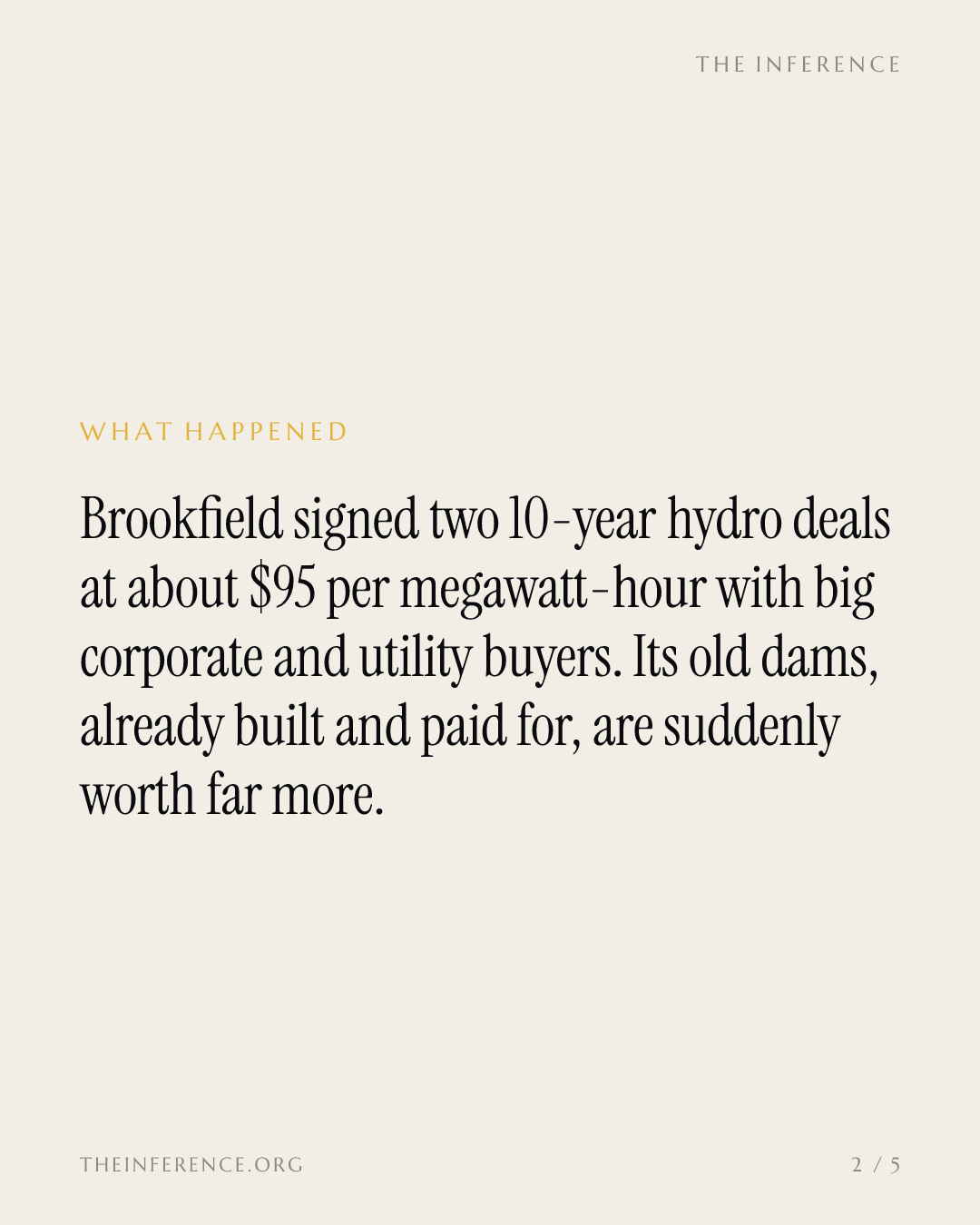
Brookfield Renewable+2.08% — Brookfield Renewable, up 2.08 percent today just put the first hard price tag on AI-era power demand for its legacy hydro fleet: two new 10-year power purchase agreements at a US hydro facility, signed this quarter with investment-grade commercial and utility customers at about $95 per megawatt-hour, which the company points to as evidence of strong demand for clean baseload power 1. That is a repricing of assets Brookfield already owns. When the 800-megawatt Ontario hydro portfolio re-contracts on 20-year, inflation-linked agreements expected to sign before year end, the same arithmetic runs again 1.
Why a 15-year-old dam is suddenly worth more
Brookfield's release ties the signed deals to strong demand for clean baseload power from investment-grade commercial and utility customers 1; it does not name AI or data centers. My read of that demand is different: the buyers willing to pay about $95/MWh are the ones bidding for firm, decade-long clean power, and the print suggests legacy hydro contracts will reset well above what they fetched years ago when old deals come up for renewal 1.
Hydro is the largest already-built firm clean source available for re-contracting; nuclear and gas can also serve this demand, but hydro assets with expiring contracts can be resold to customers almost immediately. The signed 10-year hydro deals lock in a decade of contracted cash flow on infrastructure whose cost is already sunk, and the Ontario agreements, if signed on 20-year terms, would extend that further 1. For unitholders, that part of the growth needs no shovel.
The quarter's growth leans on selling assets
Third quarter funds from operations, the cash measure this partnership reports on, came in at $346 million, or $0.51 per unit, up 15% year over year, and the company reported a $314 million net loss attributable to unitholders after non-cash items 1.
Inside the segments, the quality of that growth is mixed. Hydro FFO rose to $214 million and utility-scale solar to $187 million, but both were driven partly by realized gains from asset sales, the Maine hydro stake and the Northview and Isagen closings, not by operations 1. Wind and sustainable solutions were broadly steady at $56 million and $23 million, distributed energy and storage fell to $31 million from $89 million, and weak hydrology in Ontario and drought at Isagen in Colombia cut generation 1.
Selling the fleet to fund the repricing game
Q3 hydro and solar FFO jumped, partly on sale gains
- Q3 2026
- Q3 2025
Data
| Q3 2026 | Q3 2025 | |
|---|---|---|
| Hydroelectric | $214M | $119M |
| Wind | $56M | $47M |
| Utility-scale solar | $187M | $130M |
| Distributed energy & storage | $31M | $89M |
| Sustainable solutions | $23M | $38M |
Brookfield is financing its pivot by selling the very asset class being repriced: about $2.8 billion of asset-sale proceeds since the second quarter, $850 million net to the company, including the exit from India's Avaada at the maximum of its structured return 1. That money closed the ~$3 billion Aypa battery acquisition, the largest standalone storage platform in North America, and funds a build-out headed toward 10,000 megawatts of new projects a year in 2027 1.
Two checkpoints decide the next quarter. First, the Ontario re-contracting signature, expected before year end, is the second data point on whether the $95/MWh hydro print is a wave or a one-off.
Second, the corporate simplification into a single corporation needs approval from at least two-thirds of all outstanding BEP units; 99.7% of votes cast so far are in favor, but the company says more participation is required and has pushed the unitholder meeting to November 30 1. The vote clears the path to a $1.568 annual dividend 1. The repricing thesis is doing its job; the vote calendar now sets its pace.
Get Power by email, free
How AI's hunger for electricity moves utilities, power plants and the grid. In our daily email, every weekday.