Power

The Real Bottleneck Was Never Chips. It Was Megawatts.

Utilities are quietly re-rating every gas turbine they can find. The GPUs are on the loading dock; the interconnection queue is measured in years.

Vincent JiangVincent Jiangthree-minute read
Share
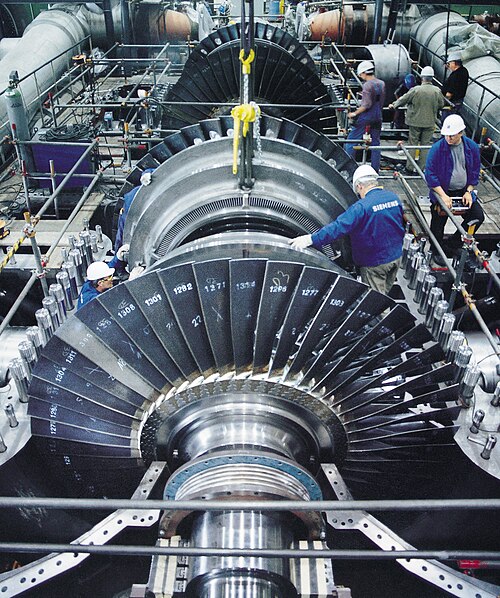
A large steam turbine under assembly in an industrial hall
A steam turbine under assembly. (Credit: Siemens, via Wikimedia, public domain)

The chips arrived. The power did not. Across three continents, AI data centers are sitting on racks of accelerators they cannot switch on, because the one input nobody hedged, grid interconnection, now runs a queue measured in years.

A queue longer than the hardware's useful life

The number utilities do not put in press releases: the typical interconnection wait in the largest US grid now runs past five years.1 A GPU generation is useful for about two.

012345Grid interconnection wait5+ yrsGPU generation, useful life~2 yrs
Data
Value
Grid interconnection wait5+ yrs
GPU generation, useful life~2 yrs
The queue outlasts the hardware it is meant to power. PJM interconnection queue data, 2026.[1]

So the buyers went around the grid. Behind-the-meter gas4, restarted nuclear like Microsoft's−0.70% — Microsoft, down 0.70 percent today deal to revive Three Mile Island6, and every idle turbine a utility could re-rate are suddenly assets with a bidding war attached.

Turbines are booked like jet engines

Turbine makers are quoting lead times normally reserved for aircraft engines. The order books are full through the end of the decade2, and the buyers are not the utilities. They are the model labs and their landlords.

The bill lands on someone else's meter

The second-order effect lands on your electricity bill. When a data center outbids a city for the same megawatt3, the clearing price moves, and regulators are only now noticing who is paying it5.

Whoever locks firm power on a ten-year contract locks the training roadmap. Everyone else is renting time on someone else's substation.

Get Power by email, free

How AI's hunger for electricity moves utilities, power plants and the grid. In our daily email, every weekday.


Loading MSFT

Reader comments

0 comments

    Power

    Bloom Energy's newest billion-dollar NTT DATA and Google power deals ship nothing until 2027

    The stock trades at 39.2x forward earnings, above GE Vernova and Enphase, yet the NTT DATA 900 MW order and the AEP plant for Google ship nothing until 2027 and 2028 while Q3 cash flow ran negative. The de-rating is a bet on when signed megawatts become invoiced ones.

    Power

    Pinnacle West files 25-year deal making TSMC fund its own power ahead of a December rate decision

    The 25-year contract is the template for every data-center deal that follows it, and it lands before two Arizona regulators elected three days earlier on bill anger. Pinnacle West's growth story now rides on convincing them.

    Power

    Energy Department paid BWXT $68 million for uranium work as its first US new-build order slips to 2027

    The payment has sat unremarked in federal data for eleven days, and the one tracker that noticed coded the award to L3Harris. It is the funded half of BWXT's growth paying out in cash, while the commercial half, the AI-power half, waits on an order that slipped to 2027.

    Power

    CPUC proposal would cut PG&E's 5,000-mile undergrounding plan to about 1,100 miles

    A judge has moved $1.7 billion of wildfire costs onto California ratepayers, and on November 19 the commission votes on a cost test PG&E says would strike 3,900 miles from the capital it earns on. The utility has already cut $2 billion from its own 2027 plan.

    Power

    AEP counts 84 GW of contracted data-center load; 46 GW of it, in Texas, cannot yet energize

    AEP sells investors 84 GW of contracted demand and a $100.4 billion buildout, but half of that load is Texas letters of agreement that obligate no one to buy power, and ERCOT has paused the process that could approve any of it. The stock, at 20.9 times earnings, prices the full headline.

    Power

    Southern Company prices $1.75B of equity units at 8.625%, forcing stock buys by 2029

    The units pay 8.625% a year and force buyers to take Southern stock by December 2029, funding a data-center build that Georgia's newly Democratic regulators were elected to police.

    Subscribe to TheInference for free