Visa and Mastercard's $198 billion swipe-fee fight reopens, with a December 10 Fed deadline
Visa, Mastercard and the banks that issue their cards fund rewards and fraud prevention from that fee pool. The first deadline that matters closes about December 10, when the Federal Reserve's window to defend its vacated debit cap ends.
 Vincent Jiangfour-minute read
Affordability won, and merchants want it cashed in
Nine in 10 voters called the cost of living a "major" or "crucial" factor in their vote 1. Democrats won healthy majorities in both congressional chambers in last week's election 1, taking the Senate on November 3 2. The merchants' side read it as a mandate: Doug Kantor, general counsel of the National Association of Convenience Stores and a Merchant Payments Coalition executive committee member, said he expects swipe-fee bills in more than a dozen states 1.
Merchants paid $198.25 billion in credit and debit swipe fees last year, according to the Nilson Report 3, roughly 2% to 3% per transaction, on rates that networks such as Mastercard−0.63% — Mastercard, down 0.63 percent today and Visa−0.53% — Visa, down 0.53 percent today set themselves 1.
Every curb so far has stalled or died
Illinois' 2024 Interchange Fee Prohibition Act, which bars interchange, the swipe fee merchants pay on each card transaction, on the tax and tip portions of a bill, was permanently enjoined for national banks and the card networks in June on federal preemption grounds, and the state is appealing 14. Colorado's version was vetoed by Governor Jared Polis 1.
The Credit Card Competition Act would require banks above $100 billion in assets to open their cards to at least two networks, and it has President Trump's public backing 3. On November 3 it lost both lead Senate sponsors: Roger Marshall of Kansas, unseated by a Democrat, and Dick Durbin of Illinois, who retires 25. Backers may try a lame-duck attachment, with long odds 2, and the fight predates the election (The Inference, October).
The risk moved to statehouses and committee gavels
Democrats also won six new state trifectas, states where the party now holds the governorship and both legislative chambers, plus five governorships including Texas 1. Washington's chairs change with the map: Elizabeth Warren is in line to lead the Senate Banking Committee and Maxine Waters the House Financial Services Committee, with bipartisan bills in both chambers to cap card rates at 10% against average APRs above 20% 2.
Card lenders slid on the week after the results, Synchrony by 2.1% and Capital One−1.45% — Capital One, down 1.45 percent today by 1.5% 2.
An appeals court has already vacated the debit cap
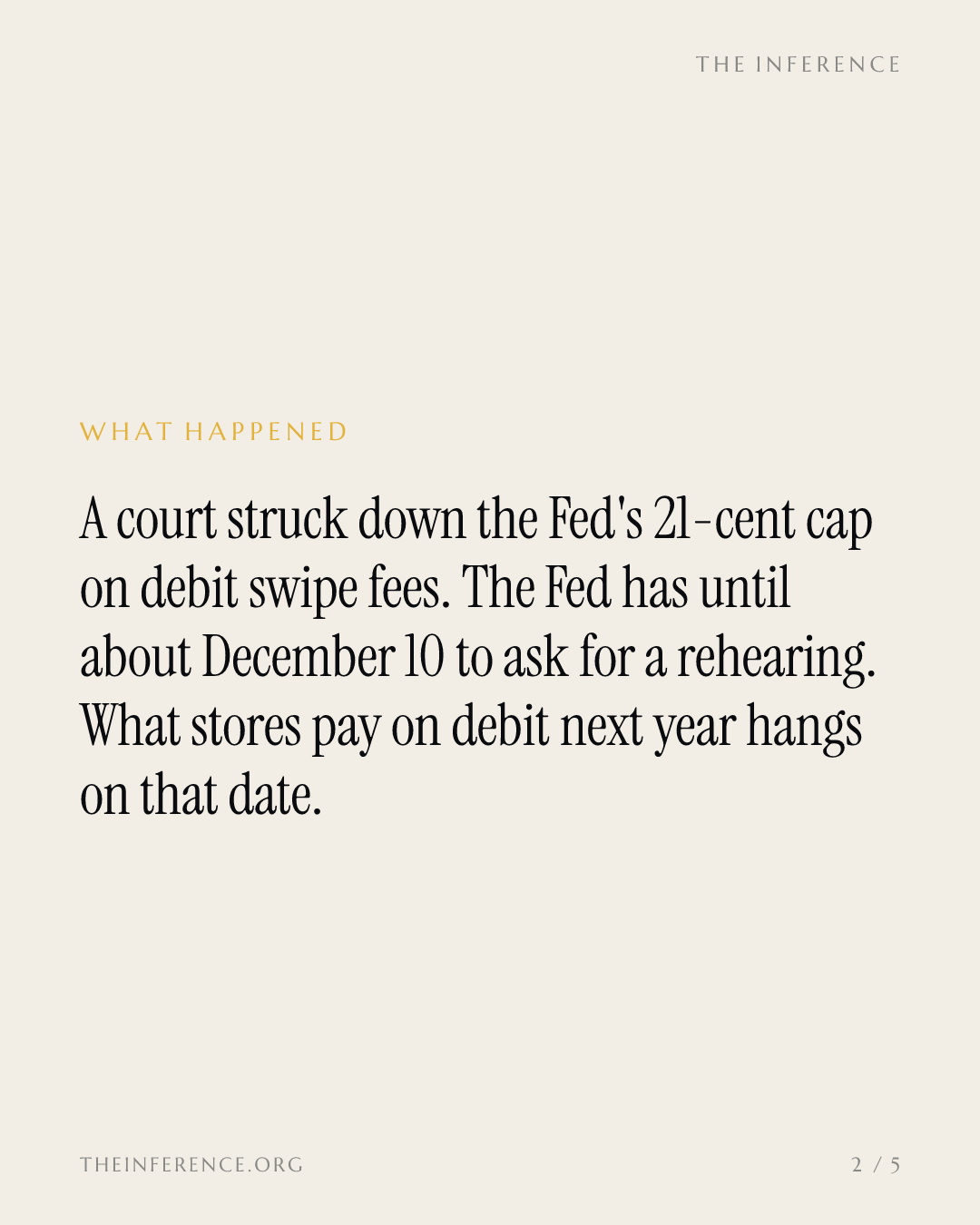
The courtroom moved before the election did. On October 26 the Eighth Circuit vacated the Federal Reserve's debit interchange cap in a suit brought by Corner Post, a North Dakota convenience store, holding that the Fed unlawfully folded fixed costs into a cap meant to cover only the marginal cost of each transaction 6. The old rate, 21 cents plus 0.05% of the transaction and a fraud-prevention cent, stands only until the court's mandate issues after the rehearing deadline 78.
| Front | What it would do | Status |
|---|---|---|
| Illinois Interchange Fee Prohibition Act, 2024 | Bars interchange on the tax and tip portions of a bill | Permanently enjoined for national banks and the card networks in June; the state is appealing |
| Colorado interchange law | A state version of the same curb | Vetoed by Governor Jared Polis |
| Credit Card Competition Act | Banks above $100 billion in assets must open their cards to at least two networks | Lost both lead Senate sponsors on November 3; a lame-duck attachment has long odds |
| Eighth Circuit, Corner Post suit | Vacated the Fed's debit cap of 21 cents plus 0.05% and a fraud-prevention cent | Old rate stands only until the court's mandate issues after the rehearing deadline |
The banks' answer, and the revenue that kept coming
Jason Stverak, chief advocacy officer of the Defense Credit Union Council, said after the ruling that a secure debit transaction "requires infrastructure, fraud monitoring, network connectivity, and ongoing investment," costs that "do not disappear because a court limits which ones may be reflected in an interchange standard" 8. Banks justify the fees as funding fraud prevention, processing and rewards 1. The revenue those fees feed kept compounding straight through the fight 910.
Network revenue is up 40% or more since late 2023, through every challenge
- Mastercard
- Visa
Data
| Mastercard | Visa | |
|---|---|---|
| Q4 '23 | $6.55B | $8.63B |
| Q1 '24 | $6.35B | $8.78B |
| Q2 '24 | $6.96B | $8.9B |
| Q3 '24 | $7.37B | $9.62B |
| Q4 '24 | $7.49B | $9.51B |
| Q1 '25 | $7.25B | $9.59B |
| Q2 '25 | $8.13B | $10.17B |
| Q3 '25 | $8.6B | $10.72B |
| Q4 '25 | $8.81B | $10.9B |
| Q1 '26 | $8.4B | $11.23B |
| Q2 '26 | $9.28B | $11.63B |
| Q3 '26 | $9.81B | $12.14B |
The December rehearing deadline is the next test
The Fed has about 45 days from the ruling to ask the Eighth Circuit to rehear the case 27. If it does not, and the mandate issues, the Fed must rebuild the cap on marginal cost alone; its own 2023 proposal to cut the rate to 14.4 cents already stalled under bank resistance 6. Next come the new state legislatures, where Kantor expects more than a dozen swipe-fee proposals 1. Whether the Fed seeks a rehearing by about December 10 decides what merchants pay on debit next year 1.
Get Economy by email, free
How AI moves rates, banks, payments and the wider economy. In our daily email, every weekday.