Zhipu's RMB 1 billion physical AI fund is mostly Hangzhou's money, not Zhipu's
A registry filed in Hangzhou shows two city-backed vehicles holding 60 percent of Zhipu's new RMB 1 billion physical AI fund, while Zhipu's own check stays unpublished and callable until 2031. The sell side prices the ecosystem story at HK$1,907 a share; the ledger still shows a RMB 2 billion half-year loss.
 Vincent Jiang · 3 min read

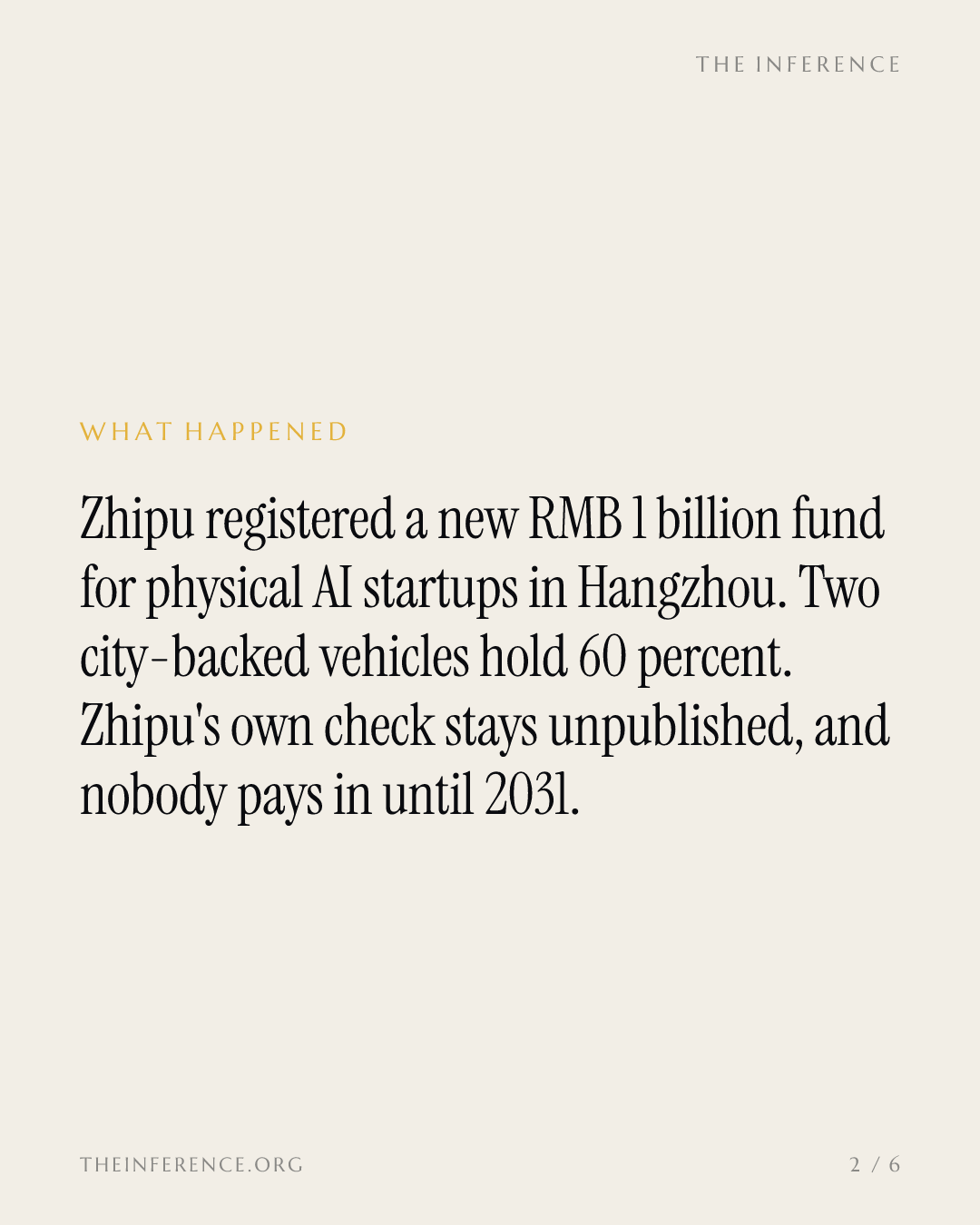
A fund named for cognitive intelligence was registered in Hangzhou on September 24, 2026, with RMB 1 billion of subscribed capital, and the registry reads less like a bet by Zhipu than a bet on Zhipu. Zhejiang Zhipu Jiangmen Cognitive Intelligence Venture Capital Partnership lists two Hangzhou government-backed vehicles holding a combined 60 percent.
Shangcheng Linghang Venture Capital and Hangzhou Urban Investment Industry Development are those vehicles. Zhipu's affiliate, QuantGroup's Hainan affiliate and two other entities split the rest, and the executive partner is run by Du Feng of Jiangmen Ventures, which backed Zhipu at Series A. Nobody has to pay in until September 2031 1.
The city that funded the model now owns the fund
The same city appears twice in Zhipu's ledger. In March 2025, Zhipu raised more than RMB 1 billion with Hangzhou municipal state-owned investors including Shangcheng Capital, and in May 2026 a subsidiary paired with Guotai Haitong's innovation arm on a RMB 540 million fund in Zhangjiang 1.
The Z Fund, an AGI-ecosystem vehicle run with LinkX Capital, closed at RMB 1.5 billion and stood at RMB 1.3027 billion with more than 30 AI investments at the end of 2025 1. The new fund's 60 percent city stake means the ecosystem around Zhipu's models is largely financed by the local state, with the model maker's own check unpublished and callable as late as 2031 1.
Three funds now sit behind Zhipu's ecosystem, the newest mostly city money
Data
| Value | |
|---|---|
| New Hangzhou fund, subscribed | 1B RMB |
| Z Fund, end-2025 value | 1.3B RMB |
| Zhangjiang fund, May 2026 | 0.54B RMB |
The sell side prices the ecosystem, the ledger shows losses
The tape has been generous. CLSA rates Z.AI Outperform with a HK$1,907 target on a survey of 1,200 IT executives in Asia outside China: 1.8 percent adoption today, 5.1 percent planning to adopt within 6 to 12 months 3.
The same survey finds 82 percent of GLM customers intending to raise spending against 77 percent for Anthropic$350B — Anthropic, private, latest valuation $350B, and 77 percent expecting switching costs 3. Against that, the hard numbers are about $142 million of first-half revenue, up around 400 percent, against a net loss near RMB 2 billion 2, and a market cap near $32 billion after a 300 percent run since January 4.
The security file the tape ignores
The counterweight arrived this week from Bloomberg. Four of Zhipu's five founder "key persons" worked on a 2018 to 2021 research project co-funded by CGTRI, the institute MI5's September 30 espionage alert tied to China's spy agency 5.
A company ledger of 2,436 vulnerabilities found in Western software was disclosed to just 5 percent of the vendors, then routed to state databases including one run by the Ministry of State Security 5. Zhipu rose 1.4 percent on October 21 while the Hang Seng fell 0.90 percent 6; the market read the fund news and priced the risk at zero.
What decides the story is not the fund's name but its calls: Zhipu's subscribed amount, and whether a model company losing RMB 2 billion a half-year converts city capital into enterprise revenue. The next interim filing carries both.
Get Model by email, free
The AI labs, their models, and the business behind them. In our daily email, every weekday.