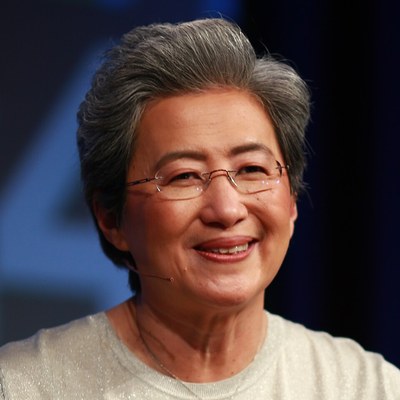
Su was born in Tainan, Taiwan, in 1969 and moved to the United States at three, growing up in Queens, New York. She graduated from the Bronx High School of Science in 1986 and went to MIT, choosing electrical engineering because it seemed the most difficult major. Undergraduate lab work making test silicon wafers and summer jobs at Analog Devices drew her to semiconductors. She earned a master's degree in 1991 and a PhD in 1994, researching silicon-on-insulator transistors, then an unproven way to make transistors more efficient.
Su joined Texas Instruments in 1994 and IBM in 1995 as a research staff member, later becoming vice president of its semiconductor research and development center. There she helped work out how to use copper connections in chips instead of aluminum, a technology launched in 1998 that made chips up to 20% faster. She founded IBM's Emerging Products division and led the team whose nine-processor design became the Cell chip in Sony's PlayStation 3. In 2007 she moved to Freescale Semiconductor as chief technology officer and later ran its networking and multimedia business.
Su joined AMD in January 2012 to oversee its global business units and pushed it beyond PCs, including chips for the Xbox One and PlayStation 4. She became president and CEO in October 2014, replacing Rory Read, with a plan to simplify the company and focus its technology investments. Non-PC products rose from about 10% of sales in 2012 to roughly 40% by February 2015. Under her, AMD passed Intel in market value for the first time, and in 2025 it announced a partnership with OpenAI. She is now chair as well as CEO.
In early October 2026 Su toured Taiwan and South Korea booking wafers, packaging and memory. She said demand is "even higher than our supply", promised a substantial supply increase for 2027 and said AMD now plans capacity three to five years out, up from one or two. At the Open Compute Project summit on October 13 she called 2026 "the year of inference", said AMD's Helios racks are running at OpenAI, Meta, Microsoft and Oracle, and put the data-center CPU market above $200 billion by 2030. Part of the OpenAI and Meta demand was secured with 320 million AMD shares at one cent each.
Sources · written 16 October 2026