Missouri votes Tuesday on half of Ameren's power buildout
MISO just awarded an Ameren and NextEra consortium a $1.23 billion Iowa transmission line that no Missouri regulator votes on. The generation half of Ameren's buildout still runs through Jefferson City, where utilities are giving to campaigns five to one ahead of the November 3 midterms.
 Richard Tang · 3 min read
The Iowa award grows with no Missouri vote
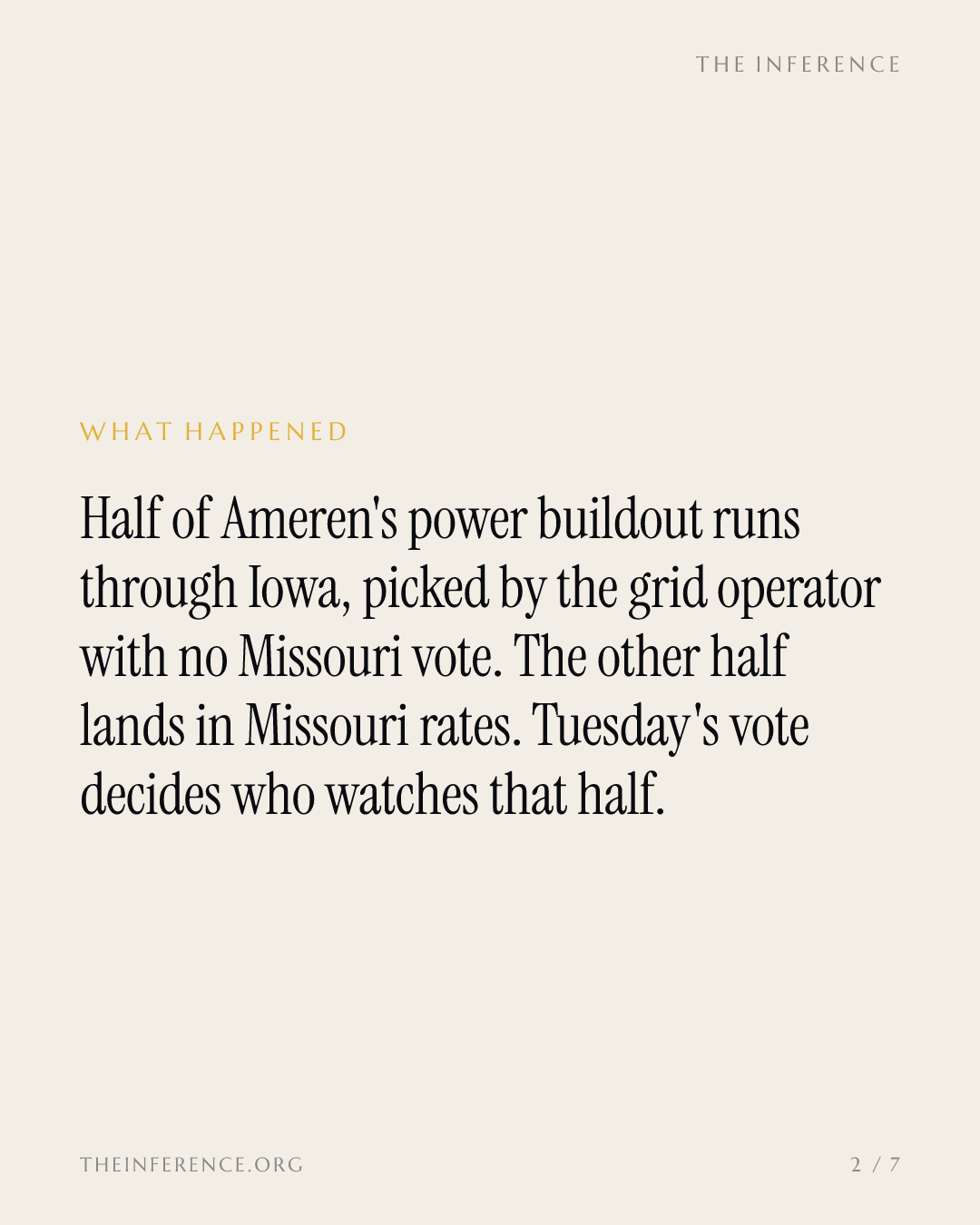
Half of Ameren's+0.54% — Ameren, up 0.54 percent today growth now sits outside Missouri's reach. On October 22, MISO, the grid operator for much of the middle of the country, selected Ameren Transmission Company of Illinois, GridLiance Heartland and Dairyland Power Cooperative, an Upper Midwest electricity cooperative, to build the East Adair project in Iowa: about 187 miles of 765-kV line, plus two short 345-kV connectors 1.
MISO puts the cost at roughly $1.23 billion, with the last piece in service by 2034 2. It is this consortium's third award of 2026 in Tranche 2.1, MISO's long-range transmission buildout 1.
Ameren's transmission arm and GridLiance, a unit of NextEra+2.46% — NextEra, up 2.46 percent today, hold 42.5% each 2. And because the line runs from southern Iowa to the Minnesota border, nothing in the award crosses a Missouri commissioner's desk. For Ameren (NYSE: AEE) and NextEra (NYSE: NEE), this is rate base, the assets a utility earns a regulated return on, added on a grid operator's calendar.
Missouri's half runs through a commission and campaign money
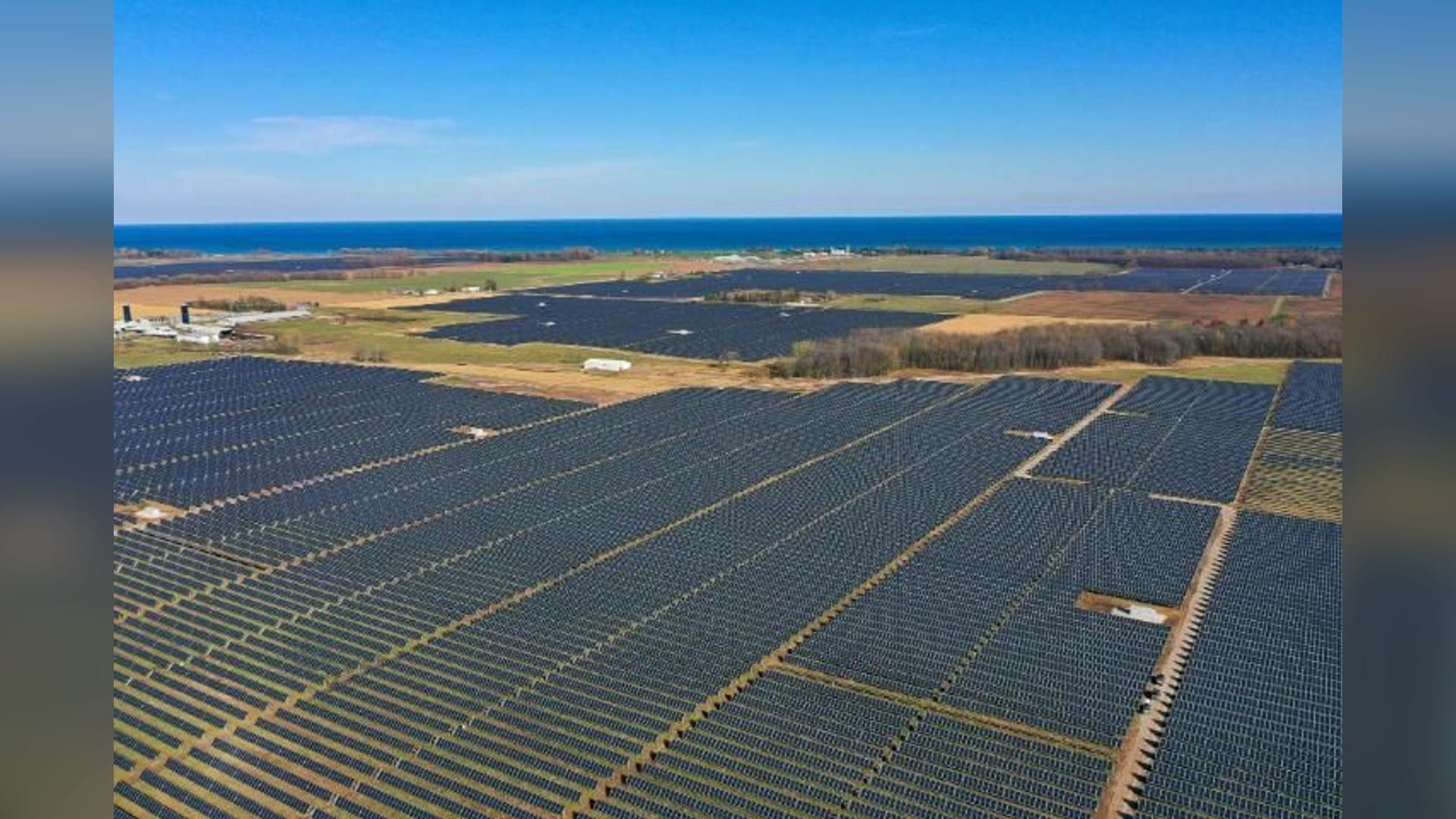
The day before, the Missouri Public Service Commission approved the other half: 945 MW of batteries and solar across five projects 3. All are due by 2029 3.
One Missouri vote: 945 MW across five projects
Data
| Value | |
|---|---|
| Millcreek, battery | 250 MW |
| Ringer, solar | 225 MW |
| Huck Finn, battery | 200 MW |
| Tom Sawyer, solar | 175 MW |
| Castle Bluff, battery | 95 MW |
Every dollar of that lands in Missouri rates, and Ameren already has a pending increase worth about $13 a month on a typical residential bill 5. Five cities that run their own electric utilities are asking a state appeals court to make Ameren pay $10 million over Rush Island 6. Ameren shut the coal plant in 2024, fifteen years early, after losing a federal Clean Air Act case 6. The votes around this half are financed as well.
Utilities and their political action committees put about $2.4 million into Missouri races over the past two years 4. About five times as much went to Republican-aligned groups as to Democratic ones 4. Three quarters of the money reaching legislators went to those who voted for Senate Bill 4, the 2025 law that rewired utility oversight 4. Ameren says none of it comes from customers' bills 4.
Both halves serve the same data center load
The customer behind both halves is the AI buildout. Ameren has committed to serving 2.8 GW of large data center demand by 2030, and its new 20-year plan leans on gas plants to serve it 7. Senate Bill 4 makes those customers sign decade-long contracts and cover their own grid costs, protections that consumer advocates in Missouri call thin if the boom slows 5.
That split is the story. The Iowa award compounds on MISO's schedule, carrying construction risk but no Missouri vote. The Missouri half compounds only as fast as commissioners and legislators allow. The build is right on the merits; what Tuesday, November 3, actually tests is who pays if the data centers arrive late.
Get Power by email, free
How AI's hunger for electricity moves utilities, power plants and the grid. In our daily email, every weekday.