Arteris is down 52% from its June high, royalties grew 65%, and cash guidance is gone before November 5
A vendor's fair-value model got the credit for Arteris' 52 percent slide, but the operating file tells the real story: royalties compounding at 65 percent, revenue guided flat, quarterly cash guidance withdrawn, and the November 5 print as the first test.
 Vincent Jiang · 3 min read

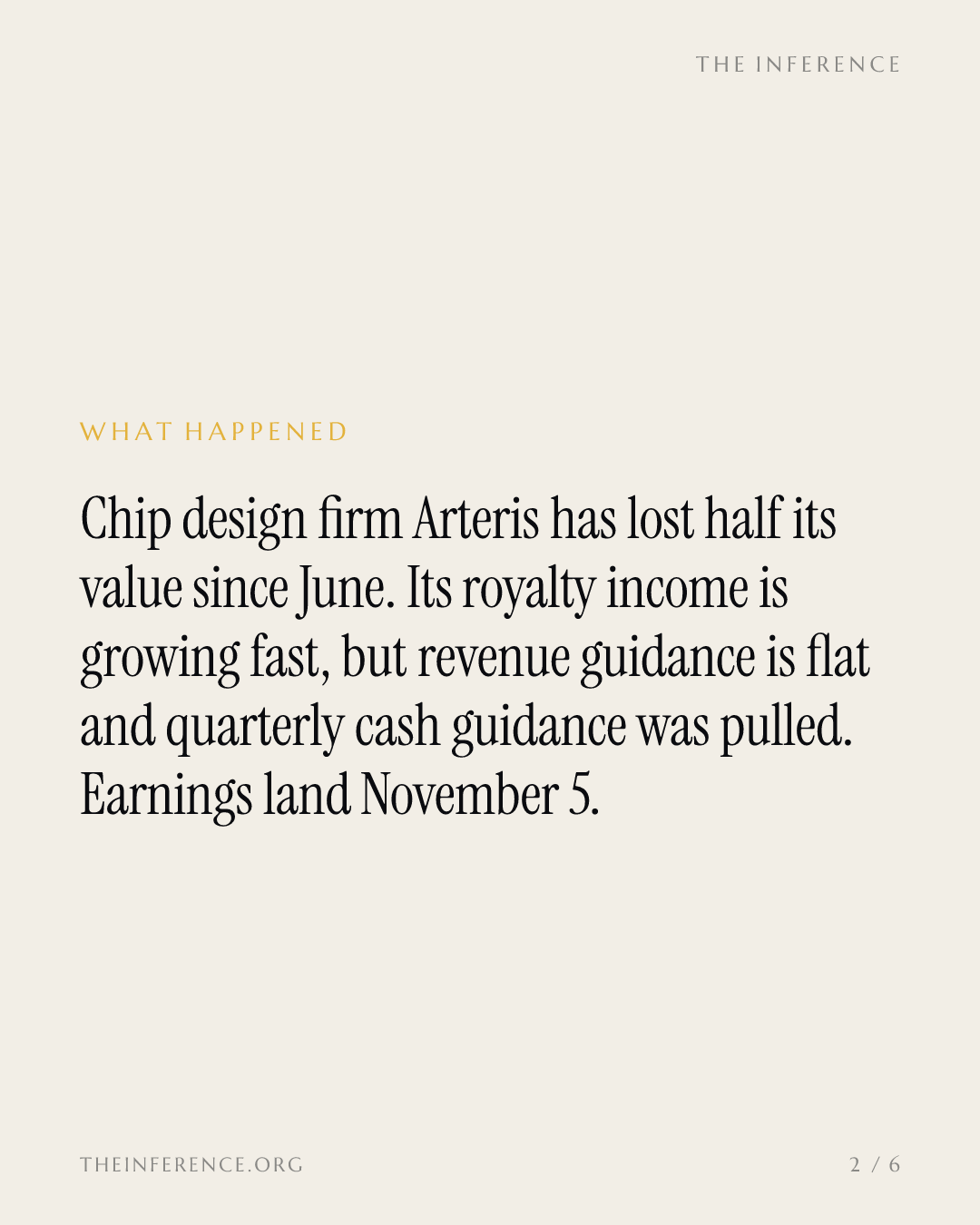
Arteris−1.23% — Arteris, down 1.23 percent today, the network-on-chip IP licensor whose technology routes data inside the chips behind AI data centers, fell 52 percent from its June high of $45.33 to $20.59 by late October 1. Nearly every line written about that slide traced back to one vendor's valuation model. The operating file behind the drop has gone unread. It contains a business compounding royalties at 65 percent, a Q3 revenue guide that barely moves, and a cash-flow disclosure the company just stopped providing 12.
Two camps, one stock
The bulls hold a royalty story. Trailing-twelve-month variable royalties, payments that follow customers' chips into production, reached $8.6 million, up 65 percent 2. Remaining performance obligations, contracted revenue not yet recognized, hit $135 million, up 36 percent 2. Cash and short-term investments stood at $122.1 million at June 30 2.
The sceptics read the same quarter differently: Q3 revenue is guided to $24.0 to $25.0 million, a midpoint about 2 percent above the $24.1 million just printed, and quarterly free cash flow guidance has been discontinued 2. That means design wins are on the contract ledger but the chips are not yet shipping. The market has already voted with a 52 percent drawdown 1.
Revenue nearly doubled in two years while cash flow swung from -$7.4M to +$8.6M
- Revenue
- Free cash flow
Data
| Revenue | Free cash flow | |
|---|---|---|
| Q3 '24 | $14.71M | $1.09M |
| Q4 '24 | $15.49M | -$2.68M |
| Q1 '25 | $16.53M | $2.68M |
| Q2 '25 | $16.5M | -$2.84M |
| Q3 '25 | $17.41M | $2.47M |
| Q4 '25 | $20.14M | $3.04M |
| Q1 '26 | $22.94M | -$7.36M |
| Q2 '26 | $24.13M | $8.62M |
What the operating file shows
Second-quarter revenue was $24.1 million, up 46 percent from $16.5 million a year earlier, and the year-on-year growth rate accelerated four quarters running, from 18.3 percent through 30 percent, 38.7 percent and 46.2 percent 25. The sequential path was not a straight climb; revenue dipped slightly from $16.53 million in Q1 2025 to $16.5 million in Q2 2025 5.
Revenue growth accelerated for four straight quarters before the November 5 print
Data
| Revenue growth | |
|---|---|
| Q3 '24 | 10.8% |
| Q4 '24 | 23.9% |
| Q1 '25 | 27.7% |
| Q2 '25 | 13.2% |
| Q3 '25 | 18.3% |
| Q4 '25 | 30% |
| Q1 '26 | 38.7% |
| Q2 '26 | 46.2% |
Losses widened too: the GAAP operating loss reached $13.9 million against $8.2 million a year before, and first-half free cash flow was just $1.3 million despite a strong $8.6 million second quarter 2. The swings have a named cause: the $7.36 million negative free cash flow in Q1 2026 included roughly $3 million of Cycuity acquisition consideration and fees 4. Management flagged the rest: larger deal sizes create quarter-to-quarter cash flow swings, so it guides annually now 4. The full-year range, $5.0 to $9.0 million of free cash flow on $95.0 to $98.0 million of revenue, is the only yardstick left 2.
The prints that cut both ways
Three signals inside the quarter point in opposite directions. Insider sales by the CEO, CFO and other executives totaled over $15 million, per one write-up; that source also carries an internally inconsistent revenue figure for Q2, so the sales total deserves its own check against Form 4 filings, the SEC disclosures that record insider trades, before any trade rests on it 1.
Chief executive K. Charles Janac told investors that two-thirds of customer engagements are into AI chips, and that data center design cycles "rise quicker and they also die quicker" 4. Chief financial officer Nicholas Hawkins gave the timing answer in the same session: hyperscaler royalties take two to three years to flow through 4. Hawkins, who built the guidance record, retires August 31 4.
The verdict arrives Thursday
Q3 results land November 5, the first print since quarterly cash guidance was withdrawn 3. Watch three lines: revenue inside the $24.0 to $25.0 million range, the non-GAAP operating loss against the guided $1.0 to $3.0 million, and royalty growth 2.
If royalties keep compounding while revenue sits flat, the compounders were right and the market mispriced a timing gap. If royalties stall too, the design wins were recorded on contracts rather than collected from shipped chips, and $122.1 million of cash is the only floor left 2. Either answer arrives in one print.
Get Chips by email, free
How AI demand is reshaping chipmakers, memory and the fabs behind them. In our daily email, every weekday.