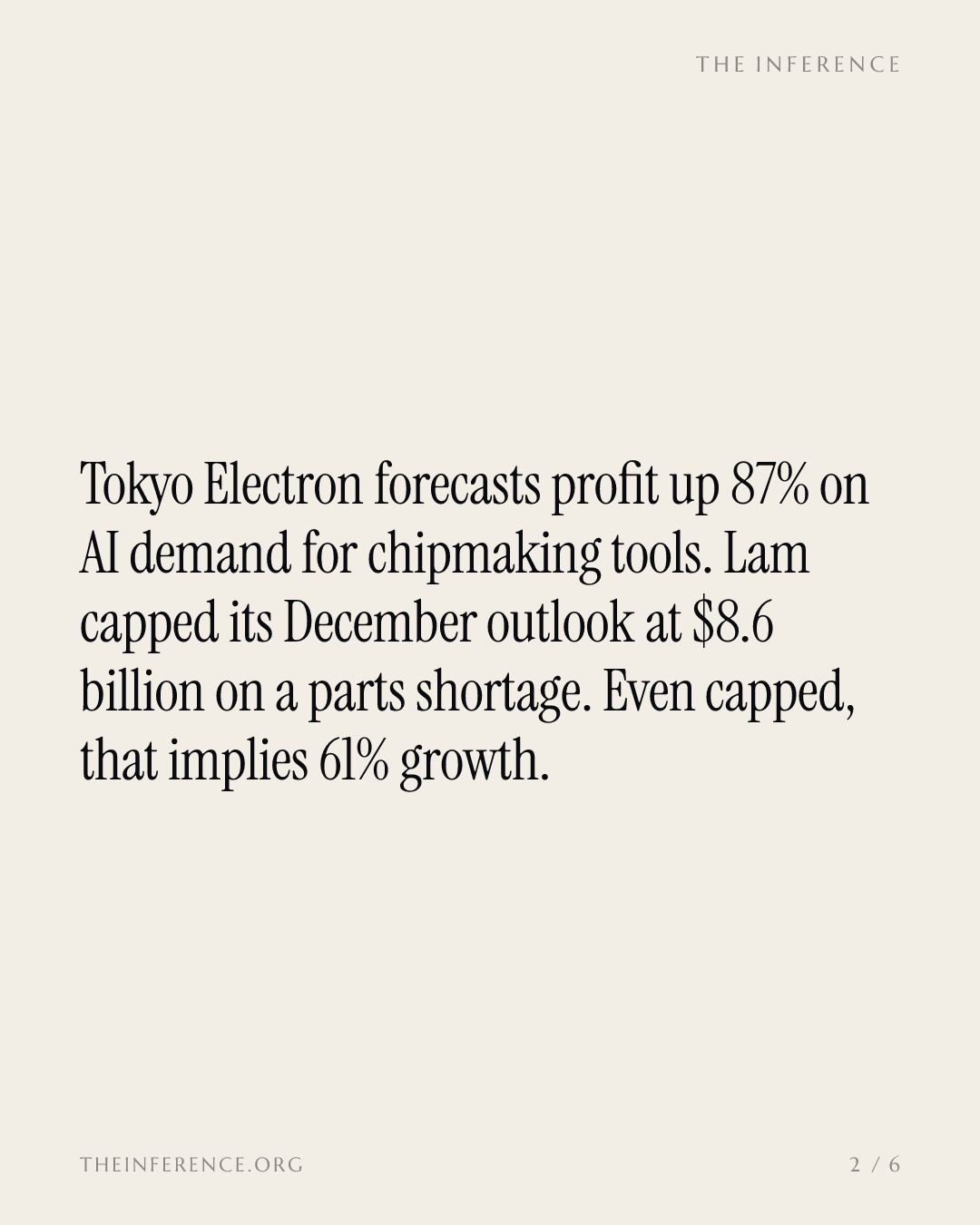
Tokyo Electron guides profit up 87%, and Lam Research's capped December guide implies 61% growth
Tokyo Electron forecast operating profit up 87.1% on AI-driven demand for chipmaking tools, and an Intel-led rout still knocked Lam Research down 6%. Lam's capped December guide implies 61% growth, and its January report decides which reading of the parts shortage holds.
 Vincent Jiang · 3 min read
The charge: a boom forecast and a capped December guide
Tokyo Electron+5.16% — Tokyo Electron, up 5.16 percent today, the Japanese maker of the etch and deposition tools that compete with Lam Research's+1.11% — Lam Research, up 1.11 percent today, forecast operating profit of ¥1.169 trillion for the year ending March 2027, up 87.1%, on sales of ¥3.7 trillion, in results released October 30 12. It puts 2027 wafer fab equipment spending, the market for chipmaking tools, above $210 billion, tied to GPUs, high-bandwidth memory and server chips 1.
On October 21, Lam finance chief Doug Bettinger capped the December-quarter outlook at $8.6 billion, plus or minus $400 million, saying it "would have been a bit higher if not for some near-term supply chain constraints" 3. The constraint has a name: the mass-flow controller, the valve that meters gas into an etch or deposition chamber. Ultra Clean Holdings, which builds the gas-delivery systems inside those tools, says the shortage "may continue for a quarter or 2" 5.
The evidence: the chain is growing near 50% either way
Lam's September quarter was a record $8.22 billion, up 54.4% 34. Tokyo Electron's July-September sales rose 48.4% 1. Ultra Clean posted record revenue of $759 million, up 49%, with operating cash flow of negative $42.3 million and $723 million of inventory, as The Inference reported October 28 5.
The chain is growing near 50% either way of the parts cap
Data
| Revenue growth | |
|---|---|
| Lam Research | 54.4% |
| Ultra Clean | 49% |
| Tokyo Electron | 48.4% |
Set against the $5.345 billion December quarter Lam reported a year ago, the capped midpoint still implies about 61% growth 34.
Even capped by parts, Lam's December guide points to a record quarter
- Revenue
- Estimate
Data
| Revenue | |
|---|---|
| Dec '24 | $4.38 |
| Mar '25 | $4.72 |
| Jun '25 | $5.17 |
| Sep '25 | $5.32 |
| Dec '25 | $5.35 |
| Mar '26 | $5.84 |
| Jun '26 | $6.72 |
| Sep '26 | $8.22 |
| Dec '26 guide (estimate) | $8.6 |
The defense: management sizes the cap as small
Chief executive Tim Archer calls this "nothing like" the COVID-era shortages and says Lam will be "caught up very shortly"; Bettinger says slipped orders land "in the March quarter" and vendors are "well capitalized and can manage this on their own" 3. The asterisks: Tokyo Electron's full-year figures are estimates, not results, and its ¥150 billion buyback may run in part or not at all 1. Ultra Clean's 17.3% gross margin against a 20% target shows who finances the ramp 5.
The verdict watch: one rout sold both camps
Intel−2.17% — Intel, down 2.17 percent today, the PC-chip maker, guided its fourth quarter to $15 billion to $16 billion on October 29, below the $17 billion expected, and sees the PC market shrinking 12% this year on a memory shortage 6. The next session closed Lam down 6.01% at $239.11, with the Street's mean target of $364.03 implying 52% upside; Teradyne+0.04% — Teradyne, up 0.04 percent today, the chip-test equipment maker, fell 6.3%, Applied Materials+2.25% — Applied Materials, up 2.25 percent today 5.8%, KLA+2.51% — KLA, up 2.51 percent today 4.3% 78. Tokyo Electron's own shares closed 5.2% lower in Tokyo 2.
Before January, three suppliers report into the same squeeze: Ichor, the fluid-delivery maker guided to $315 million to $345 million, today, November 2, then Coherent+3.81% — Coherent, up 3.81 percent today and Lumentum−9.96% — Lumentum, down 9.96 percent today, the optics suppliers behind the parts KLA says pace its shipments, on November 4 and 5 5. The decider is Lam's January report against the $8.6 billion line: December growth at the rival's rate says the cap is the industry's; a miss says it is Lam's 3.
Get Chips by email, free
How AI demand is reshaping chipmakers, memory and the fabs behind them. In our daily email, every weekday.