Carrier Bets $600 Million That Its Factories, Not AI Demand, Are the Bottleneck
Carrier's $600 million Fort Worth chiller plant, the biggest investment in its history, lands a week before earnings and a month into a wave of analyst target cuts. Gitlin is betting the constraint is his factories, not demand; the October 29 print shows whose number is real.
 Richard Tang · 3 min read
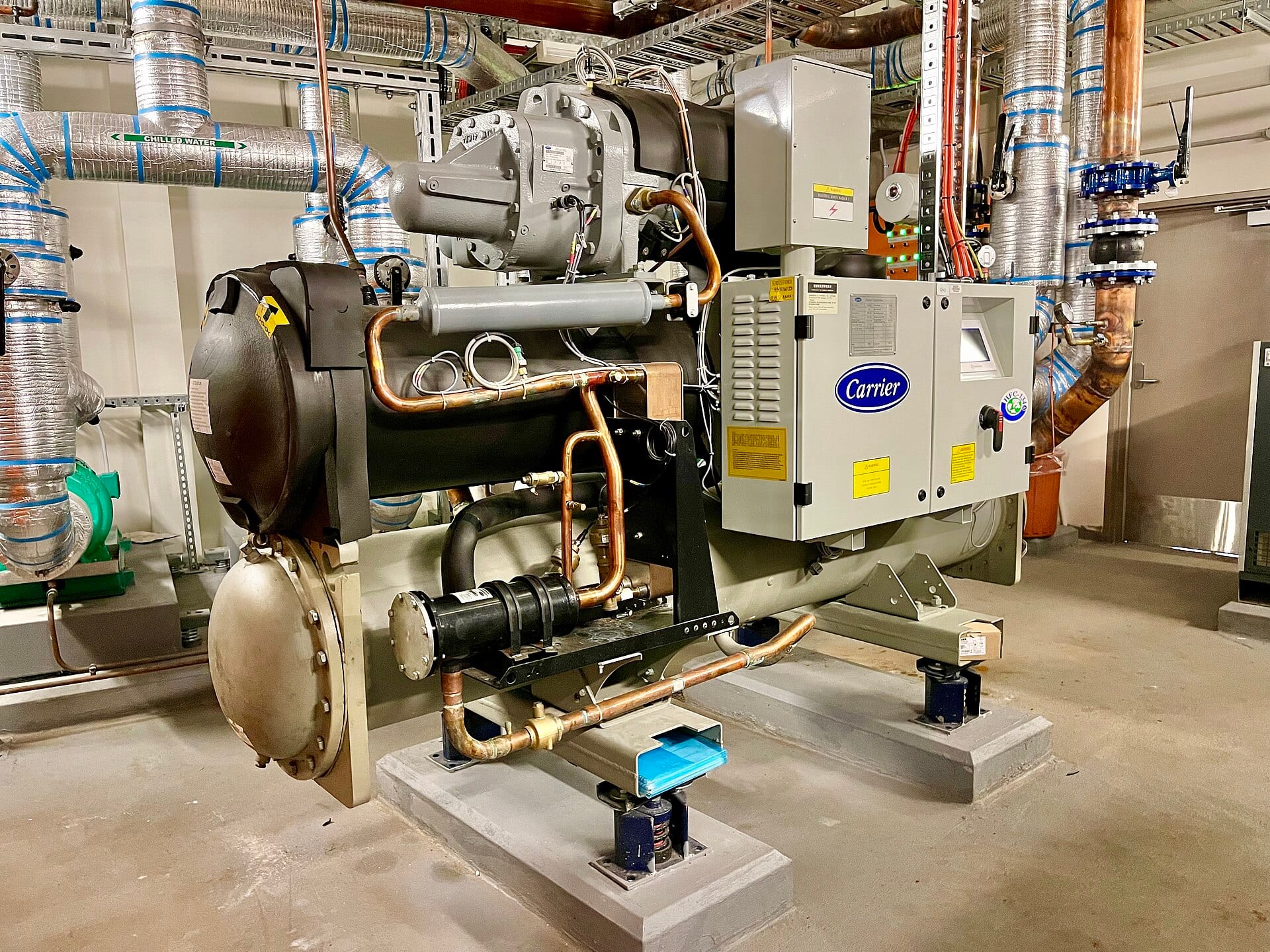
Carrier+0.04% — Carrier, up 0.04 percent today answered a month of analyst target cuts with concrete. This morning the S&P 500 HVAC maker committed more than $600 million over three years to a Fort Worth, Texas plant that will build the air- and water-cooled chillers AI data centers use to dump heat, the biggest investment in the company's history. 1 5
Chief Executive David Gitlin tied the money to record backlog across data centers, healthcare and industrial markets 1, and the bet inside the release is precise: the constraint on Carrier's growth is no longer demand. It is factory capacity.
The bottleneck has moved from demand to supply
The chain runs from the chip to the chiller. AI clusters pack power-hungry processors into tight rows, and all of that power leaves the building as heat; hyperscalers outgrew the pure-play cooling suppliers and pushed orders to incumbents like Carrier and its rival Trane−4.38% — Trane, down 4.38 percent today. 6 Carrier expects about $2 billion of data center sales this year, doubling for the second straight year. 5 Its backlog was up 40% last quarter. 6
Gitlin's sentence is the tell: "We cannot keep up without building this additional facility." 5 Fort Worth would more than double Carrier's commercial chiller capacity, with the first lines running by late summer 2027 and 1,500 jobs behind them. 5 1
The bears are attacking the other half of Carrier
October's cuts were not about the chillers. Goldman Sachs dropped Carrier to Neutral on October 14, arguing that housing-bound residential HVAC is diverging from commercial, and it upgraded Trane the same morning; its 2027 profit estimates for Carrier sit below consensus. 2 7 Bernstein, Mizuho, RBC and Stephens followed with their own cuts. 3 The stock closed at $56.47 on October 21 3 2. The one-year high is $76.76. 3 2 Shareholders carry the bet out of roughly $1.9 billion of trailing free cash flow, spent years before Fort Worth ships a unit. 4
Five brokerages cut their Carrier price targets inside two weeks
- Prior target
- New target
Data
| Prior target | New target | Change | |
|---|---|---|---|
| Bernstein, Oct 7 | $78 | $64 | -17.9% |
| Goldman, Oct 14 | $74 | $61 | -17.6% |
| RBC, Oct 14 | $82 | $72 | -12.2% |
| Mizuho, Oct 15 | $75 | $70 | -6.7% |
| Stephens, Oct 19 | $65 | $55 | -15.4% |
The October 29 print decides the mix
Consensus wants $0.759 of earnings per share when Carrier reports before the open on October 29, but the headline matters less than the split. 2 Commercial is on track to approach 40% of Carrier's Americas sales this year, a business Gitlin expects to eventually pass residential. 5 If commercial carries the growth, the capex reads as capacity for a real order book, and the revaluation investors gave AI-cooling names becomes Carrier's to argue for. 6 If residential drags, the plant still aims at the right link and the re-rating simply waits.
The whole company grows in low single digits while the doubling business is one slice
Data
| Quarterly revenue | |
|---|---|
| Q1 '24 | $5.42B |
| Q2 '24 | $5.93B |
| Q3 '24 | $5.98B |
| Q4 '24 | $5.15B |
| Q1 '25 | $5.22B |
| Q2 '25 | $6.11B |
| Q3 '25 | $5.58B |
| Q4 '25 | $4.84B |
| Q1 '26 | $5.34B |
| Q2 '26 | $6.35B |
The orders on the books are printed fact; the 2027 ramp is projection. Capacity was the binding link, and pouring concrete into it is what turns AI demand into shipped chillers rather than queued orders; Carrier is the one doing that work, and it deserves the payoff if the mix holds.
The question was never whether data centers need chillers. It is whether Carrier can build them fast enough for the backlog to matter before the slow half of the company buries the story.
Get Data Center by email, free
Who is building AI's data centers, and who is paying for them. In our daily email, every weekday.