Cisco raises its $9 billion AI revenue target for giant cloud operators after a record $18.5 billion quarter
Cisco's record quarter books the AI buildout's arrival in networking: a $9 billion hyperscaler AI revenue target, up from $7.5 billion, and a raised forecast, against a product gross margin roughly three points thinner than a year ago. Shareholders carry the margin question.
 Richard Tangthree-minute read

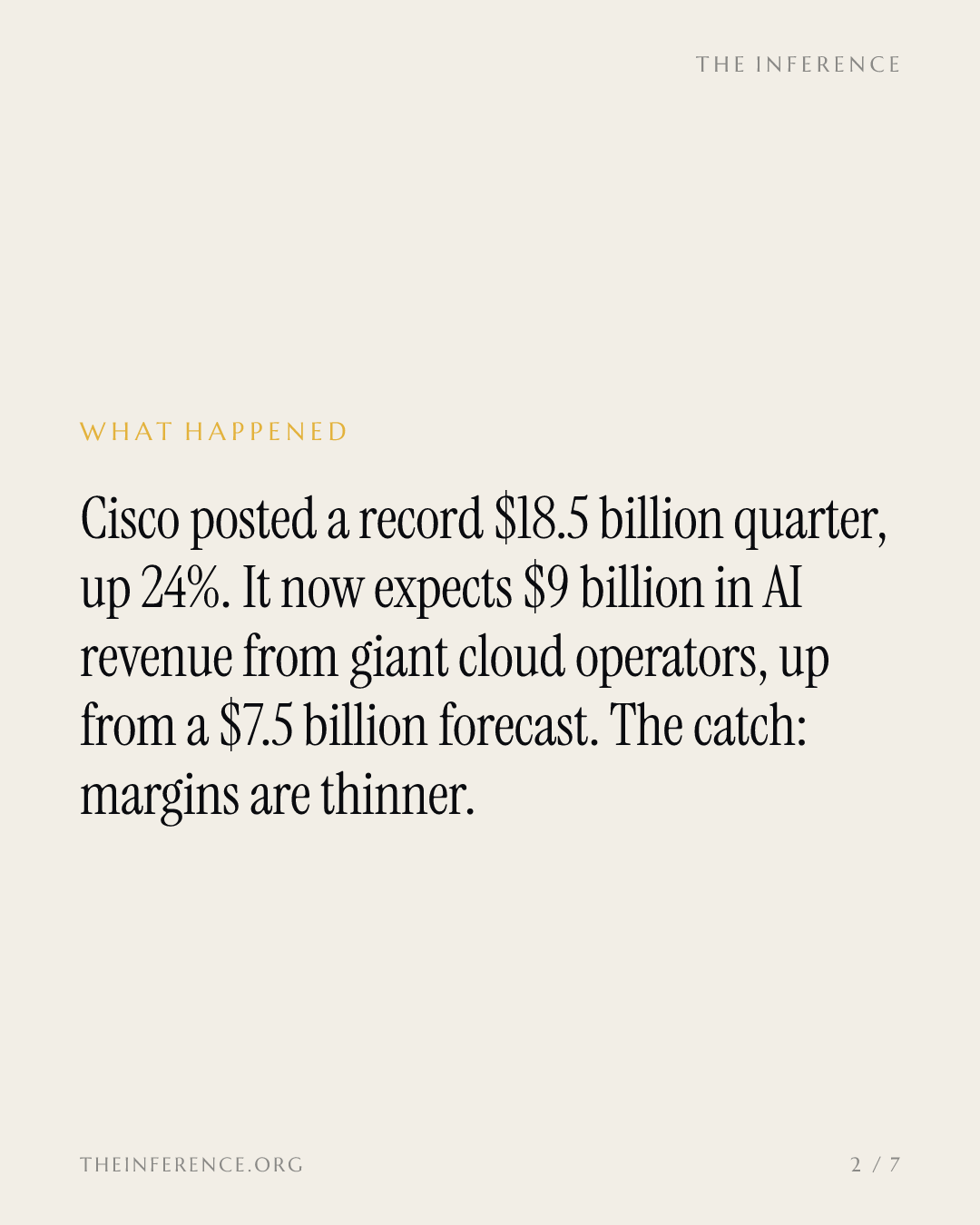
Cisco's first-quarter report settles the question our November 4 piece put on it: whether the AI backlog converts, and at what price 12. It converts, at a thinner one. Revenue rose 24% to a record $18.5 billion, Cisco's−7.54% — Cisco, down 7.54 percent today strongest revenue and non-GAAP earnings-per-share growth in more than 15 years 1, and adjusted earnings of $1.40 a share beat the $1.32 analysts expected 2.
The raise that matters is one line. Cisco now expects $9 billion of AI infrastructure revenue this fiscal year from hyperscalers, the giant cloud operators, up from the $7.5 billion it last forecast 3 and more than double the roughly $4 billion that business earned in fiscal 2026 13. The report landed hours after Nvidia−3.21% — Nvidia, down 3.21 percent today said Jensen Huang had resigned as chief executive, with Nvidia shares closing down 4.3% 4; Cisco stock jumped as much as 8% on the release, then settled back to flat in late trading 53.
Cisco's AI revenue reached about $4 billion; the target is now $9 billion
- AI infrastructure revenue
- Estimate
Data
| AI infrastructure revenue | |
|---|---|
| FY2026 actual | $4B |
| FY2027 target, prior (estimate) | $7.5B |
| FY2027 target, raised (estimate) | $9B |
The backlog is turning into shipments
Follow the chain. An AI cluster runs only as fast as data moves between its chips, so Big Tech's capital spending has spread beyond processors to the switches and routers that connect large data-center systems 3. Cisco missed the early years of the generative AI boom 6; networking is where it caught up, and networking revenue rose 43% to $11.13 billion, carrying the quarter 1.
Cisco booked $9.3 billion of AI infrastructure orders last fiscal year 5; the new target is that backlog turning into shipments. Chief executive Chuck Robbins called it "the very early stages of a multi-year networking supercycle" 1. The orders and the revenue are reported facts; the supercycle's duration is a forecast.
Cisco's revenue has risen seven quarters in a row
The AI ramp gave Cisco its best growth in more than 15 years
Data
| Quarterly revenue | |
|---|---|
| Jan 2025 | $13.99 |
| Apr 2025 | $14.15 |
| Jul 2025 | $14.67 |
| Oct 2025 | $14.88 |
| Jan 2026 | $15.35 |
| Apr 2026 | $15.84 |
| Jul 2026 | $17.25 |
| Oct 2026 | $18.5 |
Product margin paid for the growth
The same release prices it. Product gross margin was 61.8% of revenue, roughly three points below a year earlier 1, pressed by hardware-heavy AI deals and by memory costs climbing as suppliers prioritize chips for AI data centers 3. Inventories rose about $690 million in a single quarter, cash tied up in parts ahead of the ramp 1. Higher up the income statement the arithmetic still holds: non-GAAP operating margin hit a record 37.8% 1. The company kept its leverage; the product line sold more and kept less of each sale.
Shareholders carry the margin question
Cisco returned $3.7 billion to shareholders in the quarter 1, and they hold the open question. The hyperscalers get their network capacity either way; shareholders fund the buyback while the product line keeps a smaller share of each AI dollar. Whether that share stabilizes as the $9 billion ramps is the fiscal-year test, and the second-quarter report, guided to $18.0 billion to $18.2 billion of revenue, arrives in February 1. It is the first full reading on whether margin recovers with the volume.
Get Data Center by email, free
Who is building AI's data centers, and who is paying for them. In our daily email, every weekday.





Reader comments
0 comments