DeepMind says coordination beats benchmarks while Alphabet posts negative $9.07 billion free cash flow
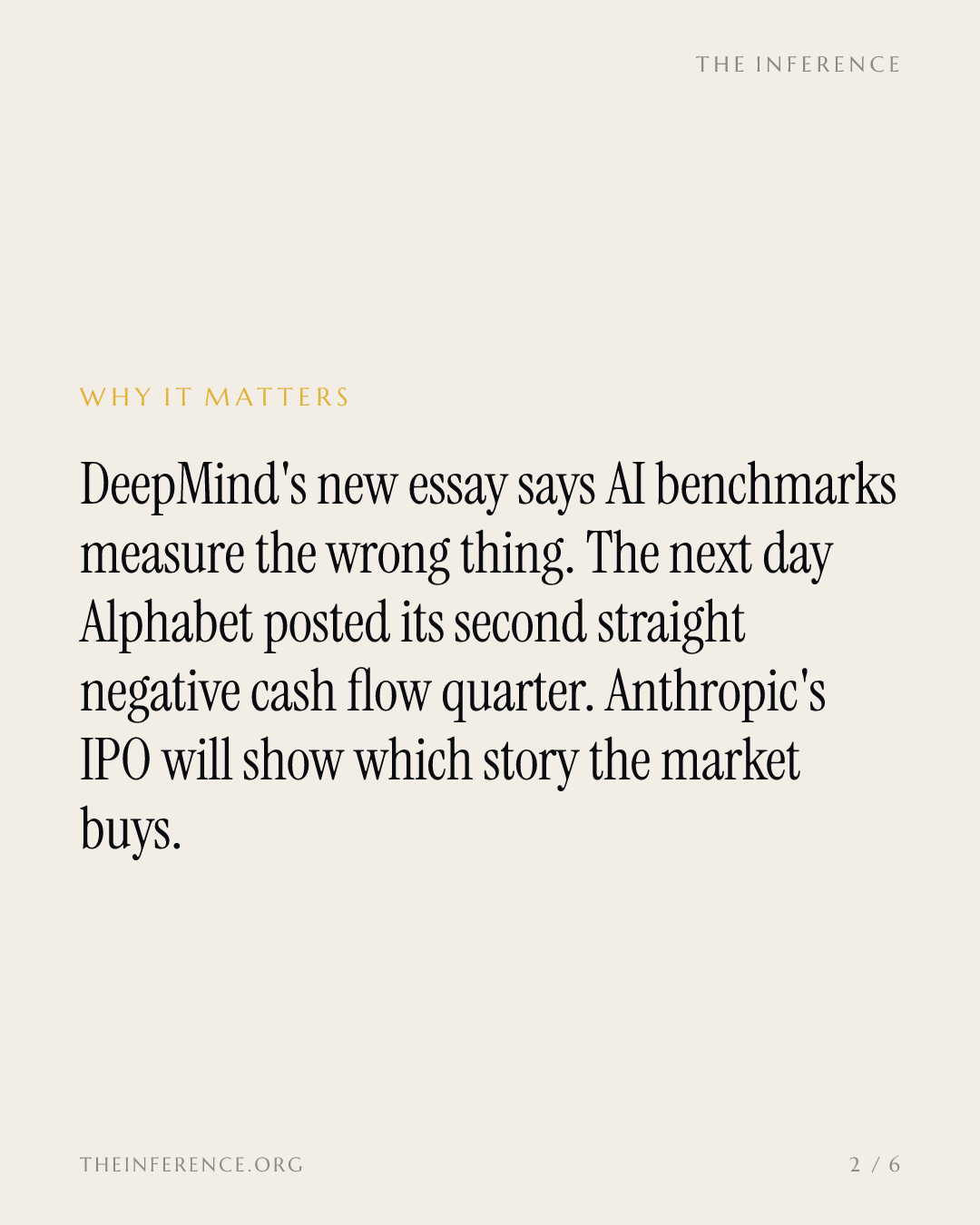
DeepMind's new essay argues solo benchmarks measure the wrong thing and that human wages will anchor to the cost of compute. The same week Alphabet posted negative free cash flow, launched a number-one benchmark model developers cannot buy, and Anthropic headed toward a mid-November IPO.
 Vincent Jiang · 4 min read

A lab wrote the case against its own launch
On October 29, 2026, Google DeepMind's research institute published "The Economics of Intelligence", an essay with a blunt finding: the economy has not changed 1. Most people still go to recognizable jobs and "aggregate productivity numbers have barely budged" 1. Its explanation is that benchmarks aim at the wrong object. They score one agent in isolation, while economies run on organizations that combine complementary specialists; in the essay's quiz of 100 people across six domains, deliberately paired specialists beat random pairs by 32% 1.
The scarce capability is coordination between agents, which, once it crosses a threshold, triggers "large, abrupt jumps in market concentration, employment, and wages" 1. One day earlier, Google shipped Gemini 4 Carbon, which tops Artificial Analysis's overhauled intelligence index at 59 2.
One point on the leaderboard, one thread on Hacker News
It is the sequel to a launch covered on this page on October 28, when Gemini 4 Argon shipped unpriced and the last launch cost Unity 24% in a day (The Inference, October 28, 2026) 3. The essay's widest airing so far is a Hacker News thread titled "AGI Economics: Coordination vs. Competence" 3.
The week the money moved
The timing is not abstract. Alphabet's−1.59% — Alphabet, down 1.59 percent today Q3 2026 results, released October 28, showed free cash flow of negative $9.07 billion, the second straight negative quarter, on capital spending of $51.36 billion, up 114% year over year 49.
The full-year capex guide is $195 billion to $205 billion, heading above $300 billion in 2027, and debt has climbed from $24.9 billion two years ago to $141.9 billion 49. Anthropic$350B — Anthropic, private, latest valuation $350B filed its S-1 on October 26 with first-half revenue of $16.3 billion 6; its pre-IPO perpetual futures fell about 7% after the filing, and a Nasdaq listing under the ticker ANT could price as early as mid-November at a valuation of $1.5 trillion to over $2 trillion 56.
Alphabet's capex nearly quadrupled in two years while free cash flow went negative
- Capital expenditures
- Free cash flow
Data
| Capital expenditures | Free cash flow | |
|---|---|---|
| Q2 '24 | 13.19B | 13.45B |
| Q3 '24 | 13.06B | 17.64B |
| Q4 '24 | 14.28B | 24.84B |
| Q1 '25 | 17.2B | 18.95B |
| Q2 '25 | 22.45B | 5.3B |
| Q3 '25 | 23.95B | 24.46B |
| Q4 '25 | 27.85B | 24.55B |
| Q1 '26 | 35.67B | 10.12B |
| Q2 '26 | 44.92B | -5.86B |
| Q3 '26 | 51.36B | -9.07B |
What the essay says about those tokens
The investor-facing line is this: whenever a model matches human capability, "human wages become tied to the cost of compute" 1. Carbon's price list reads like that thesis in practice, $2 per million input tokens and $10 output, doubling to $4 and $20 once the introductory period ends 2. Alibaba's−1.40% — Alibaba, down 1.40 percent today Qwen3.8-Max, the frontier-class flagship of the Chinese group's Qwen model line, already sells at $2 and $6, against Claude Opus 5's $5 and $25 7.
Orchestration is the moat, and Google Cloud grew 103%
If wages and rival models anchor to compute cost, the token is the cheap input and the value sits with whoever owns orchestration inside the firm. That is a case for Google Cloud, which grew 103% to $30.7 billion last quarter 4, and a warning for anyone pricing an IPO on token margins alone 56. The essay adds a rule for reading the labor market: wage effects arrive before firms restructure, so employment statistics that look quiet are weak evidence that AI is having no effect 1.
Frontier token prices cluster at $2 to $5 input, and Carbon's own price doubles after the intro period
- Input, $/1M tokens
- Output, $/1M tokens
Data
| Input, $/1M tokens | Output, $/1M tokens | |
|---|---|---|
| Carbon intro | 2 | 10 |
| Carbon after intro | 4 | 20 |
| Qwen3.8-Max | 2 | 6 |
| Claude Opus 5 | 5 | 25 |
| GPT-5.6 Sol | 5 | 30 |
The other camp's exhibit
The essay's own witnesses undercut its urgency. OpenAI's$500B — OpenAI, private, latest valuation $500B Noam Brown, after running thousands of agents in parallel on open math problems, found coordination so hard that he "wouldn't even attribute 10% of the credit to multi-agent" performance over single-agent work 1.
No published benchmark scores coordination; the essay admits leaderboards do not measure it 1. And Google still chose to launch on a solo-agent leaderboard, winning by a single point over Claude Opus 5.5's 58 8. Carbon itself remains off developers' desks: access this week goes to a subset of cyber defenders through the Fairwind Program, with general availability "as soon as possible" 2.
What prices the argument
The dated event is Anthropic's IPO. If institutions pay $1.5 trillion or more for a token seller in mid-November, the market has ruled the essay a theory; if the price wobbles, coordination becomes the story of the window 56.
The essay has drawn almost no coverage beyond that single thread 3, so the argument sits unpriced until the market votes. The tells to watch are Carbon's general-availability date and the first published multi-agent benchmark, the scoreboard the essay says does not yet exist 12. For now the arithmetic is unchanged: the lab that argued tokens are the cheap input still sells them at $2, until the introductory price doubles 2.
Get Model by email, free
The AI labs, their models, and the business behind them. In our daily email, every weekday.