Anthropic's $16.3 billion half-year meets MiniMax's $0.15 rate card
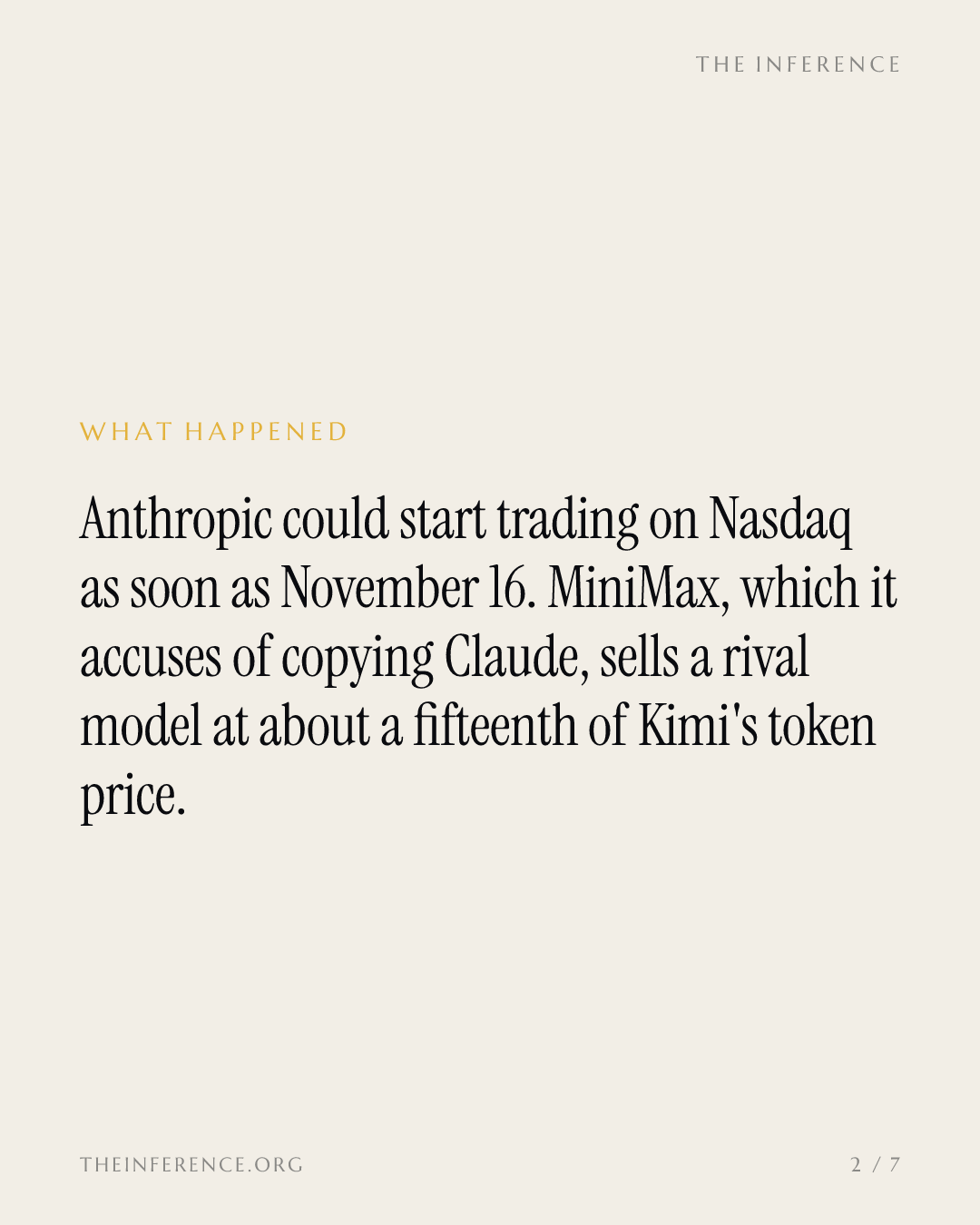
MiniMax, named in Anthropic's distillation evidence, sells a model tied for fourth among open weights at about a fifteenth of Kimi's token price. Anthropic's Nasdaq debut, with no price range set, could trade as soon as November 16 and will set the multiple Chinese AI is graded on.
 Vincent Jiang · 3 min read
A 15-fold gap on the price list
MiniMax, a Shanghai AI lab listed on the Hong Kong exchange since January 9, prices its model M3.1 Flash at $0.15 per million input tokens, $0.60 for output and $0.015 for cached input 1. Anthropic$350B — Anthropic, private, latest valuation $350B, maker of the Claude models, could begin trading on Nasdaq as soon as November 16, and the price it wins will grade a sector where Z.AI and MiniMax, the two Hong Kong-listed Chinese labs, together earned one sixty-third of Anthropic's first-half sales 23.
Moonshot AI, the Chinese lab behind the Kimi models, lists Kimi K3.1 Pro at $2.00 per million input tokens and $10.00 for output 4. On an uncached blend of three input tokens to one output token, that is $4.00 per million against MiniMax's $0.2625, about 15 times 5. In one 43-question run reported on October 26 by OrcaRouter, a benchmarking service, MiniMax answered 41 correctly for $4.09; Kimi answered 42 for $13.47 5.
Kimi's published token rates run 13 to 17 times MiniMax's
- Input, $ per million tokens
- Output, $ per million tokens
Data
| Input, $ per million tokens | Output, $ per million tokens | |
|---|---|---|
| MiniMax M3.1 Flash | $0.15 | $0.6 |
| Kimi K3.1 Pro | $2 | $10 |
The capability is cheap, and Anthropic says some of it was taken
In February, Anthropic accused MiniMax and two other Chinese AI labs, DeepSeek and Moonshot, of sending more than 16 million requests to Claude through more than 24,000 fraudulent accounts to train their own models, a practice called distillation: prompt a stronger model, then train on its answers 6.
Anthropic's September threat report named seven Chinese labs, led by Alibaba−0.71% — Alibaba, down 0.71 percent today with about 151 million requests, and in mid-October it said tighter identity checks had cut the harvest by 90 to 99 percent 6. On October 29, The Information, a tech-news outlet, reported that DeepSeek and Moonshot then distilled OpenAI's GPT-6 Astra; the companies did not comment, Beijing rejects the claims, and none is independently verified 6.
The prospectus that prices the quarrel
Anthropic's prospectus (the S-1 filing), public since October 26, shows $16.3 billion of first-half revenue; its $80.7 billion net loss is mostly accounting on convertible notes 7. Compute and infrastructure costs nearly quadrupled to $8.9 billion, against $1.6 billion of adjusted operating profit 3.
Compute costs near $9 billion left a $1.6 billion adjusted operating profit
Data
| First half of 2026 | |
|---|---|
| Revenue | $16.3B |
| Compute and infrastructure costs | $8.9B |
| Adjusted operating profit | $1.6B |
Reuters Breakingviews puts that half-year revenue at 63 times Z.AI and MiniMax combined, and MiniMax's own 2025 accounts show $79 million of revenue against a $1.87 billion loss 38. Rhodium Group, a research group, reckons all Chinese models together earn about a tenth of OpenAI and Anthropic, and Moonshot has reportedly filed confidentially for a Hong Kong listing of its own 9.
No price range is set. Securities and Exchange Commission rules allow a roadshow from November 10, with November 16 the earliest first trade 2. The Inference has covered the listing since September; what is new this week is the missing range, the 63-times revenue gap and a benchmark rebuilt around private tests 2.
What the IPO price decides
Artificial Analysis, a benchmarking service, rebuilt its Intelligence Index around private test questions on October 27, and Chinese scores fell hard: Kimi K3.1 Pro dropped from 55 to 46, still the best open-weight score even though Moonshot has yet to post the downloadable files 611. MiniMax's M3.1 Flash, at 29, ties for fourth among open weights 10.
Seventeen points behind Kimi on the rebuilt index, at a fifteenth of the token price
Data
| Value | |
|---|---|
| Claude Opus 5.5 | 58 pts |
| GPT-6 Astra | 57 pts |
| Kimi K3.1 Pro | 46 pts |
| DeepSeek V4.1 Flash | 32 pts |
| MiniMax M3.1 Flash | 29 pts |
A debut near the $1.7 trillion to $2 trillion that pre-IPO futures imply 7 would put a public multiple on the lead this rate card attacks; a stumble like SpaceX−4.18% — SpaceX, down 4.18 percent today, which went public in June and now trades below its $150 opening price 122, would hand the cost story to the cheap labs. The tell is the price range, due in an updated filing before the roadshow 2. The IPO will set the price of building frontier models; the rate card has already set the price of copying them.
Get Model by email, free
The AI labs, their models, and the business behind them. In our daily email, every weekday.