DigitalOcean prices AI agents at $50 and $200 a month before $725 million of GPU-secured debt comes due
DigitalOcean turned its Managed Agents preview into a priced product line in two October weeks, just as $725 million of GPU-secured debt starts ticking toward 2030. The November 3 earnings report is the first test of whether agent subscriptions fill the machines.
 Richard Tang · 4 min read

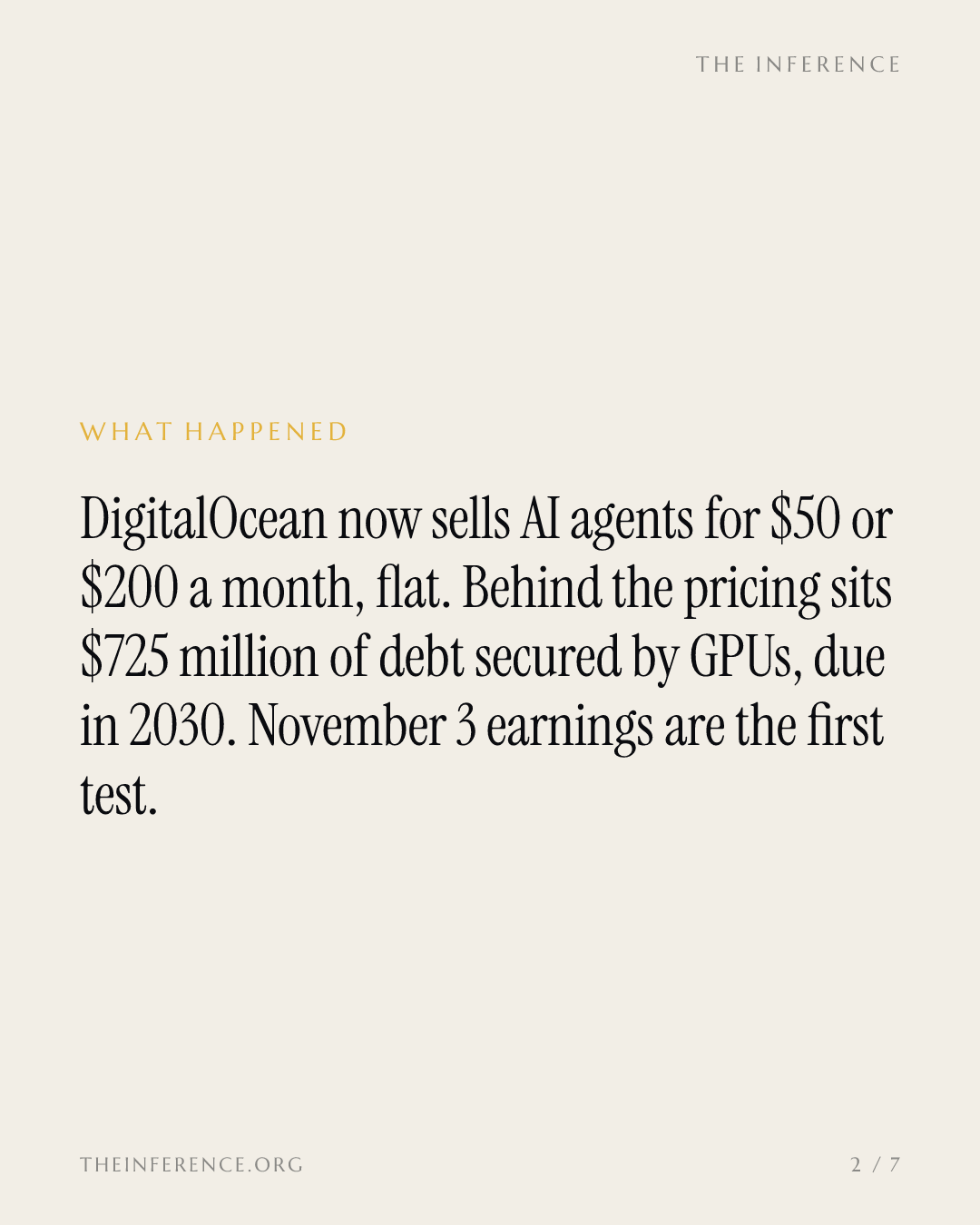
DigitalOcean−0.18% — DigitalOcean, down 0.18 percent today spent the first half of October assembling a complete storefront for AI agents, and on November 3 its third-quarter report shows whether anyone is buying. The company has packaged everything an agent needs to run, learn and improve into fixed-price subscriptions, at exactly the moment its GPU-secured debt needs tenants. This is the revenue mechanism behind the balance sheet, and it is worth reading closely.
The stack came together in two weeks
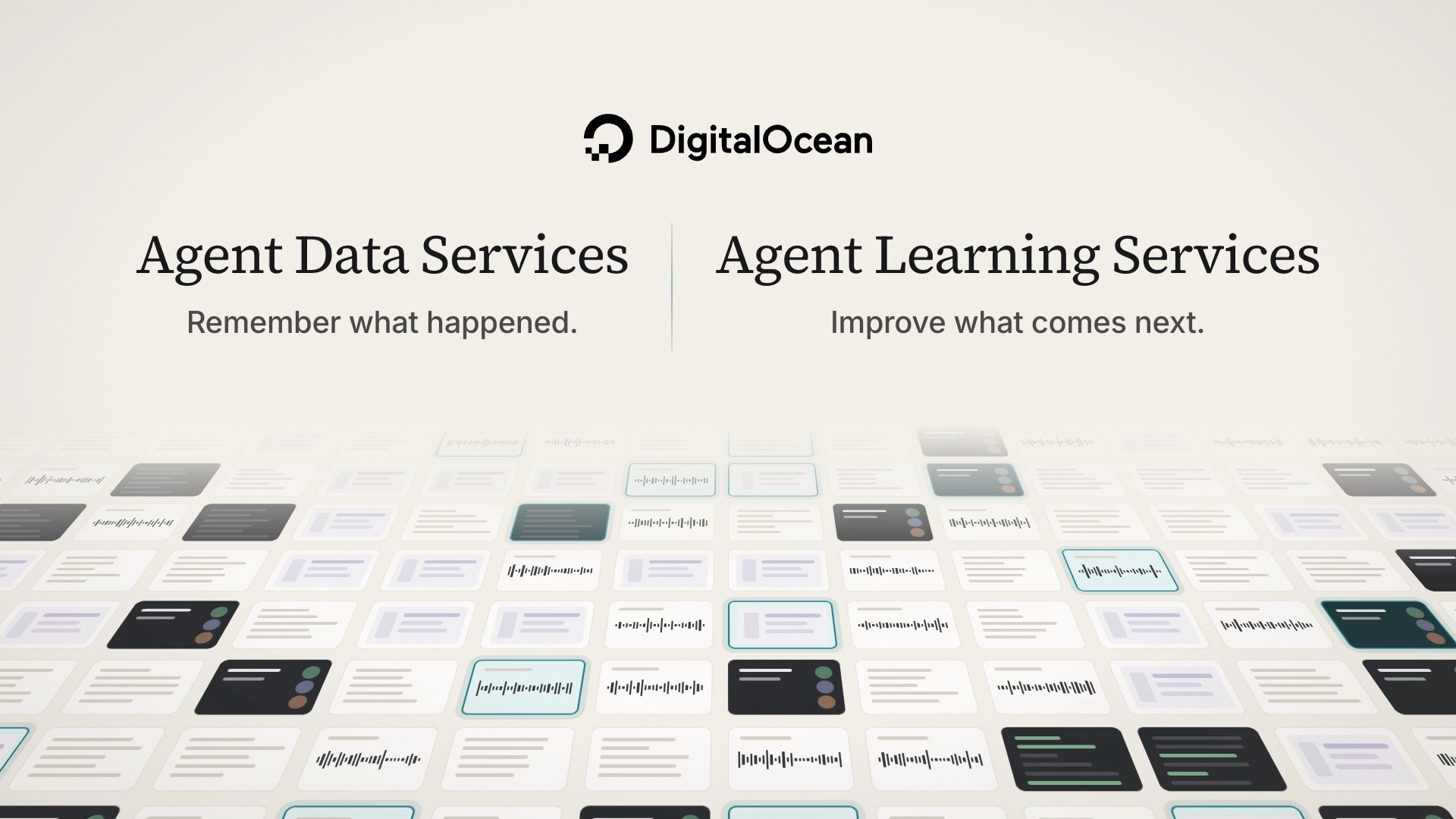
DigitalOcean, the cloud platform for developers and smaller companies, rebranded itself "the AI-Native Cloud" and built the product line to match. Agent Droplets, launched October 1, bundle a managed runtime, governed access to more than 16,000 tools, serverless inference and persistent memory into plans at $50 and $200 a month, with unlimited agents and no seat charges 12.
On October 12 it added the improvement loop: Insights records what an agent did, Signals flags the sessions where it stalled or lost the user, and Evaluations and Simulations test a fix before customers see it 3. A day later, a Bright Data partnership let agents search and extract live web data without leaving DigitalOcean's platform 4.
Chief product and technology officer Vinay Kumar frames the pitch as removing the guesswork: "You pick a size and start" 1. The pricing deliberately contrasts with per-seat AI coding subscriptions and with do-it-yourself agent stacks stitched from four or five vendors. Note what sits inside the bundle versus outside: DigitalOcean-hosted open models like Kimi K3 and GLM 5.3 ride at a discount, while frontier Claude and GPT models stay pay-as-you-go at list price 12. The structure pushes customer work onto DigitalOcean's own hardware 12.
Why the pricing model matters to the debt
In September, DigitalOcean signed a $725 million equipment finance facility, maturing September 10, 2030, to buy GPUs and CPUs for the AI cloud, with a $300 million accordion option it intends to exercise 5. Hardware secured against 2030 needs paying tenants well before then 5. A consumption bundle is the mechanism that fills it: subscriptions pull small teams in, the prepaid balance and list-price overage capture growth, and inference on hosted models runs on the financed silicon.
The market has started to side with this read
Piper Sandler upgraded DOCN to overweight on October 21, calling the pullback overdone and arguing AI demand will accelerate recurring-revenue growth; the analyst tied a lower price target to market-wide multiple compression, not to the company 6. Second-quarter numbers support the thesis so far: revenue of $281 million, up about 29% year over year, with AI customer ARR at $234 million, up 212% 6.
Adjusted free cash flow was thinner in the quarter as capital spending rose, and management guided that margin down to 11–13% for the year, the visible cost of filling the GPUs 6.
DigitalOcean guided Q3 growth above its Q2 pace
- Revenue growth, % year over year
- Estimate
Data
| Revenue growth, % year over year | |
|---|---|
| Year-ago Q3 | 15.7% |
| Q2 2026 actual | 28.6% |
| Q3 2026 guidance midpoint (estimate) | 33% |
Management guided Q3 revenue to $304–307 million, growth of 32–34%, and said growth should reach 35% or more in the fourth quarter 6. The chart shows the bar the company set for itself; beating it is the Piper case.
What November 3 has to show
Preview products are not revenue, and DigitalOcean labels Agent Learning and Data Services as previews unsupported for production 3. The self-improvement claim also has a stated boundary: the automated loop works for model selection today, while agent workflow changes still pass through human approval 3.
So the earnings test is specific: whether AI ARR growth holds near its second-quarter pace while the bundle is barely a month old. The November 3 report, confirmed for before market open on Tuesday 7, is the first document that can settle that, and with it the claim that agent subscriptions, not just GPU rental, are carrying the load.
Revenue growth accelerated as AI demand arrived
Data
| Revenue, USD millions | |
|---|---|
| Q3 '23 | $177.1M |
| Q4 '23 | $180.9M |
| Q1 '24 | $184.7M |
| Q2 '24 | $192.5M |
| Q3 '24 | $198.5M |
| Q4 '24 | $204.9M |
| Q1 '25 | $210.7M |
| Q2 '25 | $218.7M |
| Q3 '25 | $229.6M |
| Q4 '25 | $242.4M |
| Q1 '26 | $257.9M |
| Q2 '26 | $281.2M |
My judgment: DigitalOcean is doing the unglamorous middle work of the agent chain, turning a model capability into a product a small team can buy with a card, and that work deserves the reward it is now priced to receive. The Q3 numbers decide whether the reward arrives on schedule.
Get Platforms by email, free
The cloud, data and developer software AI is built on. In our daily email, every weekday.