Eli Lilly's retatrutide beat Ozempic head-to-head: 20.9% weight loss vs 9.4%, before Novo Nordisk reports
Lilly's retatrutide beat Ozempic's highest approved dose on blood sugar and cut more than twice the weight in a 1,298-patient Phase 3, published two days before Lilly's Q3 report. Novo's flagship franchise just lost its standard-of-care argument inside the window where payers and investors are repricing it.
 Richard Tang · 2 min read

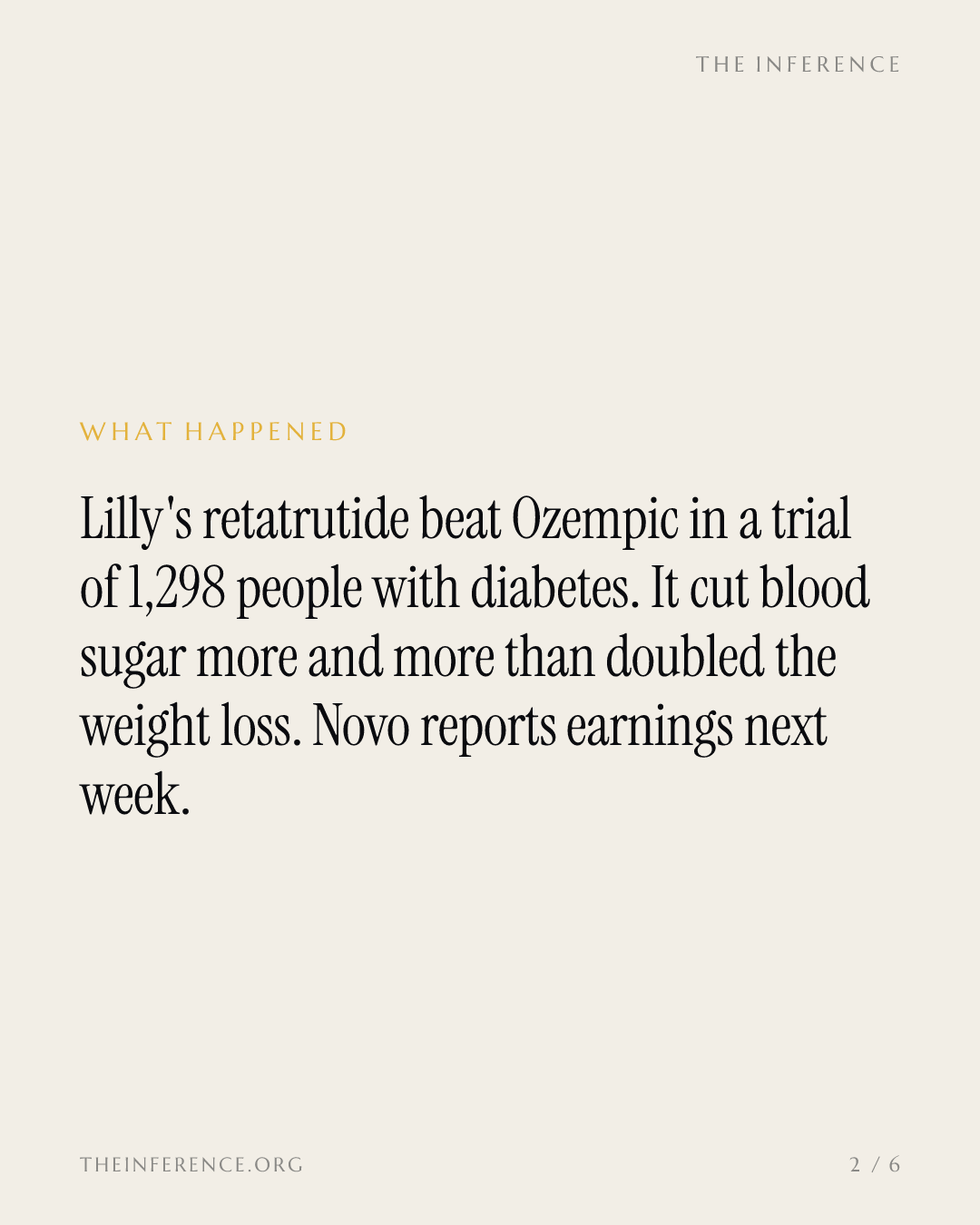
Eli Lilly+1.23% — Eli Lilly, up 1.23 percent today has its first head-to-head win over Novo Nordisk's flagship, and it published it two days before Lilly reports third-quarter results. In TRANSCEND-T2D-2, a Phase 3 trial in 1,298 adults with type 2 diabetes, Lilly's investigational drug retatrutide cut blood sugar more than injectable Ozempic at its highest approved dose, and produced more than double the weight loss, at p<0.001 12. That is not a me-too result; it is evidence for repricing the whole GLP-1 duopoly. 12
What the triple-G drug actually did
Retatrutide is a "triple-G" drug: one molecule that activates three hormone receptors (GIP, GLP-1 and glucagon), where Ozempic's semaglutide activates only GLP-1 12. At 80 weeks, both retatrutide doses lowered A1C by 2.2 percentage points from an average baseline of 8.3%, versus 1.8 on Ozempic 2 mg 12. On weight, the highest dose cut body weight 20.9% (47 lbs) against 9.4% on Ozempic 12. Weight loss of that size in people with diabetes is unusual; diabetes patients historically lose less on these drugs. 12
Retatrutide cut body weight more than twice as much as Ozempic's top dose
Data
| Value | |
|---|---|
| Retatrutide 12 mg | 20.9% |
| Retatrutide 9 mg | 19.5% |
| Ozempic 2 mg | 9.4% |
The bill shows up in the safety table. Nearly 8% of the 12 mg arm stopped treatment for side effects, versus under 3% on Ozempic, mostly gastrointestinal trouble 1. Patients and payers will weigh that against the benefit; regulators now will. Retatrutide has no approval anywhere, so nothing changes for a patient this quarter. 1
Where the money moves
Semaglutide still generates roughly three quarters of Novo's revenue, and its US sales are already slipping; Novo's−1.40% — Novo's, down 1.40 percent today stock is down about a fifth this year, with third-quarter results due November 4. 34 A head-to-head loss on both endpoints is the worst kind of datapoint for a franchise whose pricing power rests on being the standard of care: payers negotiating renewals now hold Lilly's topline as leverage, and Novo's Q3 print lands inside that window 34.
Lilly, meanwhile, reports tomorrow, October 29, with a pipeline story that just got stronger: this is the sixth strong Phase 3 readout for retatrutide, and a head-to-head against Lilly's own Mounjaro is still running. The drug is not approved, so this is optionality, not revenue. But it is exactly the kind of optionality Lilly's valuation assumes, and exactly what Novo cannot show today. The gap between capability and clinic is now a regulatory and manufacturing race, and Lilly is running it from ahead.
The takeaway: when the challenger publishes a comparison this lopsided in its favor while the incumbent's own next-generation data has been disappointing, the market's center of gravity in obesity and diabetes moves to the challenger's pipeline. Watch Novo's Q3 pricing commentary on November 4; that is where the leverage gets cashed.
Get Health by email, free
AI in medicine, pharma and biotech. In our daily email, every weekday.