Flex's AI power segment grows 75-85% and spins off as Axiom, with Vicor's ITC case still open
A record quarter and a raised fiscal 2027 guide came with the first separate outlook for the AI power business, guided to grow 75-85 percent at roughly double the margin of the rest and spinning off as Axiom, while the Vicor patent case it inherits remains open at the US International Trade Commission.
 Vincent Jiangthree-minute read

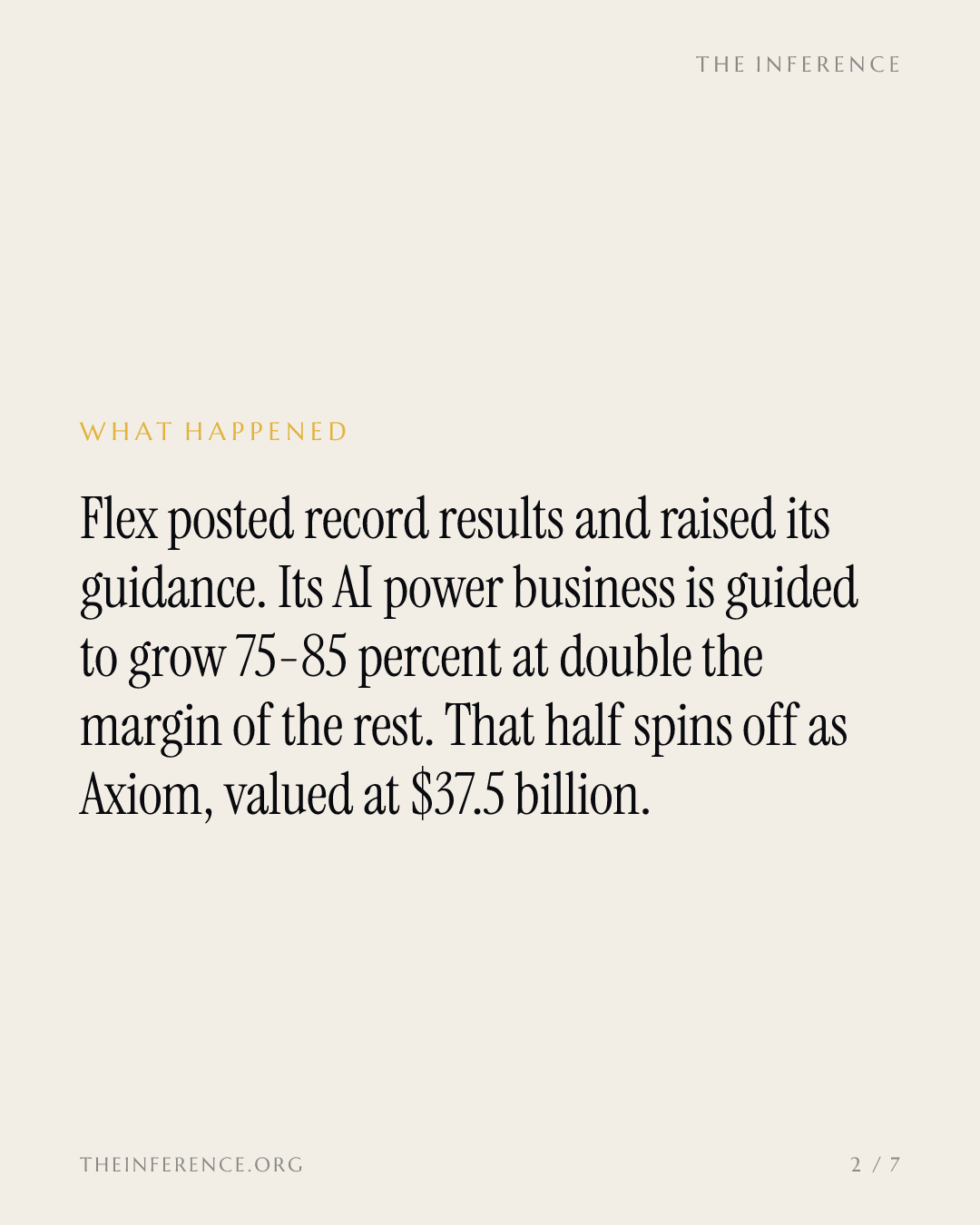
Flex−2.25% — Flex, down 2.25 percent today (NASDAQ: FLEX), the contract manufacturer building data center power and cooling gear, reported fiscal Q2 on October 28, 2026: net sales of $8.49 billion, up 25 percent year over year, GAAP earnings per share of $0.70 and record adjusted EPS of $1.18 1. Full-year guidance rose to $34.9-35.9 billion of sales and adjusted EPS of $4.84 to $5.16, up 52 percent at the midpoint 1. The headline is strong. The split inside it is the story 1.
Flex revenue accelerated from single digits to 25 percent growth as the AI power buildout took hold
Data
| Quarterly revenue | |
|---|---|
| Q1 '24 | $6.17B |
| Q2 '24 | $6.31B |
| Q3 '24 | $6.55B |
| Q4 '24 | $6.56B |
| Q1 '25 | $6.4B |
| Q2 '25 | $6.58B |
| Q3 '25 | $6.8B |
| Q4 '25 | $7.06B |
| Q1 '26 | $7.48B |
| Q2 '26 | $7.93B |
First-ever split guidance shows two companies in one stock
For the first time, Flex guided its two halves separately. The Cloud and Power Infrastructure segment, the AI power business, is guided to grow sales 75-85 percent this fiscal year at an 11.5-11.7 percent adjusted operating margin 1. The remainder, the traditional manufacturing and services businesses, is guided to grow 8-11 percent at 5.9-6.1 percent 1. On those ranges, the power segment is guided to grow roughly seven to ten times as fast as the rest of the company, at roughly double the margin 1.
The AI power segment is guided to grow roughly seven to ten times faster than the rest of Flex
- Guidance low
- Guidance high
Data
| Guidance low | Guidance high | Change | |
|---|---|---|---|
| CPI (AI power) | 75% | 85% | +13.3% |
| Rest of Flex (RMS+ITS) | 8% | 11% | +37.5% |
The AI power segment carries roughly double the guided margin of the rest of Flex
- Guidance low
- Guidance high
Data
| Guidance low | Guidance high | Change | |
|---|---|---|---|
| CPI (AI power) | 11.5% | 11.7% | +1.7% |
| Rest of Flex (RMS+ITS) | 5.9% | 6.1% | +3.4% |
The power half has a name, a valuation and a CEO
Chief executive Revathi Advaithi said the $4.4 billion purchase of power-systems maker EPC Power, completed on October 14, adds power conversion and grid-forming technology to the portfolio and will be immediately accretive in fiscal 2027, with the segment spin-off advancing under its new name, Axiom 14. The name landed on September 15, 2026: Axiom Solutions International, a preliminary Form 10 filed with the SEC, Nasdaq listing expected under the ticker AXM, separation targeted for the first quarter of calendar 2027, with Advaithi as Axiom's expected chief executive 2.
Private money has already priced the crown jewel: on October 5 Flex agreed to sell $2.0 billion of Axiom convertible preferred stock to General Catalyst and Koch Equity Development at a $37.5 billion initial enterprise value for Axiom 3.
The spin-off inherits a patent case aimed at its core layer
On October 9 the US International Trade Commission instituted a patent investigation brought by Vicor−0.34% — Vicor, down 0.34 percent today (NASDAQ: VICR), a Massachusetts power-module maker whose complaint was filed September 9, naming Flex among the respondents alongside Delta Electronics, Infineon, Monolithic Power Systems−0.70% — Monolithic Power Systems, down 0.70 percent today, Luxshare, Celestica+2.23% — Celestica, up 2.23 percent today, Quanta and Foxconn+1.05% — Foxconn, up 1.05 percent today units 56. Vicor seeks a limited exclusion order that would bar infringing vertical power delivery modules from entering the United States, and says royalty rates rise as the case advances toward that order 6.
OEMs and hyperscalers whose systems use the disputed modules would need a Vicor license to import them 6. The module layer under dispute is the layer Axiom is built on. Note the commission has made no decision on the merits, and orders it issues take effect when issued and become final 60 days later unless the US Trade Representative objects 5.
What to watch, and what it moves
Watch the ITC calendar first: within 45 days of the October 9 institution, the commission sets the target date for completing the investigation, and the case clock runs while Axiom's Form 10 economics are still being written 5. If an exclusion order lands before the separation, Axiom inherits a business whose imported modules face either a Vicor royalty or a bar at the US border, and the double-margin math above is where that cost shows up 16.
Watch November 10 next, when Flex presents each company's strategy at its Innovation Day in Austin, the date the Form 10 details are expected to surface 2. Until then, Flex trades as two companies with one unresolved patent risk between them and the border.
Get Data Center by email, free
Who is building AI's data centers, and who is paying for them. In our daily email, every weekday.