Hewlett Packard Enterprise fell 6.42% after Intel's memory warning, with $11.8 billion of inventory
Hewlett Packard Enterprise fell 6.42% on October 30 with no company news, a day after Intel's guidance cut put the AI memory shortage at the center of the tape. HPE is on the paying side of that shortage, holding nearly twice the inventory it carried last year.
 Vincent Jiang · 4 min read

A 6.42% drop with nothing to blame
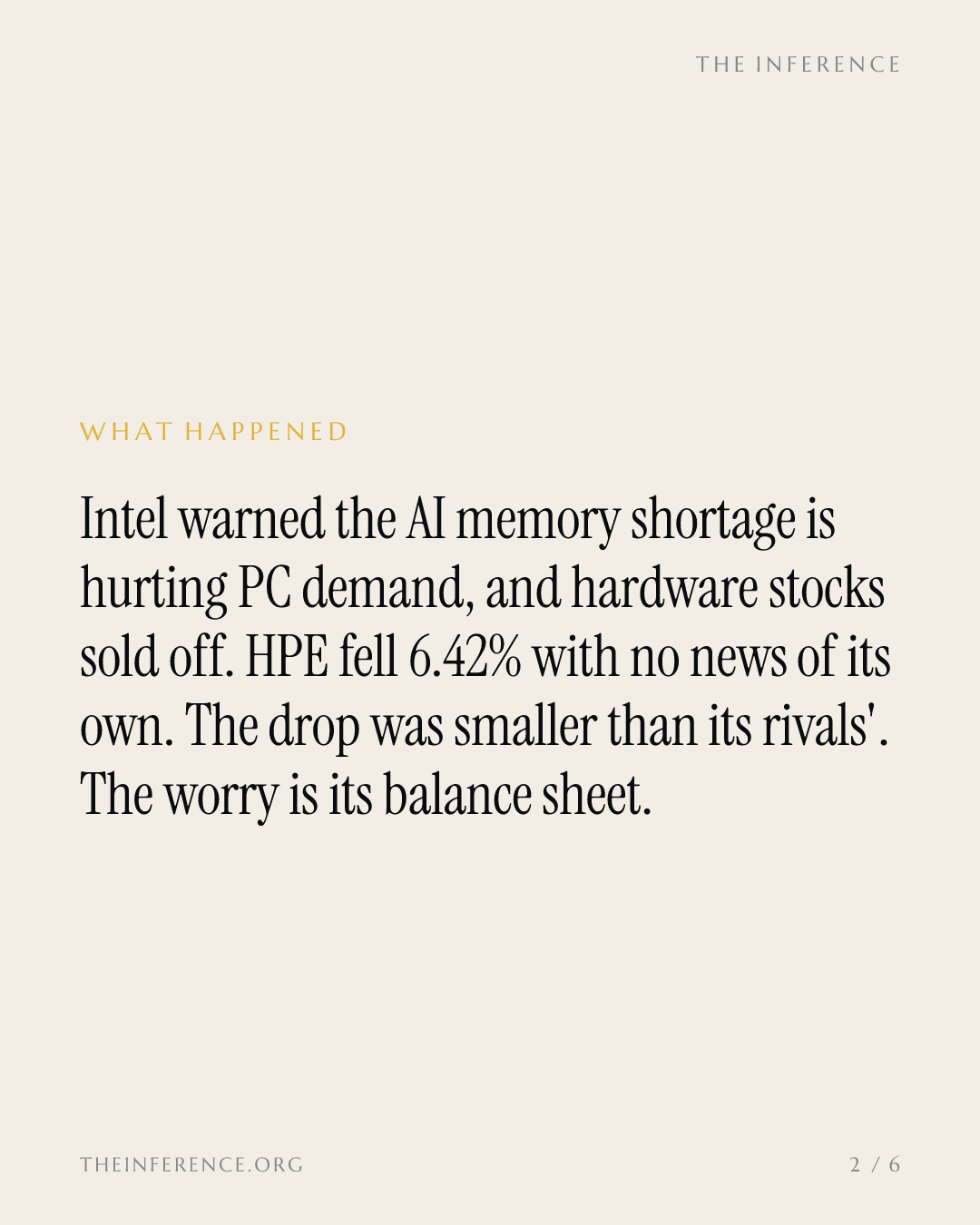
On October 30 Hewlett Packard Enterprise−6.23% — Hewlett Packard Enterprise, down 6.23 percent today closed at $55.09, down 6.42%, and the tape offers no HPE event to blame: the company's last items on the wire were an October 27 networking product integration and an October 28 price-target trim, both before the selling 1. The news was upstream.
Intel−29.36% — Intel, down 29.36 percent today fell 28.58% the same day, its worst session since 1974, after guiding the December quarter to revenue of $15 billion to $16 billion against a $17.07 billion consensus and gross margin of 38% against 44.1% the quarter before, and it blames the AI-driven memory shortage for killing PC demand 2. PC and server peers fell harder than HPE: Dell dropped 10.77%, HP−9.27% — HP, down 9.27 percent today Inc 9.58%, Cisco−3.77% — Cisco, down 3.77 percent today 3.76% 3. The gap, not the drop, is the story.
The parts pile doubled in nine months
HPE's own filing does the arithmetic the market is repricing. Inventory stood at $11,823 million on July 31, 2026, against $6,352 million last October 31, up 86% in nine months 4. Days of supply in inventory ran to 145 from 89 a year earlier 4.
Suppliers are carrying much of the build: accounts payable grew to $13.7 billion from $7.7 billion, 169 days of purchases outstanding against 108 4. The 10-Q attributes the elevated pile to buying memory components and SSDs ahead of forecast demand, customers crossing between GPU generations, and longer acceptance timelines on AI orders, and warns the worldwide memory shortage may persist until vendors shift production toward AI-grade memory 4. HPE's fiscal year closed October 31; the December report is the first print that carries parts bought at these prices 5.
The shortage that kills Intel's PC market props up HPE's server prices
Memory does opposite work on each side of this trade. For Intel, the shortage is a demand killer: management expects PC units to fall about 12% in 2026 and another 10% in 2027, with second-half shipments down more than 20% 2. For HPE, scarcity is a pricing lever: server revenue in the July quarter grew 35.3%, predominantly on higher average selling prices driven by commodity price increases, especially memory and SSDs 4.
Dell's management describes the squeeze from the middle: supply-constrained on DRAM and then NAND, with AI servers earning a lower margin rate than the rest of the business 3. HPE is priced like the seller of scarce capacity while carrying the buyer's exposure.
A winner's multiple on a buyer's balance sheet
The arithmetic camp has its numbers lined up. HPE trades at 28.7 times trailing earnings against its own five-year median of 13.9x, and 11.7 times forward earnings, which prices the current margin as the base case 6. The stock is up 129.35% this year from a 52-week low of $19.84 1.
Insiders sold $73.1 million of shares over the past twelve months and bought nothing 6. One valuation model, GuruFocus's GF Value, puts fair value at $28.75, 48% below the close; that is a model, not a verdict 6. The July quarter itself beat on both lines, non-GAAP EPS of $1.11 ahead of forecasts by $0.17 on revenue of $12.21 billion 94.
HPE fell half as far as the PC names on October 30
Data
| Value | |
|---|---|
| Intel | -28.58% |
| Dell | -10.77% |
| HP Inc | -9.58% |
| HPE | -6.42% |
| Cisco | -3.76% |
| IBM | -0.18% |
HPE's gross margin hit 41.1% in the July quarter, a high for the series
Data
| Gross margin | |
|---|---|
| Q1 '24 | 34.7% |
| Q2 '24 | 33.3% |
| Q3 '24 | 32.3% |
| Q4 '24 | 30.9% |
| Q1 '25 | 30.1% |
| Q2 '25 | 30.6% |
| Q3 '25 | 34.8% |
| Q4 '25 | 37.2% |
| Q1 '26 | 37.6% |
| Q2 '26 | 41.1% |
The bull case has receipts too
Demand is the bull's best exhibit. Dell closed its July quarter with a record $95 billion AI server backlog, orders taken and not yet delivered, and raised its own fiscal 2027 AI server outlook to $74 billion 3.
Evercore−2.38% — Evercore, down 2.38 percent today ISI trimmed its HPE target to $65 from $67 on October 28, still about 18% above the close, and 24 analysts average $72.44 1. One market commentator reads the inventory build as proactive positioning, not distress, and expects growth as networking demand accelerates 5.
What the bull case does not resolve is timing: parts bought before a repricing sell at whatever the contract allows until the book catches up, and the 41.1% gross margin of the July quarter 10 is the peak being capitalized, not the floor. The buyer has a voice too: a 119-point r/sysadmin thread titled "I can no longer recommend HPE," 81 comments deep, from a customer who orders "millions and millions of dollars" of hardware and reports support answers coming back as generated script 7. That is a lead, not evidence. Renewal rates, not Reddit−28.69% — Reddit, down 28.69 percent today, defend a margin.
December is the first print carrying the pre-spike parts
Three numbers tell whether the toll gets paid or passed through: gross margin against the July quarter's 41.1%, days of supply against 145, and whether server pricing keeps absorbing memory costs 10.
The networking story has its own clock, with EdgeConnect support in Mist promised during calendar 2026 and Aruba Central support in the first half of 2027 8. HPE is how you own the AI server buildout; the memory line on its balance sheet is now the toll, and December is where it gets weighed. Deep dive into the filings below: the balance sheet reads faster than the tape.
Get Chips by email, free
How AI demand is reshaping chipmakers, memory and the fabs behind them. In our daily email, every weekday.