IBM cut three workers with 95 combined years of service. A stray Slack message says why.
A federal complaint filed 20 September says IBM fired three employees in their late 50s to refill their roles with younger hires, and a misdirected Slack message is the evidence. It lands one day before IBM's own study warned that AI erodes human judgment, in the same week a securities probe opened into its AI-era guidance.
 Vincent Jiangthree-minute read

Sixty percent early professionals, forty percent campus hires
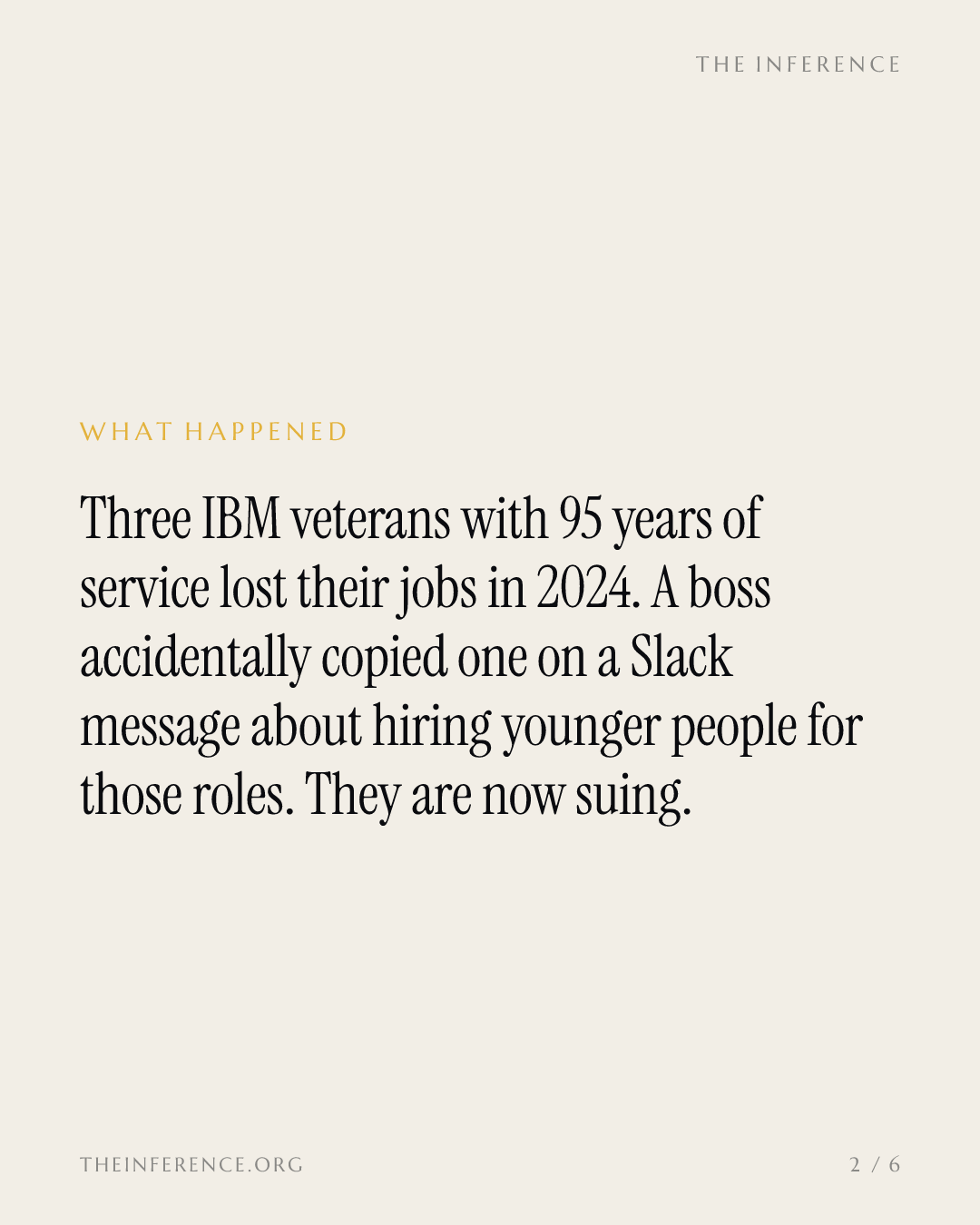
Three workers who gave IBM−1.11% — IBM, down 1.11 percent today 27, 32 and 36 years, now aged 57, 58 and 59, sued on 20 September in Manhattan federal court. Each was told in September 2024 that their position was eliminated; none had ever drawn a warning or a bad review. The filing's hinge is a delivery error: an IBM vice president, the complaint says, accidentally copied one of them on internal communications showing the company interviewing younger candidates for some of the very roles being cut. Planning documents dated less than a month later specified replacements at 60 percent Early Professionals and 40 percent Campus Hires. 1
Older workers were 86 percent of a decade of IBM's layoff pool, none of the 2024 refills
- Older workers (40+)
- Early professionals and campus hires
Data
| Older workers (40+) | Early professionals and campus hires | |
|---|---|---|
| 2024 role cuts | 0% | 100% |
| 2013–2018 layoff pool | 85.85% | 14.15% |
| 2013–2018 all US cuts | 60% | 40% |
The paper trail goes back to 2018
"Resource Actions," "seniority mix," "skills remix," "revitalization hiring": the complaint's vocabulary was documented years ago. A 2018 investigation estimated IBM cut more than 20,000 US employees aged 40 and over in five years, about 60 percent of its total US reductions, on internal decks calling to "correct seniority mix" and fund an "influx of EPs," shorthand for early professionals. 2 Later complaints quote an IBM plan to "accelerate change" by inviting the "dinobabies" to leave and make them an "extinct" species, alongside a memo describing a "dated maternal workforce." 3 The new filing cites an EEOC analysis that put older workers at 85.85 percent of the total pool considered for layoff from 2013 to 2018, and alleges IBM dodged the disclosure rule that would have shown each worker who else was being cut. 1

Growth guidance of 5 percent met a 1 percent quarter and a 42 percent mainframe fall
- IBM revenue growth
- IBM Z mainframe revenue growth
- Estimate
Data
| IBM revenue growth | IBM Z mainframe revenue growth | |
|---|---|---|
| April 2026 guidance (estimate) | 5% | — |
| Q2 2026 actual | 1% | -42% |
IBM's answer: the words carry no age meaning
IBM has an answer ready. In an earlier age case its own lawyers argued that "Early Professional Hire," "revitalization hiring" and "skills remix" carry no age-related meaning. 4 In May, answering a separate Austin suit that claimed its screening software favored early-professional hires, IBM said it "does not condone or tolerate discrimination of any kind" and called the AI screening allegations baseless. 5 This summer it settled a 63-year-old's systemic bias claims rather than try them. 6 None of the new allegations has been tested, and no judge has ruled. 1

A 1 percent quarter, $68 billion gone
April's guide was 5-plus percent growth. On 14 July, IBM delivered 1 percent, its Z mainframe line swung from 51 percent growth to a 42 percent decline, and $68 billion of market value vanished in a day; a securities investigation opened on 23 September. 7 One day after the complaint, IBM published its CHRO study: 71 percent of surveyed HR chiefs call supervising and validating AI outputs the workforce's most essential skill, while 60 percent of employees say AI is eroding theirs, critical thinking the most cited casualty and one 2026 assessment rating younger workers below average at it. 89 IBM's own research now warns that AI erodes judgment. The complaint describes a company that had already been shedding its most practiced humans.
IBM's own research: 71 percent of HR chiefs and 60 percent of employees agree on the risk
Data
| Share of respondents | |
|---|---|
| HR chiefs: validating AI outputs is the top skill | 71% |
| Employees: AI is eroding their skills | 60% |
| 2026 assessment: younger workers below average at critical thinking | 50% |
The Slack message decides it
The suit seeks back pay, reinstatement and liquidated damages, and two plaintiffs add retaliation claims. 1 The Slack message either survives discovery or this pattern theory dies quietly, like the settled cases before it. The tell is IBM's response in the Southern District of New York.
Get Policy & Labor by email, free
The rules governments write for AI, and what AI does to jobs. In our daily email, every weekday.




Reader comments
0 comments