Intuit pays accounting firms up to 25% of net billings as agents automate their book close
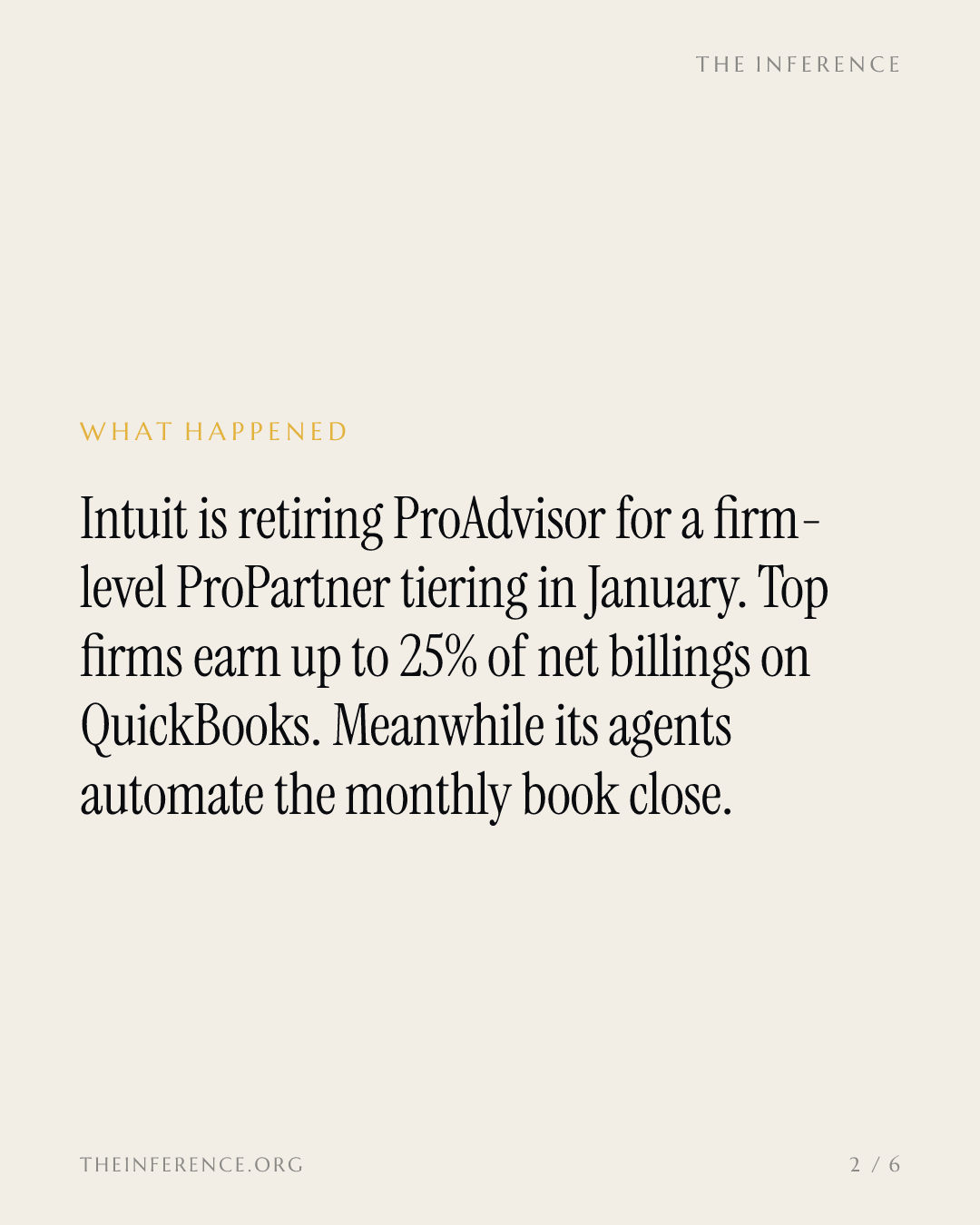
At Intuit Connect, Intuit retired the ProAdvisor program for a firm-level ProPartner tiering while rolling out agents that do the billable work accountants used to charge for. The channel is being converted from a labor pool into a distribution network, and the money says it is working.
 Vincent Jiang · 3 min read

The book close, done by software
At Intuit−3.85% — Intuit, down 3.85 percent today Connect in Las Vegas this week, CEO Sasan Goodarzi put a number on the screen that accountants bill by the hour: Agentic Book Close, a new agent in Intuit Accountant Suite that uploads a firm's own standard operating procedures, runs the monthly close automatically, flags exceptions, and finishes with a financial summary ready to send the client 1. A companion tool, Agent Studio, lets firms build their own agents and is already deployed at roughly 20 firms in beta 1.
What Intuit is really buying is the channel
The quiet move is the channel. Intuit retires its individual-level ProAdvisor program in January for ProPartner Accountants, a firm-level tiering with new AI certifications 1.
The May announcement showed the price tag: firms at the top tiers can earn up to 25% of net billings on QuickBooks Online, with revenue sharing stretched from 12 months to three years 4. Meanwhile, QuickBooks will match growing businesses with certified firms and surface client leads to accountants 1. Intuit is paying firms a cut to keep feeding its platform, while the agents it sells do the work that used to fill their timesheets.
Enterprise Suite is compounding, and 250,000 firms are aboard
Intuit keeps growing while it rewires the accountant channel
Data
| Quarterly revenue | |
|---|---|
| Q3 '24 | 3.28B |
| Q4 '24 | 3.96B |
| Q1 '25 | 7.75B |
| Q2 '25 | 3.83B |
| Q3 '25 | 3.89B |
| Q4 '25 | 4.65B |
| Q1 '26 | 8.56B |
| Q2 '26 | 4.35B |
The midmarket bet behind this is compounding: Intuit Enterprise Suite hit nearly $150 million in annual recurring revenue in fiscal 2026, midmarket revenue grew 39% and the customer base 28%, and more than 75% of Enterprise Suite customers already use an Intuit AI agent each month 2. Accountant Suite has passed 250,000 firms 3. The invoicing flywheel that funds QuickBooks Capital carries $2.7 trillion of volume, and 60% of QuickBooks businesses have at least one invoice more than 30 days past due 1.
The counterpoint firms will make
Sorren and Aprio partners quoted in Intuit's release praise the platform 3, but praise at a vendor conference is not a fee schedule. Agentic Book Close is "coming soon" and "additional fees may apply"; no price has been named 3. Rival Xero answered on October 14 by wiring live small-business financials into Google Gemini, adding to Claude, ChatGPT and Microsoft+0.10% — Microsoft, up 0.10 percent today 365 integrations launched this year, so accountants can reach the ledger without entering Intuit's walled garden at all 5.
January shows whether firms certify or resist
Watch the January tiering: whether firms certify on Intuit's AI stack or quietly resist a program that rewards the automation eating their billable hours. Then watch the next earnings print for an Enterprise Suite ARR line moving off $150 million and a named price for the book-close agent. The fee pool is being redrawn, and whoever owns the workflow keeps the fee.
Get Applications by email, free
How AI is changing the software people and companies use. In our daily email, every weekday.