PolicyFly's AI cut customer onboarding from six months with four or five employees to two weeks with one
Cory Crosland's specialty-insurance platform cut customer onboarding from six months with four or five employees to two weeks with one, and he says it cannot be automated much further because customers want a human. The unit economics of implementation-heavy software are repricing.
 Vincent Jiang · 2 min read

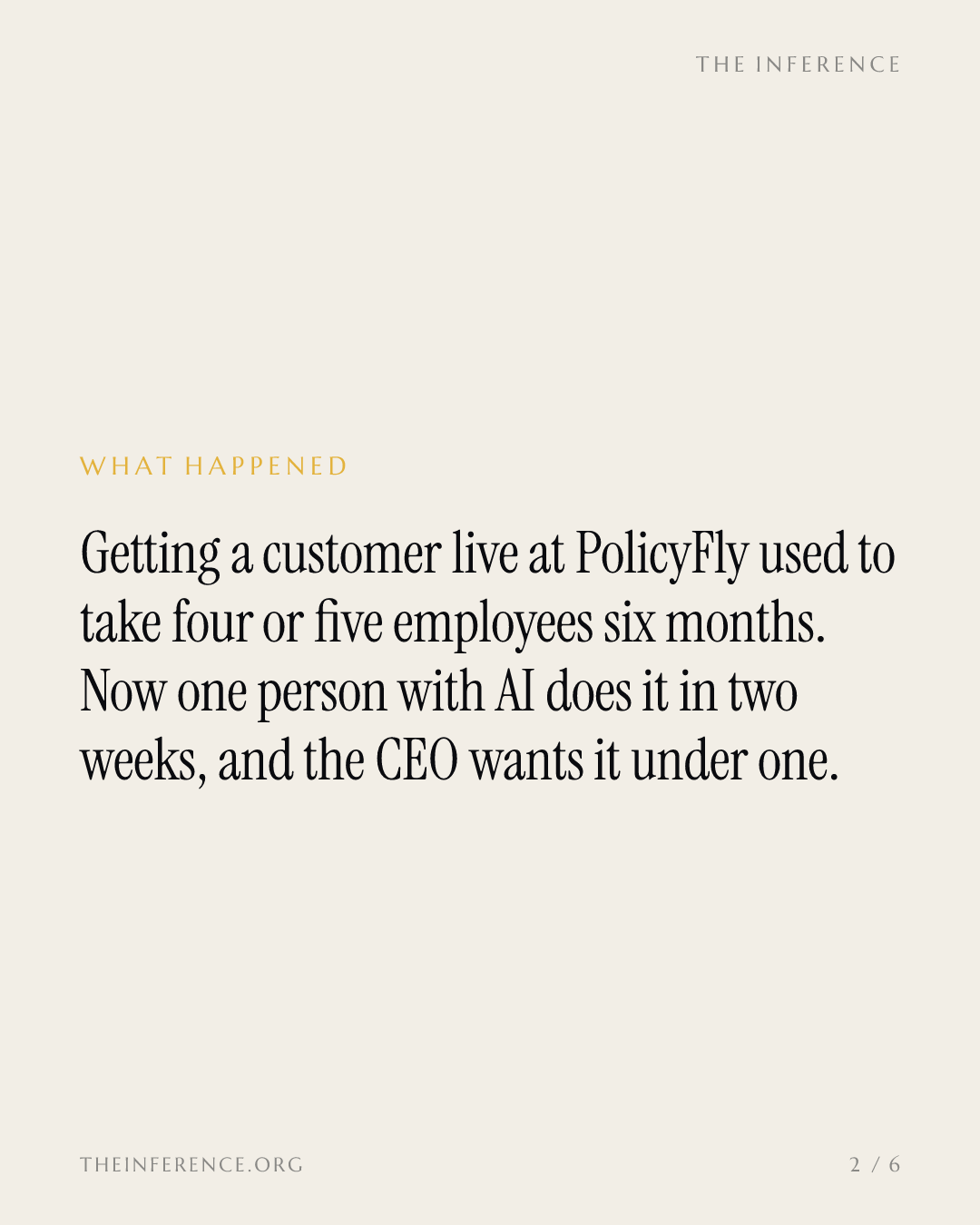
A six-month onboarding project has quietly become a two-week job, and the company that did it says one week is next. PolicyFly, a private growth-platform vendor for specialty insurers and MGAs, told New York Times labor reporter Noam Scheiber (reported April 15, 2026, recounted by the company on July 29) that AI has collapsed the cost of getting a customer live, one of the clearest quantified examples of AI reshaping a services-heavy software business. 1
The math of the collapse
In 2024, onboarding one customer took four or five PolicyFly employees an average of six months, chief executive Cory Crosland told Scheiber 1. Each insurer handles policy variables differently, so the software had to be customized by hand for every client. Now one employee does it in about two weeks using AI for that customization, and Crosland expects the time to drop below one week this year. 1
Onboarding time at PolicyFly has fallen from six months toward one week
- Months to onboard one customer
- Estimate
Data
| Months to onboard one customer | |
|---|---|
| 2024 | 6 mo |
| Now | 0.5 mo |
| This year (estimate) | 0.25 mo |
Why the moat compresses
PolicyFly's base product supplies 80% to 90% of a customer's infrastructure from day one, so implementation, not the product, is the margin lever. 1 When that final 10% to 20% of configuration shrinks from six months of staffing to under a week, more customers fit through the same team 1.
That puts rivals whose business is charging for months of manual customization on the defensive, because those billings no longer stack up. 1 Time-to-market is the sales pitch: Shepherd Compello, a London specialty MGA broker, says submissions that took 20-plus minutes are automated in seconds, and AssuredPartners, a large insurance distributor, credits the platform with faster terms and better bind ratios. 2
The human floor
Crosland says he cannot automate much further, at least for now, because customers want a human to reassure them that billing is set up properly and policies are prorated sensibly, and bigger clients bring many stakeholders to meetings. Crosland argues that ceiling means revenue scales through volume, not headcount cuts. 1
Whether rivals disclose, or the market reprices first
For investors in vertical software, the question is whether other implementation-heavy vendors disclose comparable AI-onboarding figures, or whether the market keeps pricing the staffing model as intact. PolicyFly is SOC 2 Type II compliant, which eases the security objection from larger carriers. 3
Deep dive in below to learn more.
Get Applications by email, free
How AI is changing the software people and companies use. In our daily email, every weekday.